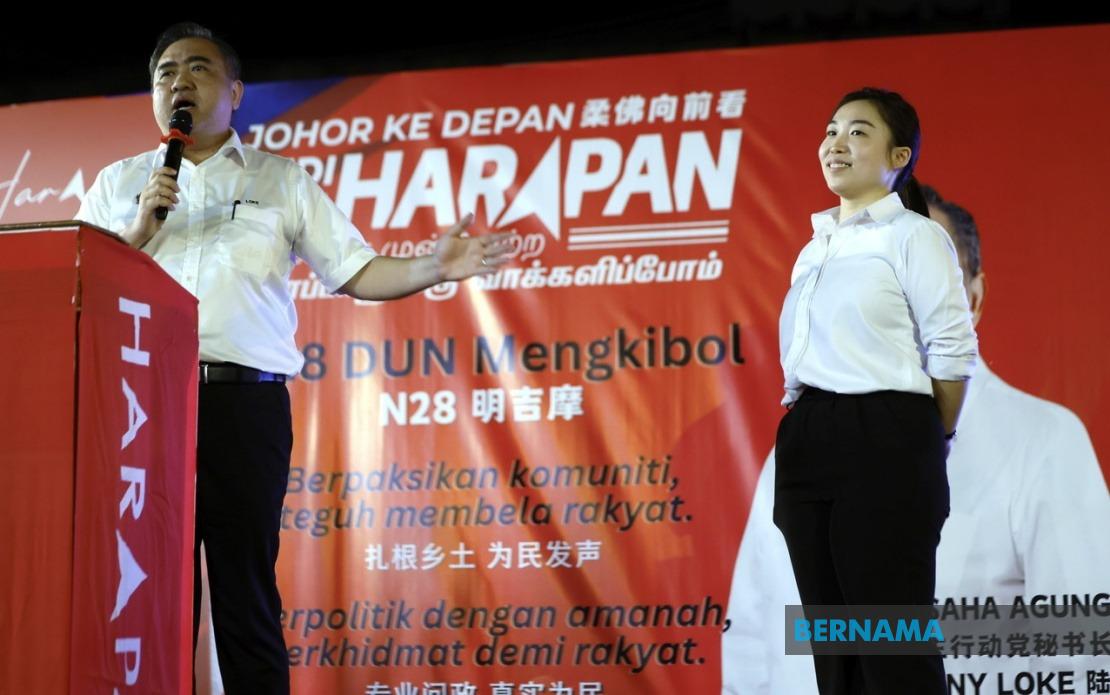
The Democratic Action Party has signalled its commitment to expanding female representation in electoral contests by nominating 33-year-old lawyer Chu Poh Yee as its standard-bearer for the Mengkibol state assembly seat in the forthcoming Johor state election. The announcement, made at a gathering in Kluang on June 18, marks the first official candidacy declaration from DAP for the polls and reflects strategic repositioning within the party's lineup across the state.
Chu's nomination comes as the party transitions its current assemblyman for the constituency. Chew Chong Sin, who has represented Mengkibol for two consecutive terms, will relinquish the seat to make space for fresh leadership. Rather than stepping away entirely, however, Chew is being groomed for higher office as DAP identifies him as a viable parliamentary prospect for the Labis constituency in the subsequent General Election, a move contingent on the retirement of sitting MP Pang Hok Liong.
Party secretary-general Anthony Loke articulated the rationale behind both decisions at the candidate launch. The repositioning of Chew reflects DAP's assessment that he possesses the calibre necessary to represent his community at the national legislative level, particularly with the sitting member indicating an intention to step down. This transition exemplifies how state electoral contests frequently serve as proving grounds for identifying and promoting candidates with broader appeal for federal representation.
Loke emphasised that DAP's leadership had reached consensus in endorsing Chu as the appropriate successor to defend Mengkibol. Her selection hinges on multiple qualifications that party officials believe position her favourably for the contest. Her background as a legal practitioner, combined with demonstrated expertise in providing legal aid assistance to constituents working alongside elected representatives, furnished the party with concrete evidence of her utility to the community she would serve.
Beyond technical legal competence, the party leadership highlighted Chu's cultural and linguistic versatility as an asset in a diverse Malaysian electoral landscape. Her multilingual proficiency—crucial in constituencies with mixed demographic compositions—and her educational standing were presented as competitive strengths. Equally significant was her existing community embeddedness within Mengkibol itself, a factor party strategists recognise as fundamental to electoral viability in Malaysia's relationship-driven political environment.
Loke's announcement also underscored an ideological commitment underlying the selection. By nominating Chu, DAP signals organisational resolve to broaden opportunities for women in political competition, reflecting broader patterns within Pakatan Harapan to diversify its candidate pool. This positioning carries symbolic resonance for an electorate increasingly conscious of gender representation in government and legislatures.
The Mengkibol candidacy announcement represented merely the opening salvo in DAP's candidate disclosure strategy for the Johor state election. Loke confirmed that the party's selection machinery had completed its vetting process for all 17 state seats the party intends to contest. This portfolio comprises a mixture of defensive and offensive positions: ten seats currently held by DAP, four constituencies previously lost but being contested again, and three additional new battlegrounds.
The sequencing of further announcements reflected careful coordination between DAP and its larger Pakatan Harapan coalition partners. Loke indicated that four additional candidates would be unveiled on the following Saturday for the seats of Tiram, Johor Jaya, Senai and Bukit Permai. This staggered disclosure ensured sustained media attention and prevented candidate announcements from cannibalising each other's coverage.
The final tranche of DAP candidates would be presented in tandem with Pakatan Harapan's complete slate, scheduled for announcement by the Prime Minister the subsequent Monday. This orchestration demonstrates the intricate choreography required within multi-party coalition politics, where simultaneous disclosure requires executive-level coordination to ensure equity in presentation and messaging across component parties.
For Malaysian observers monitoring coalition dynamics, the Mengkibol announcement illustrates how state elections function as laboratories for testing new talent and reshaping electoral strategies. The shift from Chew's incumbency to Chu's candidacy, while maintaining party continuity in the seat, embodies the balance between organisational renewal and electoral security that governs candidate selection in mature democracies and competitive electoral systems.
The Johor state election represents a significant test for DAP's electoral machinery and its capacity to retain or expand presence in a state where it has established footholds but where Umno-aligned parties retain structural advantages. Chu's nomination for Mengkibol and the broader seventeen-seat portfolio positioning will prove instrumental in determining whether DAP can consolidate recent gains or faces erosion in the state's political landscape.

