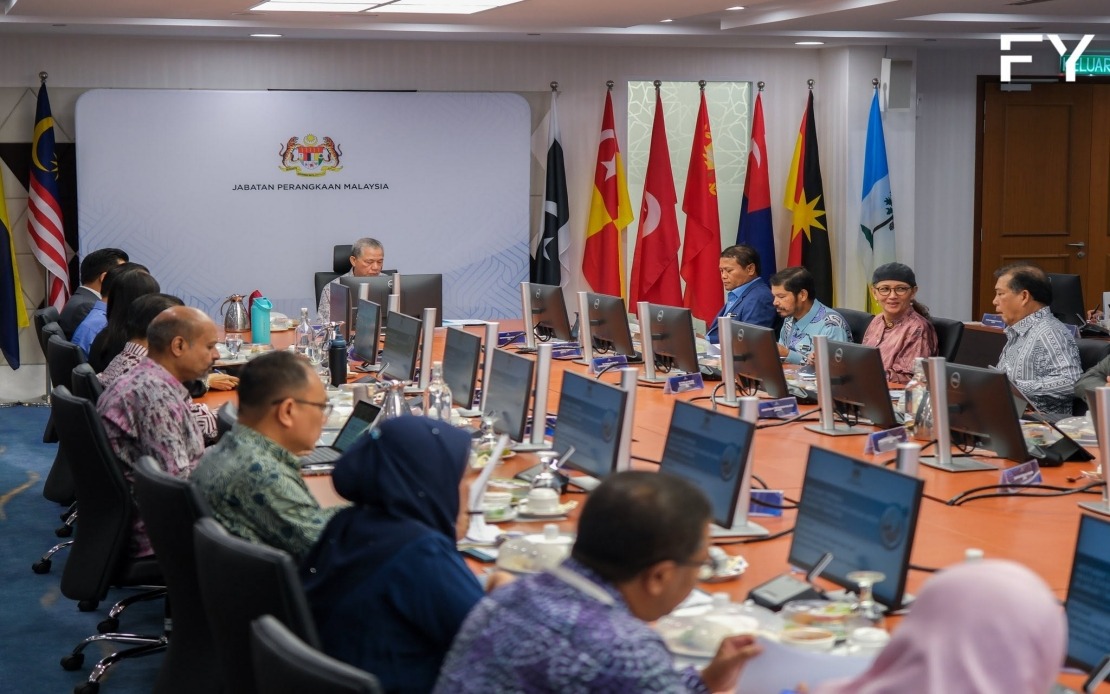
Deputy Prime Minister Datuk Seri Fadillah Yusof has identified data analytics and artificial intelligence as foundational elements that will determine whether Malaysia successfully executes its 13th Malaysia Plan spanning 2026 to 2030. Speaking after chairing a high-level meeting of the National Statistics and Data Council in Kuala Lumpur, Fadillah outlined an ambitious agenda to position quality information and computational analysis at the heart of government decision-making, replacing ad-hoc approaches with evidence-based policymaking.
The government's pivot toward data-centricity reflects a sobering recognition that Malaysia faces a complex constellation of challenges demanding sophisticated responses. Economic volatility continues to reverberate through regional markets, geopolitical realignments threaten supply chains and investment flows, digital disruption accelerates across sectors, and the climate emergency demands urgent mitigation strategies. Within this environment, Fadillah stressed, robust statistical capacity and AI-driven insights become not merely administrative conveniences but strategic national imperatives that directly influence the nation's competitive standing and resilience.
Fadillah reframed the conceptual status of data itself, arguing that official statistics have transcended their traditional role as passive repositories of information. Instead, he positioned them as active strategic assets whose quality, timeliness and integrity directly enable or constrain government effectiveness. This reorientation carries significant implications for how public institutions operate. Rather than viewing data collection and analysis as peripheral administrative functions, the government signals intent to embed them within core machinery, ensuring that policy architects and implementation teams access validated, comprehensive information before committing resources or issuing directives.
Economic performance offers immediate validation for this approach. Malaysia's gross domestic product expanded at 5.4 per cent during the first quarter of 2026, a figure Fadillah attributed directly to development policies informed by rigorous data analysis. This claim warrants scrutiny, yet the underlying logic resonates across development literature: governments that measure baselines, monitor progress and adjust course based on evidence typically outperform those relying on intuition or ideology. For Malaysia, this means that the 13th Plan's ambitious targets for infrastructure, social provision and economic transformation rest fundamentally upon whether the statistical foundation proves sufficiently robust.
Strengthening the National Statistical System itself emerges as a prerequisite rather than an afterthought. Fadillah outlined a collaborative architecture spanning traditional government departments alongside federal agencies, state administrations, private enterprises, universities and specialist research institutions. This ecosystem approach acknowledges that comprehensive understanding increasingly requires integration of disparate data streams—administrative records from multiple agencies, commercial datasets from corporations, academic research outputs and community-level intelligence. The coordination challenge is formidable; establishing common standards, ensuring interoperability, protecting privacy and maintaining ethical guardrails demands sustained institutional commitment.
The digital era amplifies both the opportunity and the risk. Fadillah identified data integration as crucial, noting specifically the imperative to combine sources securely, ethically and effectively. These qualifiers matter. Malaysian readers understand acutely the tension between exploiting digital potential and protecting individual privacy—a concern heightened by regional incidents of data breaches and surveillance overreach. The government's acknowledgement of ethical constraints suggests awareness that data collection divorced from privacy safeguards ultimately erodes public trust and compliance, undermining the statistical system's foundations.
Big data analytics and artificial intelligence represent the technical frontier. Fadillah emphasized their deployment to enhance national productivity, innovation and competitiveness. AI capabilities enable pattern recognition across massive datasets, scenario modelling for complex policy questions, and real-time monitoring of implementation progress. For Malaysia specifically, these tools address longstanding capacity challenges; smaller nations often lack the specialist expertise and computational resources that larger powers command. AI democratizes analytical capacity, allowing Malaysian agencies to extract insights from available information without necessarily developing large in-house data science divisions.
Certain strategic sectors demand priority attention within this data-driven governance model. Energy transition, climate adaptation, water resource management and sustainable development feature prominently in Fadillah's remarks—and appropriately so. These domains inherently involve long-term planning across complex systems where outcomes depend critically on accurate baseline measurement and continuous monitoring. Water security, for instance, requires real-time data on supply, demand, quality and infrastructure performance; climate adaptation demands granular understanding of localized risks and vulnerabilities. Without comprehensive data infrastructure, governments operate essentially blind in these arenas.
The specific initiatives reviewed at the high-level council meeting illuminate practical implementation priorities. Standardizing official statistical definitions and methodologies facilitates comparisons across agencies and time periods, foundational for evidence-based adjustment. Data governance frameworks establish accountability and quality control. Integration of administrative datasets—unemployment records, tax filings, healthcare utilization patterns—creates holistic pictures of population outcomes without burdening citizens with fresh surveys. A science, technology and innovation talent database guides workforce development and innovation investment. Youth development initiatives informed by data target resources where impact proves greatest. Road asset management systems optimize infrastructure maintenance and capital allocation.
These initiatives, while technical in character, carry profound implications for governance quality. They represent movement toward what scholars term "systematic governance"—an approach where policies emerge from evidence, implementation proceeds under continuous monitoring, and outcomes feed back into subsequent planning cycles. For Malaysian readers, this translates into government services and development programmes increasingly calibrated to actual population needs rather than bureaucratic assumptions or political preferences.
However, ambition and execution diverge frequently in developing democracies. Success of the 13th Plan's data agenda hinges upon sustained resource commitment, technical capacity development, and institutional discipline. Silos between agencies must dissolve—a notoriously difficult organizational transformation. Privacy and security standards must satisfy international benchmarks while accommodating Malaysia's regulatory environment. Talent recruitment and retention in data science and AI fields requires competitive compensation amid regional competition. Political interference in statistical processes must remain unthinkable, a standard honored more consistently in some democracies than others.
The broader context matters too. Malaysia's statistical system inherits both strengths and limitations. Department of Statistics Malaysia commands respect for methodological rigor, yet historical constraints on resources and political interference have periodically undermined independence. Embedding data-driven governance across 13 million citizens and complex federal-state structures presents scaling challenges distinct from smaller or more centralized nations. Regional precedents—Singapore's sophisticated data infrastructure, Indonesia's emerging initiatives—offer lessons in what succeeds and what stumbles when ambition exceeds capacity.
Fadillah's emphasis on integrated, high-integrity, development-oriented data ecosystems ultimately signals that Malaysia recognizes data and AI as differentiators in an increasingly competitive global environment. Nations that master systematic evidence-based governance, technological integration and real-time adaptation will likely outpace those bound by traditional bureaucratic rhythms. Whether Malaysia translates rhetorical commitment into institutional reality over the 13th Plan period will substantially determine whether ambitious development targets become reality or remain aspirational.

