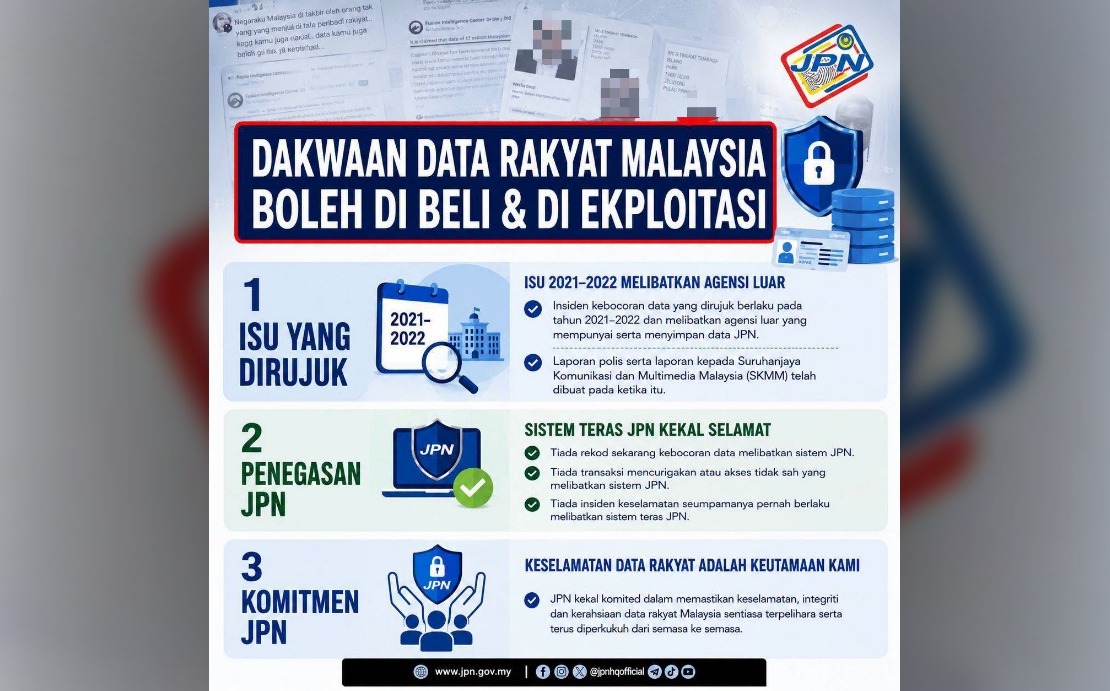
The National Security Council (MKN) has moved to dispel public concern about a viral data leak by confirming that the compromised information traces back to unauthorised intrusions occurring before 2022 and is entirely unrelated to any operational platform currently in use. Through a statement issued by the National Cyber Security Agency (NACSA), the council sought to reassure Malaysians that the breach does not represent a fresh vulnerability in modern infrastructure, but rather the unlawful recycling of older stolen data through online channels.
According to NACSA, the personal information being shared across social media platforms was originally obtained illegally through cyber attacks targeting various systems in years prior to 2022. The agency's investigation indicates that threat actors or their associates are now redistributing this aged dataset without authorisation, deliberately repackaging the information to create the impression of a recent incident. This practice of republishing historical breaches is increasingly common among cybercriminals seeking to maintain market relevance or extract value from data theft efforts that may have lost commercial appeal.
The broader implications of this situation extend to understanding how stolen data circulates in the digital underground. Even years after an initial compromise, criminals maintain archives of personal information and periodically resurface these collections through alternative channels, sometimes bundling them with newer data or selling access through illicit platforms. For Malaysian citizens, this underscores a critical risk: data breached five or even ten years ago remains potentially exploitable for fraud, identity theft, or targeted social engineering attacks.
NACSA has emphasised that Malaysian law explicitly prohibits the distribution, provision, and sharing of unlawfully obtained information, regardless of whether the hosting infrastructure or service providers operate outside the country's borders. This legal position reflects international norms but acknowledges a practical challenge: the borderless nature of the internet means that data theft and redistribution often involve servers, criminals, and customers spread across multiple jurisdictions. Nevertheless, NACSA asserts that both foreign service providers and domestic individuals engaging in such conduct face potential prosecution.
In response, the agency has mobilised a coordinated response involving MyNIC, the Personal Data Protection Department, and international service providers to identify and block access to websites distributing the compromised data. These technical interventions aim to raise the barriers to accessing the stolen information and to signal to service providers that they may face liability or cooperative pressure for hosting such content. The Royal Malaysia Police have simultaneously launched digital forensic investigations to trace the individuals involved in the redistribution effort, establishing the groundwork for potential criminal charges.
The MKN has also issued a cautionary message to all Malaysians, warning against purchasing access to services or platforms offering unlawfully obtained personal data. Beyond the legal penalties involved, the council frames this advisory as a matter of collective responsibility: individuals who patronise such services inadvertently fuel the cybercrime ecosystem and generate profit incentives for future data theft. This framing reflects a growing recognition among policymakers that cybercrime is not merely a technical problem but a socioeconomic one, requiring both enforcement and public awareness.
The incident has reinforced the government's push for stronger legislative frameworks. The proposed Cyber Crime Bill, scheduled for parliamentary debate, would introduce more stringent penalties for unauthorised system access, data theft, and identity-related offences. Critically, the bill would formalise identity theft as a distinct crime, addressing the scenario in which stolen personal data is weaponised to impersonate individuals or establish fraudulent accounts. Such legislative enhancements reflect Malaysia's recognition that existing legal tools, while adequate for some purposes, lack the specificity and deterrent force necessary to address modern cyber threats.
Concurrently, the Cyber Security Act 2024, which commenced in August 2024, establishes mandatory security frameworks for operators of National Critical Information Infrastructure (NCII). These entities—typically in telecommunications, finance, energy, and essential services—must implement codes of practice, conduct risk assessments, and undergo periodic security audits. The legislation represents a shift from advisory guidance to enforceable compliance, ensuring that the organisations handling Malaysia's most sensitive systems meet baseline defensive standards.
MyDigital ID has featured prominently in recent government initiatives to modernise digital identity verification. With over 16 million registrations, the platform functions not as a personal data repository but as an authentication mechanism that validates users directly against the National Registration Department's records. This architectural distinction is significant: rather than storing comprehensive personal information in a centralised digital vault, MyDigital ID leverages existing government identity systems to confirm user authenticity. The widespread integration of MyDigital ID across government agencies, telecommunications providers, and banking institutions is intended to reduce identity fraud and strengthen the integrity of digital transactions.
The rollout of MyDigital ID across sectoral boundaries addresses a practical vulnerability in Malaysia's digital economy: legacy identity verification methods remain labour-intensive and prone to manipulation. By enabling private-sector players in telecommunications and banking to authenticate users through a standardised government-backed platform, the system theoretically reduces the incentive for criminals to exploit compromised personal data for account takeover or fraudulent service activation. However, the effectiveness of this approach depends on widespread adoption and complementary cybersecurity investments by all participating organisations.
Beyond the immediate containment measures, MKN's statement reflects a broader policy orientation prioritising digital transformation within a security-conscious framework. The council acknowledges that Malaysia's continued economic and social progress depends on robust digital infrastructure and trustworthy digital services, but contends that this transformation can only be realised if citizens and institutions have confidence in the security and integrity of digital systems. The coordination between NACSA, MyNIC, the Personal Data Protection Department, the Royal Malaysia Police, and international service providers demonstrates the multi-layered governance approach the government considers necessary in combating cybercrime at scale.
The clarification also carries implications for Southeast Asia more broadly. Regional economies increasingly grapple with legacy data breaches, the proliferation of dark-web markets for stolen information, and the challenge of enforcing cybercrime laws across borders. Malaysia's response—combining technical remediation, law enforcement investigation, legislative reform, and public communication—illustrates the multifaceted strategy that governments across the region must adopt. The fact that stolen data from years-old breaches can still pose current risks demonstrates that digital resilience requires not merely forward-looking security investments but also effective management of historical vulnerabilities.

