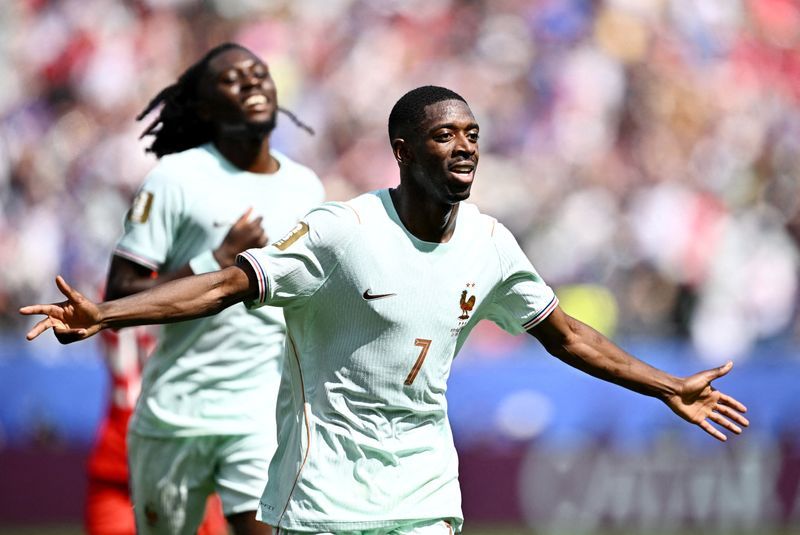
Ousmane Dembele produced a stunning display of finishing to propel France to a commanding 4-1 victory over Norway in Foxborough, Massachusetts, on Friday, allowing the French to claim first place in World Cup Group I with maximum attacking intent. The Paris Saint-Germain winger was virtually unstoppable during a devastating opening half, completing his hat-trick within just 25 minutes—an extraordinary feat that underscored France's attacking dominance and set the tone for what would become a comprehensive performance from the tournament favorites.
Already assured of a knockout berth before the match, France's motivation ran deeper than mere mathematical qualification. The French squad had collectively pledged to deliver a spirited performance as a tribute to head coach Didier Deschamps, who had returned to his home country to be present at his mother's funeral. This personal connection transformed what might otherwise have been a routine group-stage encounter into something more emotionally charged, and the players' intensity and commitment were evident from the opening kick.
Norway's coach Stale Solbakken made a tactical gamble that ultimately backfired spectacularly. Rather than field a competitive lineup, the Norwegian manager rested nearly his entire starting XI that had previously faced Senegal, a decision that left crucial attacking players—most notably the prolific Erling Haaland and captain Martin Odegaard—watching from the bench. This wholesale rotation effectively handed the initiative to France and created a vacuum that the French exploited relentlessly throughout the contest.
France's intensity was apparent within seconds of kickoff. Kylian Mbappe, the tournament's leading scorer and primary contender for the Golden Boot award, nearly broke the deadlock before the first minute had elapsed, his angled effort clattering against the crossbar with stunning violence. The early warning sign went unheeded by Norway's depleted defensive unit, which would soon find itself overwhelmed by the sheer quality and movement of the French attack.
Dembele opened the scoring in the sixth minute following a sumptuous cross-field pass from Mbappe that sliced through Norway's midfield. The winger showed sharp positioning and clinical finishing, cutting inside his marker before dispatching a precise angled shot beyond goalkeeper Egil Selvik. Fourteen minutes later, Mbappe again turned provider, and Dembele demonstrated composure in finding space to finish with a dipping effort that gave Selvik no chance whatsoever.
Norway's response through Thelo Aasgaard offered only temporary respite before Dembele completed an extraordinary hat-trick in the 32nd minute, curling a low effort into the far corner with the precision of a player completely in control of his capabilities. This performance placed Dembele among an elite group of French World Cup scorers—only Just Fontaine and Kylian Mbappe had previously managed hat-tricks for France at the World Cup. Remarkably, Dembele's was the second-fastest ever scored at a World Cup tournament, surpassed only by Austria's Erich Probst, who achieved the feat in 24 minutes against Czechoslovakia in 1954.
The second half saw Norway mount sporadic attempts to reduce the deficit, with Jorgen Strand Larsen spurning a golden opportunity from the penalty spot when his soft effort was comfortably saved by France goalkeeper Mike Maignan. Oscar Bobb forced another save from the alert Maignan as the Scandinavian side exposed occasional defensive vulnerability, but France's superior quality ultimately proved insurmountable. Substitute Bradley Barcola delivered a cross that Desire Doue converted into a header to seal the win in the closing stages, cementing France's dominant performance.
By topping Group I, France secured a theoretically advantageous path through the knockout stages, positioning themselves for a first-round matchup against Sweden. Norway, finishing as runners-up despite their second-string selection, face Ivory Coast in the last 32—a task that may prove considerably more demanding than their weakened squad composition suggests. The group stage result underscores how team selection and tactical decisions at this elite level can dramatically influence outcomes, even when qualification has already been secured.
For Malaysian football enthusiasts and Southeast Asian observers, this match exemplified the vast gulf in quality between the tournament's elite nations and their competitors. The clinical nature of France's attacking play—characterized by intelligent movement, precise passing, and ruthless finishing—represents the benchmark that aspirational nations must target. Dembele's performance particularly demonstrated how individual brilliance, combined with intelligent service from creative teammates, can overwhelm even organized defensive structures. As France advances deeper into the tournament, they appear sufficiently potent to challenge for their second World Cup title in eight years, with players like Dembele and Mbappe offering genuine goal-scoring threats from positions across the attacking third.

