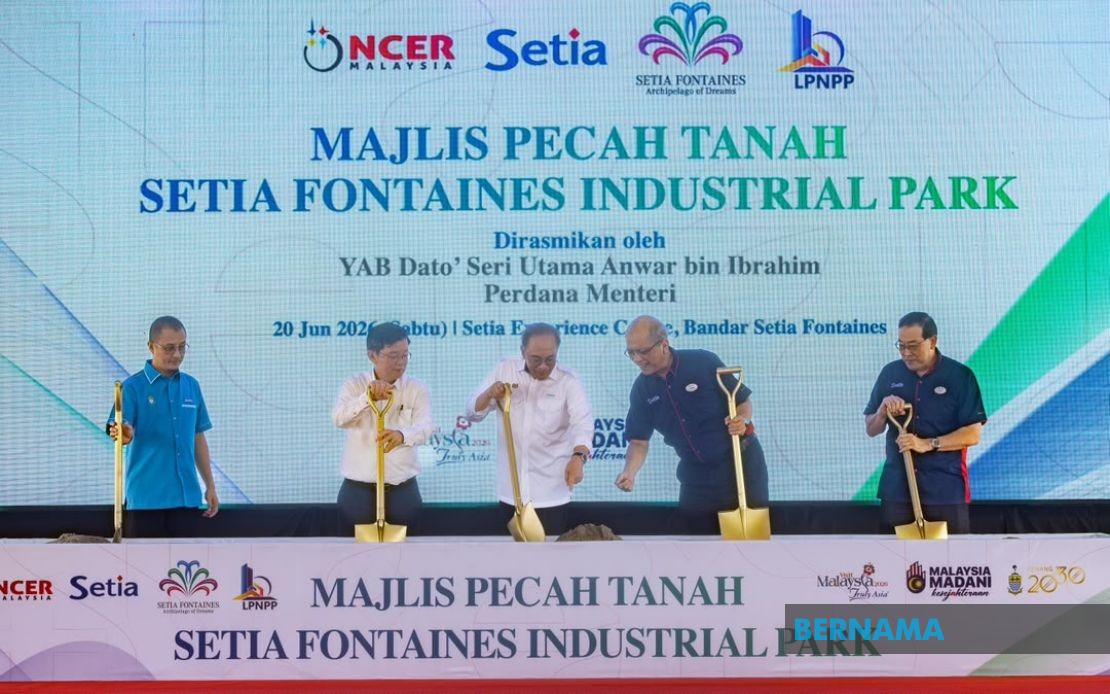
Prime Minister Datuk Seri Anwar Ibrahim has called on government-linked entities and the private sector to embed inclusive growth into their development strategies, warning that without deliberate efforts to benefit middle and lower-income communities, Malaysia risks deepening socioeconomic divides. Speaking at the groundbreaking ceremony for the Setia Fontaines Industrial Park in Bandar Setia Fontaines, Kepala Batas, Anwar outlined a vision where rapid economic expansion and surging investment become vehicles for broad-based prosperity rather than instruments that concentrate wealth among already-privileged groups.
The Prime Minister's remarks reflect growing concern within government circles about inequality trends despite Malaysia's sustained development trajectory. Anwar stressed that every project greenlit by major institutional investors—whether Khazanah Nasional Berhad, Permodalan Nasional Berhad, the Employees Provident Fund, or private corporations—must incorporate deliberate pathways for those earning modest incomes to participate meaningfully in economic opportunities. This represents a fundamental shift in how Malaysia assesses development success, moving away from purely headline growth metrics toward measuring whether prosperity reaches ordinary households.
The interconnection between investment approvals and equitable outcomes is central to Anwar's economic philosophy. Rather than viewing inclusive growth as philanthropic add-on, he positions it as integral to sustainable development. Without such mechanisms, he cautioned, Malaysia would witness the paradoxical outcome of accelerating economic activity alongside shrinking prospects for lower-income workers—a pattern that historically breeds social tension and political instability. The Prime Minister's emphasis suggests cabinet-level directives to all agencies overseeing major projects to incorporate equity considerations in project design from inception rather than retrofitting inclusivity measures later.
Seberang Perai's development trajectory illustrates the regional dimension of this challenge. The state has experienced uneven growth patterns, with the island and southern regions advancing rapidly while the mainland Seberang Perai lagged comparatively. The Setia Fontaines Industrial Park represents a strategic attempt to rebalance this equation, channelling investment into the overlooked mainland area and positioning it as an engine for local employment and skills development. Anwar's appearance at the ceremony underscores the federal government's commitment to addressing such geographical inequalities, recognizing that regional resentment over uneven development poses political risks.
Manufacturing's technological evolution presents both challenge and opportunity for equitable growth in Malaysia. As the country transitions from labour-intensive back-end manufacturing toward advanced technology sectors, the skill requirements for industrial employment have risen sharply. Anwar acknowledged that creating high-quality jobs means little if the domestic workforce lacks requisite capabilities to fill them. This skills gap, if unaddressed, risks creating a perverse situation where new industrial investments generate employment that remains inaccessible to local workers, necessitating foreign labour and negating the inclusivity objective.
The Prime Minister's emphasis on collaboration between industry, technical and vocational education institutions, and universities—specifically naming Universiti Sains Malaysia—reflects recognition that market forces alone will not automatically align labour supply with demand. Government must actively orchestrate partnerships that ensure educational curricula remain responsive to evolving industry requirements. The rapid pace of technological change, with Anwar noting that technology landscapes shift within one or two years, means traditional education systems struggle to maintain currency without sustained industry engagement.
This approach carries implications for how Malaysia positions itself within regional manufacturing networks. As the country competes with Vietnam, Thailand, and Indonesia for industrial investment, offering a workforce equipped with emerging-technology skills becomes a competitive differentiator. Yet ensuring such capability development reaches lower-income Malaysians requires deliberate policy design and resource allocation that might not occur through market mechanisms alone. Anwar's messaging to investors appears designed to communicate that Malaysia's stability and growth potential depend on inclusive skill development, framing equity not as cost but as strategic necessity.
The articulation of these principles at an industrial park opening carries symbolic weight. Rather than obscuring development's distributive dimensions, Anwar chose to foreground them, signalling that the government views inclusivity as non-negotiable rather than aspirational. This stance potentially influences how government-linked companies evaluate projects and how private investors assess regulatory expectations. Projects designed with genuine consideration for lower-income participation likely face faster approvals and smoother implementation, while those perceived as exclusionary may encounter regulatory friction.
For Malaysian readers concerned about their economic futures, Anwar's statements offer both assurance and challenge. The assurance lies in explicit commitment from political leadership to ensure development benefits extend beyond elite circles. The challenge lies in the operational difficulty of embedding such principles into massive development undertakings where cost pressures and profit motives naturally push toward exclusivity. Success requires sustained government monitoring, realistic performance metrics, and willingness to enforce accountability on both institutional and private-sector partners.
The Setia Fontaines development becomes a test case for these principles. Its success in creating accessible opportunities for Seberang Perai residents while maintaining commercial viability and attracting quality investment will signal whether Malaysia can genuinely achieve inclusive growth or whether such rhetoric remains disconnected from implementation realities. Given the state's historical development disparities and the surrounding region's political sensitivity, stakeholders will scrutinize whether the park delivers on the equity promise or reproduces familiar patterns where benefits concentrate among already-advantaged groups.

