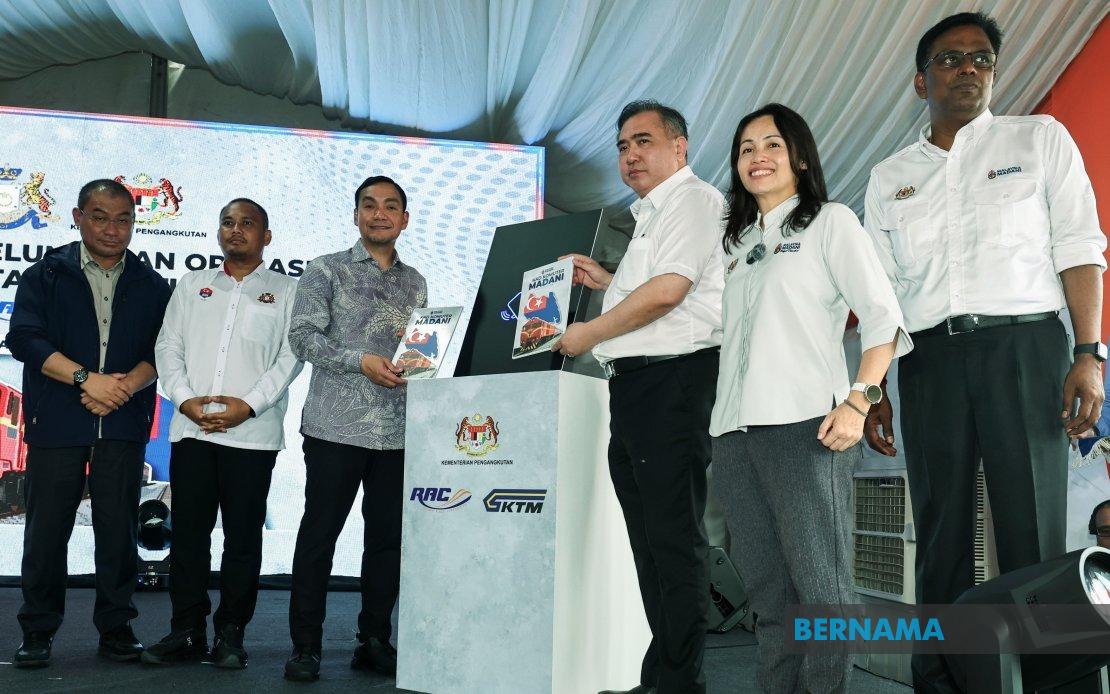
Johor Menteri Besar Datuk Seri Onn Hafiz Ghazi has underscored the urgent necessity of the Elevated Autonomous Rapid Transit (E-ART) system in safeguarding Johor Bahru's mobility when the Johor Bahru-Singapore Rapid Transit System (RTS) Link commences service in 2025. Speaking at the inauguration of the Southern Shuttle train service at KTM Kulai Station, Onn Hafiz positioned the E-ART not merely as a complementary project but as an indispensable long-term architectural solution to accommodate the exponential surge in passenger volumes that will inevitably overwhelm existing surface transport networks once cross-border connectivity is fully established.
The interconnection between these two major transport initiatives reveals the intricate planning challenges facing Malaysia's second-largest urban centre. The RTS Link represents a transformative regional development, yet its success hinges on supporting infrastructure that extends well beyond the rail corridor itself. Onn Hafiz's remarks acknowledge a fundamental urban planning principle: that high-capacity transit nodes, without corresponding distribution networks, merely concentrate congestion at specific points rather than alleviating it across the metropolitan area. The E-ART system would function as the critical dispersal mechanism, channelling passengers from RTS Link terminals throughout greater Johor Bahru and preventing the convergence of peak-hour traffic that could paralyse the city's arterial roads.
The scale of this challenge cannot be understated given Johor Bahru's demographic profile. With approximately 1.8 million residents—a population comparable to the entire state of Penang—the city already grapples with significant congestion during peak periods. The addition of cross-border commuter traffic, tourists, and commercial transport once the RTS Link becomes operational would intensify existing pressure on road infrastructure that was not designed for such volumes. Current projections suggest daily ridership could reach substantial figures, but without integrated last-mile connectivity, passengers would revert to private vehicles, negating the environmental and efficiency benefits of rapid transit investment.
Onn Hafiz acknowledged that the government has already initiated interim measures to manage the transition period before the E-ART becomes operational. Park and Ride facilities are being expanded to encourage commuters to abandon personal vehicles before reaching Johor Bahru's congested core, whilst intelligent traffic management systems are being deployed at major interchanges like JB Sentral. These short and medium-term interventions serve a crucial bridging function, providing breathing room for congestion management whilst longer-term infrastructure projects progress. However, the Menteri Besar was careful to characterise these measures as temporary expedients rather than permanent solutions, signalling that reliance on such systems beyond their intended timeframe could prove inadequate.
The E-ART project represents a substantial leap in transport technology for Malaysia, involving elevated autonomous transit that would operate independently of road-level traffic. This separation from conventional road networks provides a fundamental advantage: capacity that is not constrained by existing street configurations or vulnerable to surface congestion. The elevated configuration also minimises environmental and community disruption associated with ground-level construction whilst enabling rapid deployment across the sprawling metropolitan area. For Malaysian planners and regional observers, the E-ART represents a test case for autonomous rapid transit in a Southeast Asian context, with implications extending beyond Johor Bahru to other congested urban centres throughout the region.
The presence of Transport Minister Anthony Loke and Deputy Communications Minister Teo Nie Ching at the Southern Shuttle inauguration underscored federal commitment to Johor's transport agenda. This high-level political engagement reflects the national strategic importance assigned to Johor Bahru's development, particularly as the country's primary land gateway and a crucial node in Malaysia's broader economic architecture. The city's role as the main international crossing point for trade and tourism with Singapore necessitates transport systems capable of handling sustained high volumes whilst maintaining efficiency. Any significant congestion at this juncture could disrupt not merely local commerce but regional supply chains and bilateral economic relationships.
Onn Hafiz framed the E-ART initiative as more than technical infrastructure—he characterised it as a tangible manifestation of federal intervention that would be immediately perceptible to ordinary citizens. This rhetorical framing suggests that transport projects possess political dimensions beyond their functional purpose. By emphasising that accelerated E-ART implementation would create a lasting positive impression among Johor residents, the Menteri Besar signalled the project's importance as a demonstration of governance effectiveness. In Malaysian politics, where public perception of federal-state cooperation significantly influences electoral dynamics, rapid progress on visible infrastructure projects carries considerable political weight alongside its practical benefits.
The timing of these announcements carries particular significance given the RTS Link's imminent launch. The operational commencement in 2025 represents a fixed deadline against which all supporting infrastructure must be evaluated. Any delay in E-ART development could result in a period of inadequate capacity during the crucial initial years of RTS Link operation, potentially undermining public confidence in the entire transport system and reinforcing preferences for private vehicle use. Conversely, coordinated delivery of both systems could establish a virtuous cycle where complementary infrastructure encourages transit adoption and reduces road congestion, benefiting environmental outcomes and urban livability simultaneously.
For Malaysian commuters and Southeast Asian observers monitoring transport policy developments, the E-ART project exemplifies the complexity of contemporary metropolitan planning. The assumption that a single major infrastructure project will resolve systemic congestion is demonstrably insufficient; sustainable solutions require layered, complementary systems operating in concert. The Johor Bahru experience illustrates that cross-border economies, which increasingly characterise Southeast Asian cities, demand proportionally sophisticated transport architecture. As other regional cities contemplate similar rapid transit investments, the integrated approach being adopted in Johor Bahru—combining rail, autonomous transit, and traffic management—may offer instructive lessons for addressing comparable mobility challenges across the region.