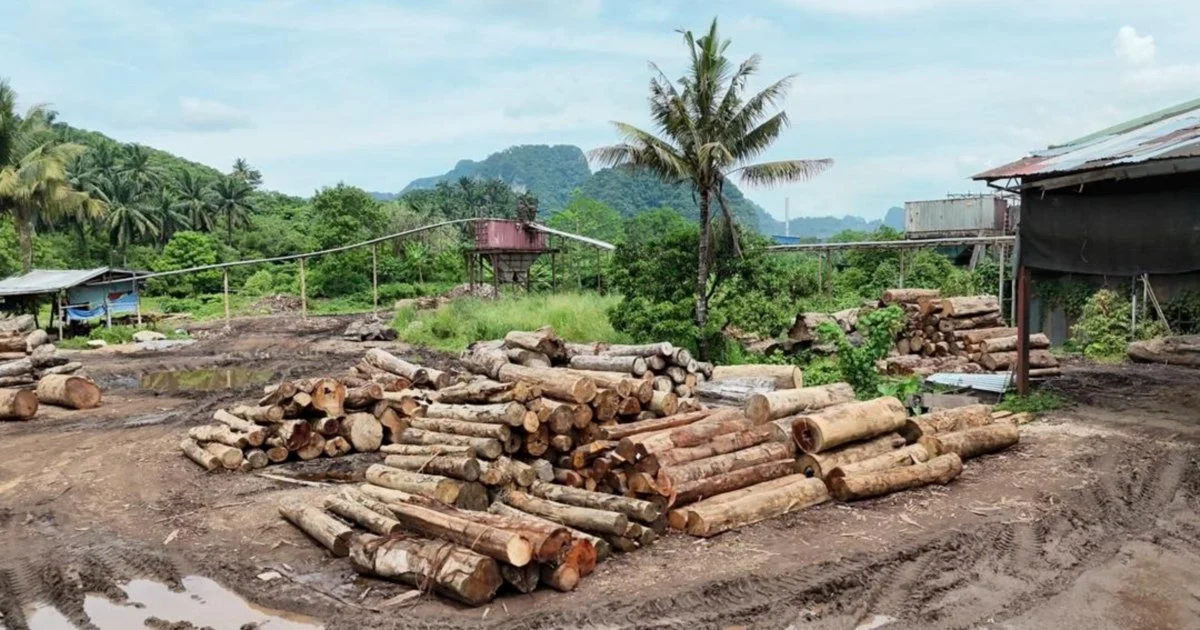
Authorities have moved decisively against timber trafficking operations in Malaysia's northern region, detaining eleven individuals and confiscating assets worth over RM2.43 million during coordinated raids across Kelantan and Terengganu. The enforcement action, which included four Indonesian nationals among those apprehended, signals intensified scrutiny of illegal forestry activities that have long plagued the peninsula's forested states.
The scale of the seizure reflects the significant economic dimensions of unlawful timber extraction. Beyond the confiscated wood products themselves, enforcement teams recovered machinery and equipment integral to logging and processing operations, indicating that authorities have targeted not merely individual transactors but rather operational infrastructure. The RM2.43 million valuation encompasses both raw materials and the capital equipment used to extract, transport, and process forest resources, suggesting a relatively sophisticated supply chain rather than opportunistic small-scale poaching.
The involvement of Indonesian nationals points to a persistent regional dimension in forestry crime. Cross-border timber trafficking exploits porous boundaries and regulatory gaps between Malaysia and Indonesia, where demand for wood products creates incentives for sourcing from protected or restricted areas. The arrest of foreign nationals alongside local suspects indicates either a mixed operation or the involvement of established trafficking networks that span international lines, arrangements requiring coordination and resources that go beyond amateur criminality.
Kelantan and Terengganu have historically been focal points for forest enforcement concerns, partly due to their expansive forest reserves and strategic location near international waters and borders. The concentration of operations in these two states reflects where authorities have identified patterns of illegal activity, though it also raises questions about capacity distribution across other forested regions in Peninsular Malaysia and the pace of monitoring in less-publicized areas.
The timing and scale of today's operations suggest sustained intelligence work preceding the arrests. Successful raids of this magnitude typically require advance surveillance, mapping of supply chains, and coordination between multiple agencies. The simultaneous nature of operations across two states indicates planning at a level beyond individual enforcement units, suggesting either a dedicated task force or enhanced inter-agency coordination that Malaysian authorities have increasingly emphasized in recent years.
Under Malaysian forestry legislation, particularly state-level forest ordinances and federal environmental statutes, illegal logging carries substantial penalties including imprisonment and significant fines. The detained individuals face potential charges ranging from unlicensed timber extraction to trafficking or conspiracy, depending on their roles within the operation and the jurisdictional classifications authorities apply. The recovery of machinery adds complexity to prosecutions, as equipment ownership and financing may trigger additional financial crime or money laundering investigations.
The broader context encompasses Malaysia's international commitments regarding forest preservation and sustainable timber management. The country has pledged to combat illegal logging under ASEAN frameworks and bilateral environmental agreements, making high-profile seizures politically and diplomatically significant. Public enforcement actions also serve deterrent functions, signaling to potential operators that law enforcement capacity and commitment remain active.
For legitimate timber industry stakeholders in Malaysia, enforcement actions carry mixed implications. Sustained crackdowns on illegal competitors should theoretically protect licensed operators by reducing undercutting from illicit sources. However, broader enforcement pressure may also constrain the entire sector's operational flexibility, creating compliance burdens that extend beyond illegal operators to legitimate businesses navigating increasingly stringent documentation and sourcing requirements.
The recovery of RM2.43 million in assets represents substantial value, though precise cost accounting remains opaque without details about equipment depreciation and market pricing for seized timber. The confiscated goods typically enter government asset management systems, with timber sometimes released to licensed processors under controlled arrangements or destroyed, and machinery often liquidated through official channels.
Moving forward, these arrests underscore the resource-intensive nature of combating organized timber crime. Individual raids, however successful, address symptoms rather than structural drivers—namely persistent demand for discounted timber, regulatory enforcement gaps in sourcing verification, and insufficient controls over industrial machinery that facilitates illegal processing. Experts have long emphasized that sustained reduction in timber trafficking requires complementary measures addressing market incentives, supply chain transparency, and cross-border coordination infrastructure.
The four Indonesian nationals' involvement raises questions about how bilateral law enforcement cooperation will proceed. Such cases often require diplomatic coordination for potential extradition or joint prosecution arrangements, and outcomes depend partly on political commitment from both governments to prioritize environmental crimes relative to other enforcement priorities. Regional cooperation frameworks, including the ASEAN Convention on Transboundary Haze Pollution and environmental crime initiatives, provide legal scaffolding for such coordination, though implementation varies considerably.
Authorities have indicated these operations will continue, reflecting official determination to sustain pressure on timber trafficking networks. The scale of today's seizure suggests that despite enforcement efforts, significant illegal operations remain capable of moving substantial volumes of forest resources and industrial equipment, indicating both the scope of the underlying problem and the ongoing demand that sustains illicit markets.

