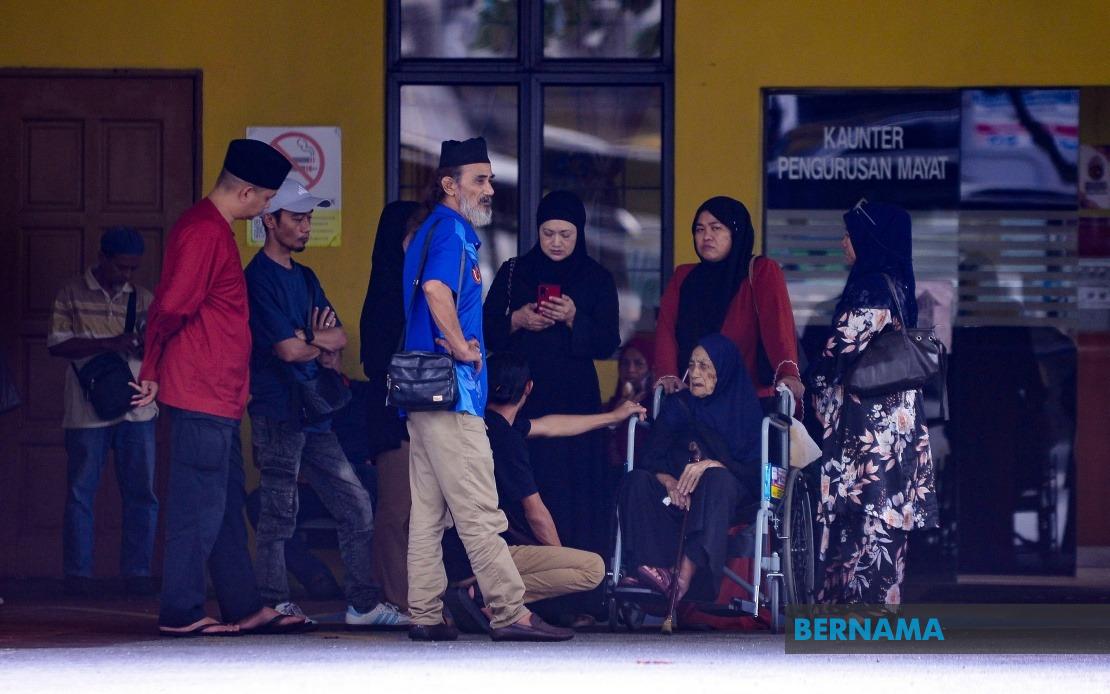
A grieving family member is pressing for a comprehensive and transparent investigation into a predawn collision at Maju Junction involving a Malaysian Immigration Department lorry that claimed three lives and left a fourth family member critically injured. Mohd Nadzri Razali, 69, the brother-in-law of the deceased Shaik Mohd Firdaus Shaikh Yahya, 53, has publicly appealed for authorities to conduct a thorough probe, citing unconfirmed reports that the immigration vehicle allegedly violated traffic signals at the intersection on Jalan Sultan Ismail. Speaking from his home in Taman Aman Fasa 2, Mambang Di Awam, Mohd Nadzri stated his determination to secure justice for his extended family, emphasizing the urgency of establishing precisely what transpired in the moments leading up to the tragedy.
The catastrophic incident unfolded approximately 1 am when an unoccupied Isuzu Black Maria lorry operated by the Immigration Department was en route from the Kuala Lumpur Immigration Office to Chow Kit to conduct enforcement operations targeting undocumented migrants. According to witness accounts and preliminary details, the lorry entered the Maju Junction intersection while its traffic signal was displaying red, though the vehicle's emergency beacon and siren were activated. Simultaneously, a Proton Saga sedan travelling perpendicular to the lorry's trajectory was advancing on a green light when the collision became unavoidable. The impact dislodged the Immigration lorry from its intended path, sending it into an uncontrolled skid that struck down four pedestrians and subsequently collided with an Inokom Matrix multi-purpose vehicle.
The human toll of the crash was devastating for a single family unit. Three pedestrians perished at the scene: Shaik Mohd Firdaus Shaikh Yahya, his 25-year-old daughter Siti Nor Sazlin, and his 12-year-old daughter Siti Darwisyah Auni. The family matriarch, Norhayati Razali, 55, sustained severe injuries and remains under intensive care at Kuala Lumpur Hospital, where she has regained consciousness. Mohd Nadzri expressed hope that his sister's condition will stabilize sufficiently for her to be transferred to either Hospital Ipoh or Teluk Intan for ongoing medical treatment, though her discharge timeline remains uncertain pending clinical assessment.
The compound grief inflicting the family extends beyond this singular tragedy. Mohd Nadzri revealed that the extended family had suffered another significant loss merely three months prior, on May 30, compounding the emotional devastation wrought by the Maju Junction collision. He recalled that his last encounter with his sister's family occurred approximately two weeks before the incident, when they had collectively visited Teluk Bakong in Ayer Tawar to observe religious observances at ancestral burial sites. The unexpected and simultaneous loss of three immediate family members has shattered the household and left surviving members grappling with logistics of grief while navigating the health crisis confronting Norhayati Razali.
The family has made arrangements to inter the three deceased in a single grave at the Muslim Cemetery in Kampung Air Hitam Labu, Kampar, reflecting both cultural and practical considerations. Mohd Nadzri's residence in the same residential enclave as his sister's household has intensified his personal connection to the incident, transforming what might otherwise be a distant tragedy into an intimate devastation that has reverberated through their immediate neighbourhood. The proximity of familial bonds makes his advocacy for investigative transparency particularly poignant, as he navigates the simultaneous demands of supporting his injured sister while pursuing accountability on behalf of the deceased.
The criminal investigation into the collision is proceeding under Section 41(1) of the Road Transport Act 1987, which establishes the legal framework for prosecuting traffic-related offences resulting in injury or death. This statutory foundation suggests authorities are examining whether negligence, violation of traffic regulations, or operational impropriety on the part of the Immigration Department contributed to the catastrophic collision. For Malaysian readers, the incident raises broader questions about whether emergency vehicles operating under activated sirens and beacons should enjoy differential treatment at traffic signals, and whether enhanced training protocols for Immigration Department drivers might reduce such incidents.
The alignment of the Proton Saga driver's green light signal with the Immigration lorry's allegedly red signal creates a critical factual dispute that underpins Mohd Nadzri's call for investigation. If verified, such a violation would indicate that the Immigration Department vehicle breached standard traffic conventions, thereby establishing potential liability. Conversely, if the lorry's emergency systems somehow malfunctioned or were overridden, the investigation might uncover mechanical or operational failures. The transparency that Mohd Nadzri demands is not merely emotional catharsis but a legitimate procedural requirement to establish whether systemic deficiencies exist within Immigration Department operations.
For Southeast Asian observers, the incident highlights recurring tensions between emergency service operational imperatives and public safety obligations. Throughout the region, enforcement and immigration agencies frequently operate under time-sensitive mandates that may create pressure to prioritize mission completion over vehicular safety protocols. The Maju Junction collision exemplifies the human cost when such pressures intersect with complex urban intersections and unpredictable civilian traffic patterns. Malaysian authorities may face heightened scrutiny regarding whether current protocols for Immigration Department operations adequately balance enforcement effectiveness with pedestrian protection.
The investigation's outcome will likely reverberate beyond this singular tragedy. Should evidence substantiate allegations of red light violation, the Immigration Department may face institutional accountability and potential reform of operational procedures. Conversely, if investigation reveals contributory negligence by the Proton Saga driver or technical malfunctions in traffic signal systems, responsibility apportionment will shift accordingly. Regardless of findings, the incident underscores the vulnerability of pedestrians at major urban intersections and the cascading consequences when multi-tonne vehicles operated by any government agency malfunction or behave erratically.
Mohd Nadzri's explicit appeal for justice reflects not only familial grief but also a broader social demand for governmental transparency and accountability. In Malaysian public discourse, such calls gain particular resonance when involving state institutions, as citizens increasingly expect that government agencies operate under equivalent accountability standards as private entities. The Immigration Department, as a law enforcement body entrusted with public safety responsibilities, occupies a position where procedural transparency becomes essential to maintaining public confidence. The comprehensive investigation that Mohd Nadzri demands represents a minimal institutional obligation to the bereaved family and to public understanding of how such incidents occur and whether systemic reforms might prevent recurrence.

