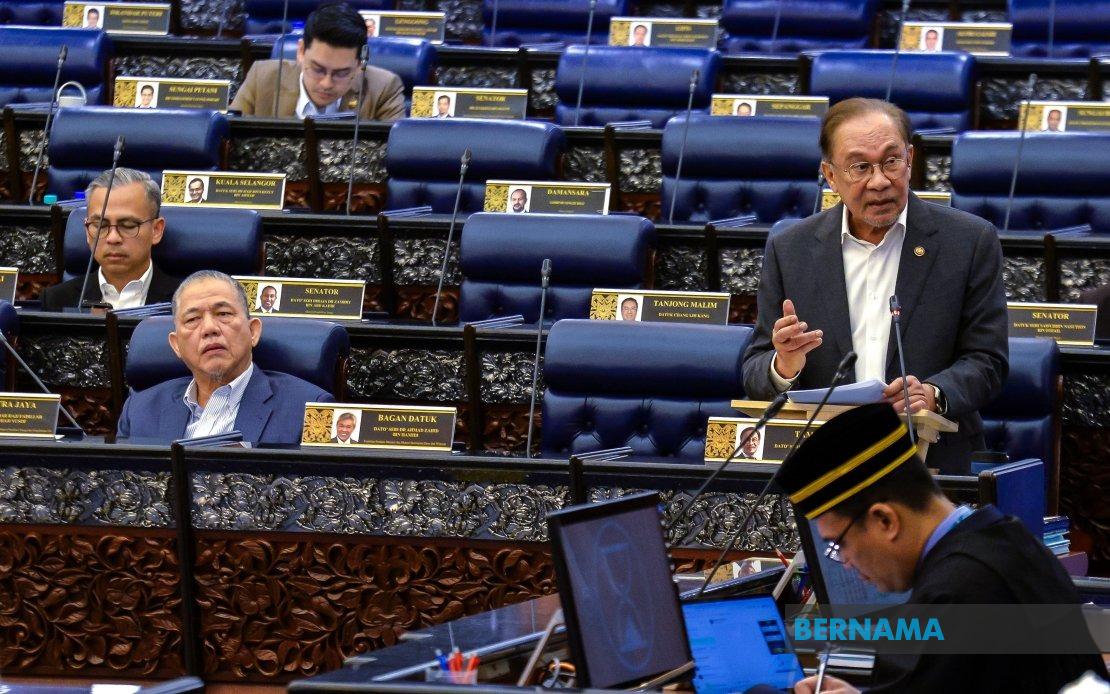
Prime Minister Datuk Seri Anwar Ibrahim has moved to quell persistent concerns about the equity of federal funding distribution, asserting that the allocation methodology prioritises the genuine development needs of each state rather than mirroring their individual tax contributions to the national coffers. Speaking during parliamentary proceedings, he underscored a fundamental principle underlying the MADANI Government's fiscal approach: resources should flow to where they are most urgently required for public benefit, regardless of a state's revenue-generating capacity.
The Prime Minister's clarification addresses a longstanding tension in Malaysian federalism, where wealthier states like Selangor and Penang naturally generate higher tax revenues but paradoxically receive lower federal allocations per capita. Anwar presented this apparent imbalance as evidence of deliberate redistribution policy, explaining that almost every other state receives substantially more in federal funding than it contributes in taxes. This mechanism effectively channels resources from economically productive regions towards less developed areas, a strategy that reflects broader social policy objectives centred on reducing regional inequality.
In his parliamentary address, Anwar articulated the concrete priorities shaping allocation decisions across Malaysia's states. The government identifies pressing infrastructure and development gaps—particularly flood mitigation systems, which have become increasingly critical given climate-related challenges in vulnerable regions, the comprehensive upgrade of the Pan Borneo highway corridor essential for Sarawak and Sabah's economic integration, construction of new road networks to improve connectivity, rehabilitation of water drainage and supply systems, targeted poverty eradication initiatives, and educational infrastructure expansion. This enumeration illustrates how federal funds are deployed as strategic instruments for addressing specific regional vulnerabilities rather than as mechanistic distributions of national wealth.
The timing of Anwar's remarks is significant given persistent accusations from certain quarters that particular states face systematic marginalisation in federal spending. By directly confronting these allegations in parliament, the Prime Minister sought to establish transparent accountability for allocation decisions, countering narratives that funding is arbitrary or politically motivated. His statement implicitly invites scrutiny of the government's priorities, suggesting confidence in the defensibility of its resource allocation methodology.
A particularly telling aspect of Anwar's defence involves comparison with the previous administration's spending patterns. He emphasised that states such as Kedah, Terengganu and Kelantan have received record allocations under the current MADANI Government relative to their historical funding levels. This comparative framing serves multiple purposes: it demonstrates the incumbent government's commitment to rectifying what may have been genuine imbalances, establishes a measure of progress on regional equity, and implicitly critiques predecessor governance without requiring explicit denunciation. For observers tracking the government's social contract with voters, particularly in northern and east coast states that have shifted their political alignments in recent elections, this claim carries electoral significance.
The distinction Anwar draws between needs-based and revenue-based allocation reflects broader international practice in federal systems, though implementation remains contested. Countries such as Australia, Canada and India employ sophisticated mechanisms to ensure that taxation capacity does not determine resource entitlement, recognising that backward regions require sustained investment to overcome structural disadvantages. Malaysia's approach, as articulated by the Prime Minister, follows this comparative logic, positioning the nation as committed to inclusive development rather than pure fiscal federalism.
For Malaysian readers and policymakers, Anwar's statement carries implications extending beyond immediate funding disputes. It signals the government's intention to maintain progressive redistribution even as fiscal pressures mount and overall budgetary resources face constraints. The emphasis on needs-based allocation also suggests that decisions about infrastructure investment, poverty reduction programmes and educational development will remain contested terrain, with different stakeholders advocating for their regions' specific requirements.
The parliamentary context of these remarks—responding to a query from GPS backbencher Datuk Seri Doris Sophia Brodi regarding allocation sufficiency and fairness—indicates that regional representation concerns remain active even within government coalition benches. The necessity for a Prime Minister to publicly defend allocation methodology during parliamentary proceedings suggests these issues resonate with constituents across multiple states. The GPS question itself, coming from a Sarawakian representative, underscores how resource distribution remains entwined with East Malaysia's historical grievances about proportionate development investment.
Moving forward, the MADANI Government's allocation transparency will likely face continued scrutiny. States receiving lower-than-expected increases, infrastructure projects facing delays or reduced scope due to budgetary constraints, and variations in the implementation of federal commitments across regions will generate fresh allegations of inequitable treatment. Anwar's articulation of needs-based principles provides a framework against which such criticisms can be evaluated, though disagreement about how needs are assessed and prioritised will persist.
The broader economic context renders this debate increasingly consequential. As Malaysia navigates post-pandemic recovery, climate adaptation, and technological transformation, federal allocation decisions fundamentally shape regional competitiveness and social stability. Whether the stated commitment to needs-based distribution translates into sustained implementation across political cycles and fiscal pressures will determine the framework's credibility. For Southeast Asian observers, Malaysia's approach to regional fiscal equity offers instructive lessons about balancing development imperatives with federation management principles.

