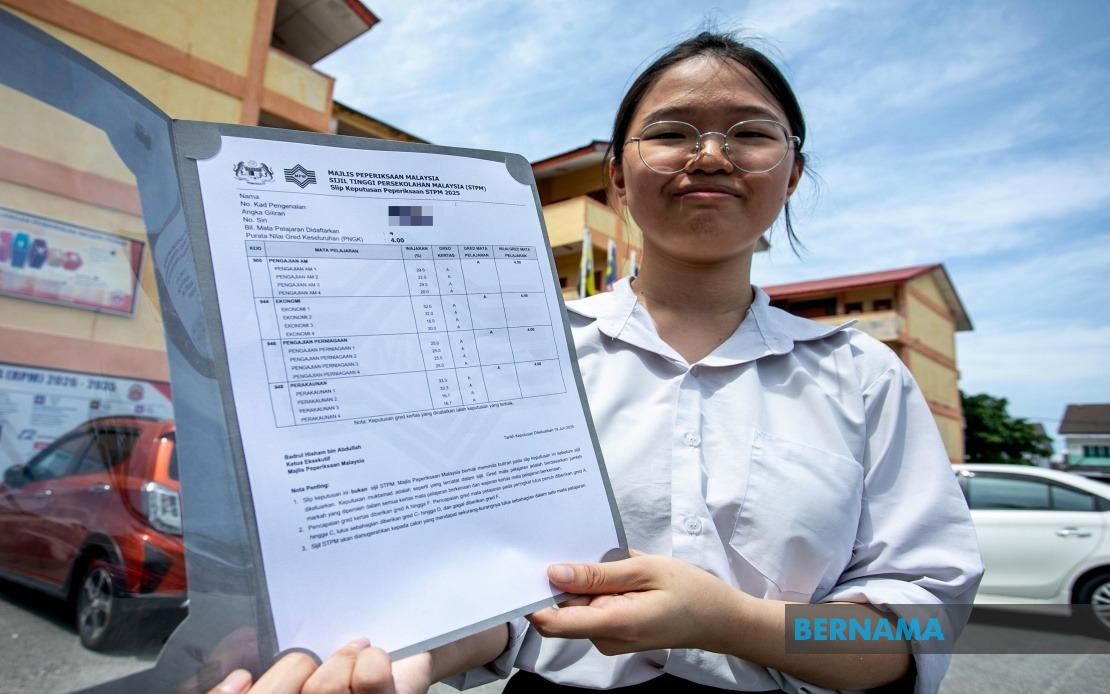
Twenty-year-old Yong Xin Yi has become one of the standout performers in the 2025 Sijil Tinggi Persekolahan Malaysia (STPM) examination, securing an impressive 4As result with a perfect Cumulative Grade Point Average of 4.00. The student from SMK Jalan Tasek in Ipoh earned top marks across General Studies, Principles of Accounting, and Economics, joining only four other classmates who achieved identical results at her school. Her success demonstrates how methodical planning and consistent execution can yield exceptional academic outcomes in Malaysia's pre-university examination system.
The foundation of Xin Yi's achievement rests on a carefully structured daily schedule that she has maintained throughout her STPM preparation. Each evening, she dedicates five uninterrupted hours—from 5:00 pm to 10:00 pm—to reviewing and reinforcing the material covered during school hours. This extended revision window allows her to move beyond mere memorisation, instead working through problems and deepening her conceptual understanding of complex topics. The consistency of this routine has enabled her to build momentum and retain information effectively over the extended pre-examination period.
What distinguishes Xin Yi's approach from conventional study methods is her emphasis on maximising classroom engagement before embarking on home revision. She views active participation and focused attention during teaching and learning sessions as the primary lever for academic success, reasoning that a thorough grasp of the teacher's explanation substantially reduces confusion and ambiguity during independent study. This front-loaded comprehension strategy means her evening revision sessions become refinement and consolidation exercises rather than scrambling to understand entirely new concepts. The efficiency gained from this layered approach has allowed her to cover extensive material without excessive strain.
Beyond scheduled revision, Xin Yi places significant weight on completing all assigned homework promptly and thoroughly. Rather than treating homework as a box-ticking exercise, she views each assignment as an integral component of the learning process, a means through which she can identify gaps in her understanding and progressively strengthen her mastery of each topic. This commitment to completing all academic obligations sets a high baseline of engagement that complements her evening study sessions. The combination creates a comprehensive learning ecosystem where in-class instruction, homework completion, and structured revision reinforce one another in a continuous cycle.
Among her three subjects, General Studies presented the most significant challenge to Xin Yi, demanding not only subject knowledge but also sophisticated writing skills, understanding of specific question formats, and familiarity with the marking scheme's nuances. Rather than viewing this difficulty as a deterrent, she strategically adjusted her resource allocation, directing disproportionate attention to this subject to eliminate weakness before the examination period intensified. This capacity to identify weak areas and respond with targeted intervention reflects mature metacognitive awareness—the ability to assess one's own learning and adjust accordingly. Her willingness to confront challenging material head-on rather than avoiding it contributed substantially to her ultimate success.
Xin Yi's journey to academic excellence has been supported significantly by her parents, a clerk and phone salesman, who have provided consistent encouragement and emotional backing throughout her secondary education. As the only child in her family, she carries particular awareness of the hopes her parents have invested in her future. She frames her STPM achievement not merely as a personal milestone but as a stepping stone toward improving her family's circumstances, viewing her academic success as a means of rewarding her parents' sacrifices and commitment to her education. This motivational framework extends beyond individual achievement, situating her studies within the broader context of family aspiration and responsibility.
Looking ahead, Xin Yi has charted a clear pathway into higher education and professional development. She intends to pursue economics at Universiti Putra Malaysia, having carefully considered both her personal aptitudes and the career prospects available within that field. Her selection of economics reflects deliberate decision-making rather than default choices, demonstrating that she has invested time in understanding the employment landscape and assessing where her strengths align with market demand. The field of economics offers robust employment opportunities across government, financial institutions, corporate organisations, and international bodies, a consideration that has clearly influenced her selection.
The aspiring economist's ambition to eventually enter the profession represents a logical extension of her STPM specialisation, suggesting she has constructed a coherent educational trajectory from secondary through tertiary study and into career practice. Her academic excellence in Principles of Accounting alongside Economics positions her well for university-level study, as both subjects develop analytical and quantitative capabilities essential for advanced economics programmes. The intellectual disciplines required to achieve 4As in these demanding subjects provide a strong foundation for university coursework that will deepen theoretical understanding and develop research capabilities.
Xin Yi's achievement within the broader context of STPM results offers valuable insights for other Malaysian students approaching or undertaking this critical examination. Her experience illustrates that excellence need not depend on extraordinary talent alone, but rather emerges from disciplined application of proven study strategies. The combination of classroom attentiveness, systematic homework completion, structured revision, strategic resource allocation toward challenging material, and sustained motivation creates a replicable framework for academic success. For Malaysian families navigating the education system, her story affirms that consistent effort, parental support, and strategic planning can collectively produce outcomes that open doors to premier universities and career opportunities.

