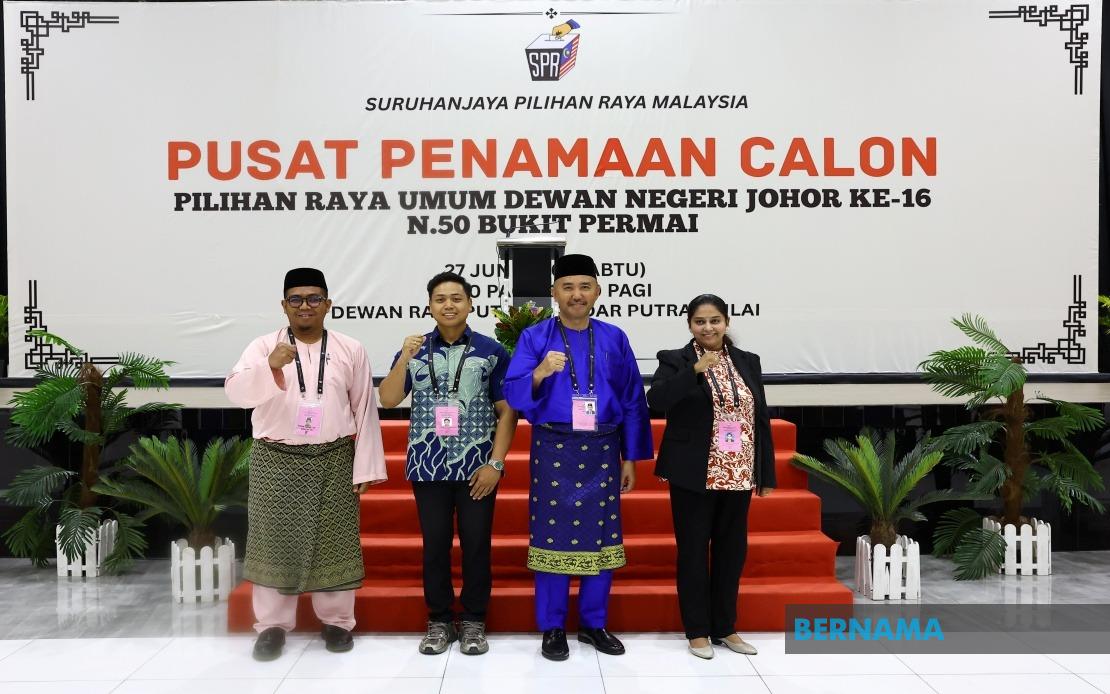
Datuk Mohd Jafni Md Shukor, the incumbent assemblyman for Bukit Permai, will face a competitive battle to retain his seat in the 16th Johor state election, as nomination papers were formally closed in Batu Pahat on June 27. The Barisan Nasional candidate is now locked in a four-cornered contest that reflects the increasingly fragmented political landscape across Malaysia's southern state, with challengers representing three different coalitions vying to unseat him or capitalise on voter sentiment.
Three opposition-aligned candidates will challenge Mohd Jafni's re-election bid. Mohamad Shafwan Ani carries the colours of Pakatan Harapan, the main federal opposition coalition that maintains significant presence in several Johor constituencies. M. Lina Manoh represents Perikatan Nasional, the alliance of UMNO and PAS that has made substantial inroads in Johor politics in recent years. Rounding out the contest is Muhammad Aidil Riduan Mohd Yusof from Parti Bersama Malaysia, a newer political entity that has sought to position itself as an alternative force in Malaysian politics. This multiplicity of candidates underscores the splintering of electoral support that has become characteristic of Johor politics.
Returning officer Afzan Azhari formally announced the candidate lineup at the Dewan Raya Putra in Bandar Putra following the close of the nomination window at 10 am. The official confirmation came after the standard nomination procedures, during which Johor DAP chairman Teo Nie Ching arrived early at the centre to support Mohamad Shafwan, signalling Pakatan Harapan's commitment to contesting the seat aggressively. The presence of senior opposition figures at nomination ceremonies often indicates the strategic importance parties assign to particular constituencies.
Mohd Jafni enters this election as a proven incumbent with a track record of electoral success. In the previous Johor state election held in 2022, he secured victory with a substantial majority of 4,755 votes, despite contesting in an equally crowded four-cornered field at that time. His demonstrated ability to consolidate support in a divided electoral scenario suggests he possesses strong local networks and community connections. However, the intervening period since 2022 has witnessed significant political shifts at both state and federal levels, which could reshape voter preferences and coalition loyalties across Johor's constituencies.
The electoral calendar has been set with precision by the Election Commission to ensure orderly conduct of the state election. Early voting is scheduled for July 7, providing registered voters who are unable to cast ballots on polling day with an opportunity to participate in advance. The main polling day is fixed for July 11, giving all eligible voters their opportunity to determine the composition of the Johor state assembly. This compressed timeline between nomination and polling reflects the electoral commission's standard procedures for state elections, allowing candidates approximately two weeks for campaign activities.
The Bukit Permai contest carries broader significance within the context of Johor's political trajectory. The state has emerged as a crucial battleground in Malaysian politics, with Barisan Nasional, Pakatan Harapan, and Perikatan Nasional all maintaining meaningful presence across different constituencies. The outcome of individual seats like Bukit Permai will collectively determine whether the BN-led state government continues, whether opposition coalitions can gain meaningful ground, or whether the balance of power shifts in unexpected directions. Voter behaviour in Johor has proven volatile in recent election cycles, making predictions hazardous.
The fragmentation evident in Bukit Permai's four-candidate contest reflects national trends toward political pluralism and reduced two-coalition dominance. With neither Pakatan Harapan nor Perikatan Nasional able to present a unified challenge, voters face genuine choices between distinct political visions. For Mohd Jafni and Barisan Nasional, this scenario could prove advantageous if opposition support splits sufficiently. Conversely, if anti-incumbent sentiment runs high, consolidation around any single opposition candidate could threaten his position. The numerical dominance of non-BN candidates suggests significant grassroots appetite for change, though electoral mathematics involving multiple competitors often defy simplistic analysis.
Mohd Jafni's previous victory margin of 4,755 votes provides one data point for analysis, but past results offer limited predictive value in Malaysia's shifting political environment. Demographic changes, shifting economic sentiment, and evolving community priorities can alter electoral outcomes substantially between contests. The absence of any single dominant opposition challenger mirrors dynamics in other Johor seats, suggesting that the state's political culture has evolved beyond the two-bloc framework that characterised Malaysian politics a decade ago. Whether this fragmentation benefits incumbent governments or facilitates opposition breakthroughs remains contested among political analysts.
The campaign period leading to July 11 will prove crucial for all candidates seeking to establish clear differentiation and mobilise their respective support bases. In a four-cornered contest, second-place finishes become as consequential as wins, as they represent political capital for future contests. Johor's voters will determine whether the incumbent government retains control of state politics or whether opposition coalitions can achieve breakthrough results. The Bukit Permai outcome will contribute to the larger narrative of Malaysian politics as the nation continues navigating its post-2018 political realignment and evolving voter preferences.

