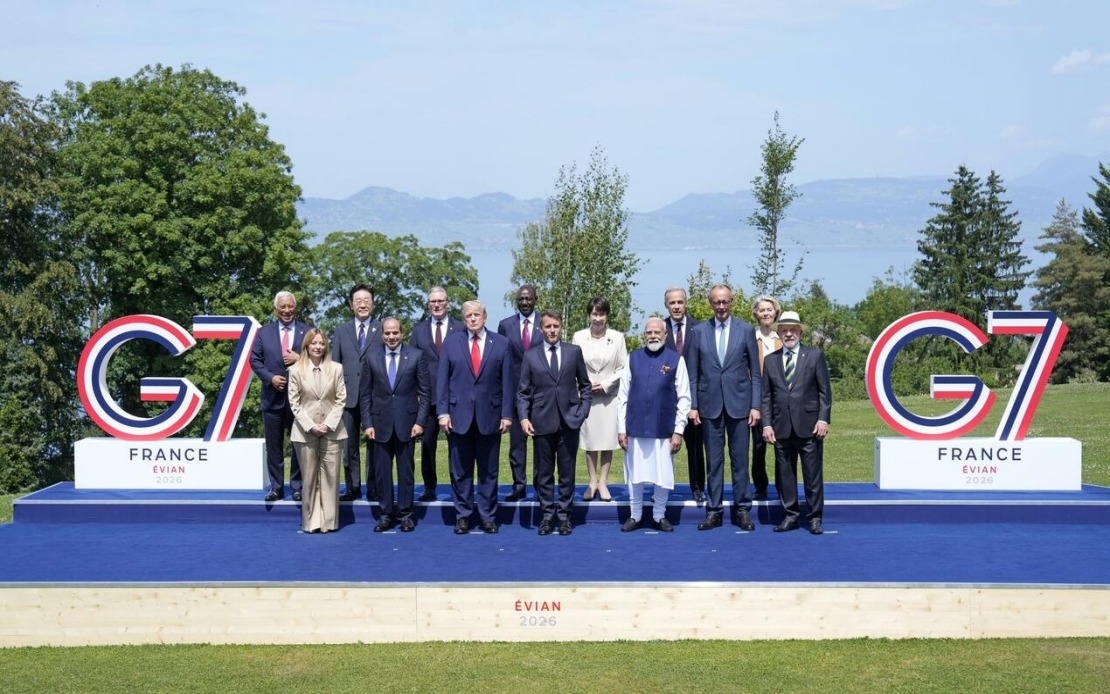
The Group of Seven's annual summit in Evian-les-Bains, a lakeside French resort town near Switzerland, produced a rare show of unity on Tuesday around Ukraine policy, even as underlying disagreements between the United States and its European allies threaten the cohesion of the world's leading democracies. Gathered for their three-day meeting, the G7 leaders—representing Britain, Canada, France, Germany, Italy, Japan and the United States, alongside the European Union—reaffirmed their commitment to achieving a "just and lasting peace" in Ukraine by maintaining diplomatic and military pressure on Russia. The breakthrough came during a dedicated session where Ukrainian President Volodymyr Zelenskyy directly addressed the assembled leaders about his nation's circumstances, providing first-hand perspective on the battlefield situation and diplomatic possibilities.
President Donald Trump, breaking from European caution, openly encouraged Russia to conclude a peace agreement, framing the conflict in terms of mutual suffering and exhaustion. "Russia should make a deal. Russia has lost tremendous amounts of people, and so has Ukraine," Trump declared to journalists after the closed-door session, signalling his determination to pivot American focus toward resolving the conflict. The American leader suggested that the United States possessed leverage over Moscow through its control of sanctions regimes, specifically referencing temporary relief measures implemented to manage global oil prices following recent conflicts in the Middle East. Trump's commentary reflected his broader strategic inclination toward negotiation and deal-making, even as his European counterparts emphasised the importance of maintaining unified pressure on Russia without apparent preconditions.
The consensus around Ukraine, however, exists against a backdrop of significant transatlantic friction that extends across multiple domains. Trade disputes, differing approaches to NATO expansion and burden-sharing, American ambitions regarding Greenland, and disagreements over Middle Eastern conflicts have created palpable tension between Washington and European capitals. That G7 members managed to align on Ukraine despite these broader disagreements speaks to the gravity of the situation in eastern Europe and the recognition that Russian aggression represents a foundational challenge to the international rules-based order upon which post-war Western security architectures depend. The unified statement represents the kind of consensus that transcends particular presidential administrations and reflects deeper commitments to European stability.
Zelenskyy's public remarks on social media following his engagement with G7 leaders emphasised two priority areas: substantially strengthening Ukraine's air defence capabilities and advancing diplomatic initiatives that could compel Russian withdrawal. The Ukrainian president characterised these objectives as interdependent elements of a broader peace strategy—suggesting that military readiness and diplomatic pressure must operate in concert. His framing reflects Kyiv's evolution in recent months, as Ukraine has deepened military cooperation with European nations while navigating a more ambiguous relationship with the American administration. This tactical recalibration has allowed Ukraine to maintain battlefield momentum and strengthen its negotiating position simultaneously.
Japan's Prime Minister Sanae Takaichi articulated concerns that extended beyond immediate Ukrainian circumstances, highlighting the troubling alignment between Russia and North Korea and the expanding military partnership between Moscow and Beijing. Tokyo's perspective carries particular weight in G7 deliberations given Japan's own security vulnerabilities in the Indo-Pacific and its experience with great power coercion. Takaichi's emphasis on preventing unilateral alteration of international borders through force reflected a principle with direct application to Japanese security interests, particularly regarding potential Chinese actions toward Taiwan and Russian or Chinese designs in the Arctic. The Japanese leader's call for rapid and concrete Russian movement represented a calibrated appeal for urgency without abandoning diplomatic channels entirely.
Trump's assertion that American involvement in Middle Eastern conflicts was concluding suggested a significant reallocation of geopolitical attention and resources. The American president referenced a preliminary agreement with Iran regarding reopening the Strait of Hormuz, a critical chokepoint controlling roughly one-third of global maritime oil traffic, as evidence of his administration's capacity to achieve major diplomatic breakthroughs. By drawing connections between resolution of Middle Eastern tensions and availability of American resources for European security challenges, Trump implicitly communicated that other allies should welcome his eagerness to settle conflicts that have consumed American diplomatic and military attention. Whether this optimistic assessment of Middle Eastern de-escalation proves accurate will significantly shape American capacity to support Ukraine over coming months.
The expanded G7 summit agenda reflected recognition that global challenges operate across interconnected domains rather than in isolated silos. By inviting leaders from Brazil, Egypt, India, Qatar, South Korea and the United Arab Emirates to participate in selected sessions, France—holding the G7 presidency this year—sought to broaden the discussion and incorporate perspectives from crucial emerging economies and regional powers. This outreach approach acknowledges that Western institutions must increasingly accommodate non-Western powers if they aspire to shape global outcomes, particularly regarding development finance and strategic stability in contested regions.
Discussions on West Asia during a working lunch brought together G7 members alongside representatives from Egypt, Qatar and the United Arab Emirates to assess implications of the Iran conflict and evaluate prospects for sustainable peace architecture in the region. Leaders welcomed the preliminary American-Iranian agreement aimed at ending hostilities and restoring maritime access through the Hormuz Strait, whilst committing to continued collaboration toward durable peace and stability. Takaichi particularly stressed the imperative of guaranteeing unobstructed navigation through this vital shipping lane and accelerating final agreement negotiations between Washington and Tehran, reflecting Japan's energy security interests and broader dependence on Middle Eastern hydrocarbons.
The G7's discussion of development finance reform represented an acknowledgment that traditional official development assistance mechanisms have become insufficient for addressing infrastructure, health, education and climate adaptation needs in developing economies. France has championed the creation of more mutually advantageous partnerships that respect both donor strategic interests and recipient developmental priorities, moving away from the paternalistic models that characterised earlier aid paradigms. The joint declaration emphasised the importance of mobilising private capital toward long-term projects and creating partnership frameworks that generate shared benefits rather than perpetuating dependent relationships. For Southeast Asian nations and other emerging economies, this evolving approach to development cooperation offers potential advantages, as wealthier nations increasingly recognise that sustainable partnerships deliver better geopolitical outcomes than extractive relationships.
The summit underscores a critical moment for Western unity and multilateral institutions. Despite persistent disagreements over trade, NATO financing, and regional security approaches, the G7 demonstrated capacity to coalesce around fundamental principles regarding international law, territorial integrity and the prevention of great power conflict escalation. The presence of Zelenskyy, the inclusion of non-Western partners in selective discussions, and the engagement with development finance reform all suggest that Western democracies are attempting to adapt their institutions and practices to contemporary challenges. Yet the underlying tensions—particularly between American unilateralism and European preference for coordinated approaches—will likely persist, shaping the trajectory of Western responses to evolving global crises.