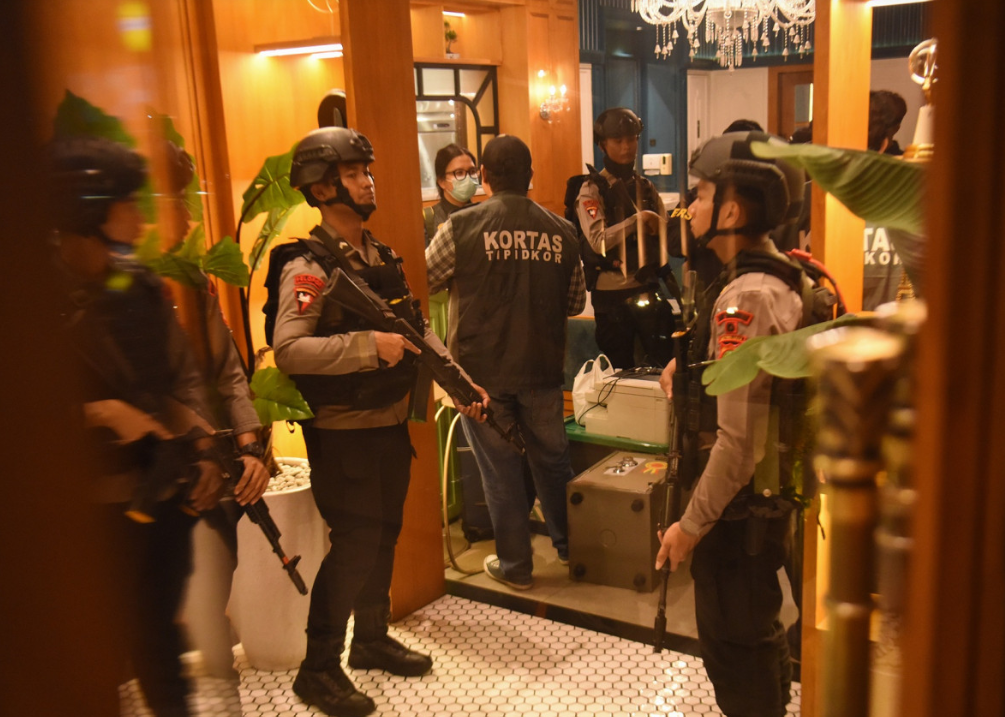
The streets of South Jakarta witnessed an extraordinary show of state power when heavily armed police descended on de'Clan Signature, a fashionable restaurant in the Cipete neighbourhood, on the afternoon of Wednesday, July 8. Mobile Brigade officers in full tactical gear, weapons at the ready, cordoned off the establishment as personnel from Jakarta's police force and the National Police's corruption crime corps methodically searched the premises. Inside a safe concealed behind a cabinet, they discovered documents and substantial quantities of currency in multiple denominations, totalling millions of dollars. The operation did not end there—authorities immediately moved to the adjacent Koin Money Changer, where they cracked open another vault containing hundreds of thousands of dollars in rupiah notes.
What began as a surgical strike on two connected businesses swiftly escalated into one of the most comprehensive anti-corruption operations Jakarta has witnessed in recent memory. As evening gave way to night and darkness fell over the capital, teams of police fanned out across the city and its suburbs, executing simultaneous raids on at least a dozen locations. They swept through upscale residential towers, including units at the Pacific Place apartment complex near the city's financial district, seized documents and mobile phones from corporate offices scattered throughout the metropolis, and combed through private residences in prestigious neighbourhoods. The coordinated nature of the operation and its sheer scope left observers in no doubt that Indonesian authorities were pursuing a significant figure suspected of serious financial crimes.
The investigation's focal point emerged as the raids proceeded into the early morning hours. Police converged on an exclusive residence in Sentul, a verdant hillside enclave approximately one hour's drive south of Jakarta, where the true magnitude of the alleged criminal enterprise became apparent. Inside the residence, authorities discovered seven suitcases brimming with 74 kilograms of gold bars, alongside substantial quantities of cash denominated in various international currencies. When officials tallied their haul, the total valuation reached US$26.3 million—a staggering sum that would dominate headlines across the archipelago and beyond. The photographs of neatly stacked bullion and bundled currency notes, released by authorities and disseminated widely by media outlets, would become the enduring visual symbols of what many commentators were already calling one of Indonesia's most significant law-enforcement scandals in years.
The owner of the Sentul residence, Febrie Adriansyah, had until recently occupied a position of considerable authority within Indonesia's judicial hierarchy. For more than four years, Adriansyah had served as deputy attorney general responsible for special crimes—a role that placed him at the epicentre of the nation's anti-corruption and organised crime investigations. His elevated position made the subsequent allegations all the more shocking to Indonesian observers accustomed to hearing about corruption among lower-ranking officials. Adriansyah's resignation came over the weekend following the raids, and authorities subsequently named him as a suspect in investigations relating to corruption and money laundering. However, reflecting the procedural intricacies of Indonesian law enforcement, he has not been detained pending trial, a detail that would later become the subject of legal and constitutional scrutiny.
When confronted with evidence of the extraordinary wealth discovered at his residence, Adriansyah adopted a posture of denial, acknowledging ownership of the Sentul property while categorically denying that the seized assets belonged to him. He suggested that the true origin and ownership of the gold and currency would emerge through the formal legal proceedings, essentially deferring substantive explanation to the judiciary. This response did little to quell the firestorm of public speculation and concern that swept through Jakarta's political and legal circles. The juxtaposition of his position as a guardian of the nation's anti-corruption apparatus against the magnitude of illicit wealth allegedly under his control created a narrative of profound institutional failure.
Police investigations subsequently expanded to include additional locations and individuals. A lawyer named Don Ritto emerged as a co-suspect, with authorities alleging business connections between him and the restaurant and money-changer operations targeted in the raids. Unlike Adriansyah, Ritto was placed into detention, signalling a more aggressive prosecutorial stance toward the subordinate figure. The asymmetry in treatment—with the higher-ranking official remaining free while a lower-ranking associate faced immediate incarceration—raised eyebrows among observers and legal experts monitoring the case's trajectory. Corporate records examined by local journalists suggested that Ritto maintained financial interests in entities connected to the raided establishments, lending credence to allegations of a coordinated scheme.
As Monday afternoon dawned and Jakarta's business community digested developments over the weekend, the investigation prompted searching questions about Indonesia's anti-corruption architecture and whether recent institutional reforms were functioning effectively. Optimists interpreted the raids as evidence that internal oversight mechanisms were working—that the nation's law enforcement agencies possessed the capacity to investigate even high-ranking officials suspected of serious misconduct. Pessimists drew the opposite conclusion, viewing the scandal as symptomatic of endemic corruption that had metastasised throughout the judicial and law-enforcement establishment. The scale of the alleged embezzlement, the seniority of the suspect, and the apparent sophistication of the scheme all pointed to systemic vulnerabilities that extended beyond individual moral failures.
The investigation's procedural handling became itself a matter of constitutional concern. Mahfud MD, a prominent legal figure whose credentials included former service as chief justice of Indonesia's Constitutional Court and coordinator of political, legal and security affairs, publicly questioned the decision to transfer Adriansyah's investigation from the police to the Attorney General's Office. In a YouTube video released to his substantial audience, Mahfud, attired in traditional batik formal wear, argued that this procedural shift lacked statutory foundation under Indonesia's criminal procedure code. The transfer, he suggested, opened the case to potential pretrial challenges that could derail prosecution efforts. Instead, Mahfud advocated for Indonesia's Corruption Eradication Commission—an independent state body intentionally positioned outside the traditional prosecutorial hierarchy—to assume leadership of the investigation, thereby insulating the case from political manipulation and institutional conflicts of interest.
Mahfud's intervention underscored the larger institutional tensions surrounding the case. The revelation that a senior official charged with combating corruption had allegedly accumulated staggering illicit wealth exposed troubling questions about accountability, oversight, and internal controls within Indonesia's law-enforcement establishment. Whether the discovery of Adriansyah's alleged hidden assets represented a success story of anti-corruption mechanisms finally apprehending a high-ranking violator, or instead revealed how thoroughly corruption had penetrated the institutions designed to prevent it, remained a matter of intense debate among Indonesia's political and legal elite. The investigation's ultimate resolution would likely carry implications extending far beyond the individuals directly implicated, shaping public confidence in the nation's commitment to combating institutional corruption.

