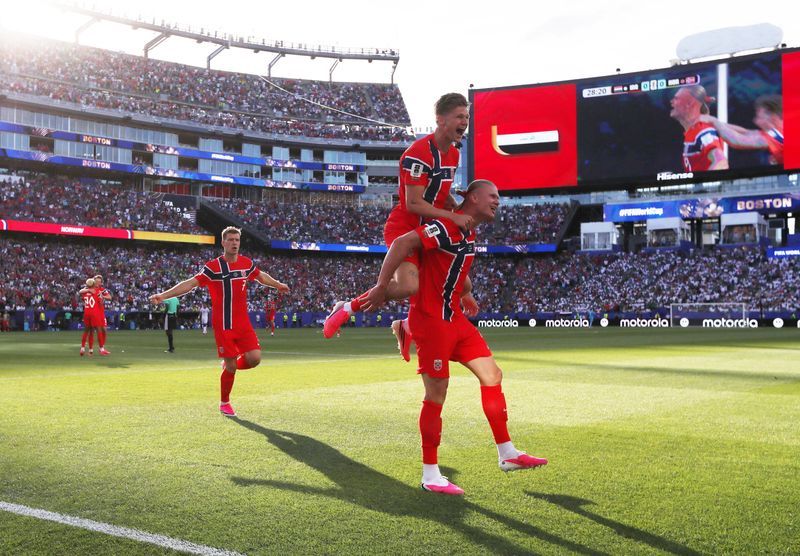
Erling Haaland introduced himself to World Cup football in devastating fashion on Tuesday, netting twice as Norway overwhelmed Iraq 4-1 and signalled their intent to become genuine contenders in the tournament. The Norwegian striker's emphatic double in the opening half capped a display that vindicated his status as one of the sport's most lethal finishers, adding the World Cup finals to an already impressive list of competitions where he has scored on debut.
The 23-year-old's ability to deliver when the pressure mounts proved crucial for a Norwegian side making their first appearance at a men's World Cup in 28 years. That weight of expectation could have proven overwhelming, yet Haaland thrived under the scrutiny, demonstrating the composure and clinical finishing that has made him one of Europe's most coveted talents. His first-half goals effectively settled the contest, allowing Norway to manage the latter stages despite some defensive vulnerabilities that surfaced during the match.
Haaland's opening strike exemplified the art of positioning, as he converted David Moller Wolfe's cross from close range with the instinctive movement of a born goalscorer. His second showcased different qualities—reading the play to press the Iraqi defence, forcing an error that resulted in a wayward back-pass, and responding with lightning reflexes to block the goalkeeper's clearance attempt into the net. These contrasting finishes illustrated his complete repertoire as a forward, combining both tactical intelligence and raw predatory instinct.
For a Norwegian contingent that had endured more than a quarter-century of World Cup absence, the victory represented far more than three points in the group standings. It validated their return to the tournament's elite stage and provided genuine optimism that manager Stale Solbakken's team possessed the quality to progress beyond the initial knockout stages. The tactical philosophy underlying the team's approach became apparent from their setup—constructing play to funnel opportunities to their most dangerous weapon and trusting Haaland to capitalise on the moments created.
Yet the scoreline, whilst commanding, concealed some underlying concerns for the Norwegian management. The midfield often appeared loose and fragmented, with captain Martin Odegaard failing to impose himself on proceedings as expected from a player of his European credentials. Iraq's response through Aymen Hussein's equaliser laid bare defensive deficiencies, particularly moments when concentration wavered and opponents found space near the box. Should Norway face opposition of France or other heavyweight calibre, these weaknesses could prove punishing.
The comparative strength of their group became apparent when France's 3-1 victory over Senegal on the same day created a fascinating dynamic. Norway's three points positioned them marginally ahead of the French side on goal difference—a precarious perch that underscored how tightly competitive this group appeared. With the defending champions lurking, Haaland's early burst proved timely, establishing momentum before facing genuine heavyweight opposition.
Haaland's reticence with the media contrasted sharply with the volubility of his performances on the pitch. Rather than offering lengthy interviews or soundbites, the Norwegian forward permits his goals to articulate his message. This approach resonated with Norwegian football culture and the national temperament, where actions speak louder than words. Yet when he did address the gathered press, his message carried authority—acknowledging that his team would require significant improvement despite the victory, a reality check that suggested maturity alongside his exceptional talent.
The concept that teams rather than individuals win tournaments, as Norwegian Prime Minister Jonas Gahr Stoere observed before the match, took on deeper meaning watching Norway's performance. Whilst Haaland's brilliance undoubtedly shaped the contest's outcome, his teammates' primary function appeared to be engineering scenarios where he could operate. This concentration of responsibility on one player's shoulders represents both opportunity and vulnerability—opportunity because Haaland possesses the technical excellence to exploit openings, yet vulnerability because overreliance on a single performer invites strategic targeting from opponents.
Norway's return to the World Cup after the lengthy absence generated palpable emotion throughout the nation, with celebrations in Scandinavia reflecting the magnitude of the achievement. Qualification itself had represented a demanding journey through the qualifying campaign, and reaching the finals marked a watershed moment for a football nation previously accustomed to tournament exclusion. Haaland's starring role in this comeback narrative transformed him into something beyond merely an exceptional athlete—he became a symbol of national resurgence and ambition.
The striker's personal achievement in scoring on debut across multiple elite competitions—from the Bundesliga to the Premier League to the Champions League and now the World Cup—represents a remarkable statistical feat. Few players across football history have maintained such consistency in finding the net immediately upon arrival in new environments. This pattern suggests a mentality specifically calibrated for high-pressure situations and suggests Haaland possesses psychological attributes matching his physical and technical gifts.
Looking ahead, Norway faces the daunting prospect of navigating a group containing France, with their credentials as defending champions and their demonstrated attacking prowess against Senegal. The Scandinavian side's margin for error has effectively evaporated, meaning subsequent matches require both improved performances and continued goals from their talismanic striker. Haaland's early announcement of his World Cup presence provides foundation, yet tournaments demand consistency across multiple fixtures.
For Malaysian and Southeast Asian football enthusiasts, Haaland's emergence as a World Cup force carries implications for the competitive balance of the tournament. His talent elevation reminds observers that depth of elite talent across multiple nations continues to expand, concentrating quality amongst accomplished individual performers distributed across competing nations. Norway's capacity to mount a genuine challenge will ultimately depend not solely on Haaland's contributions but upon whether supporting cast members elevate their performances sufficiently to provide genuine assistance.