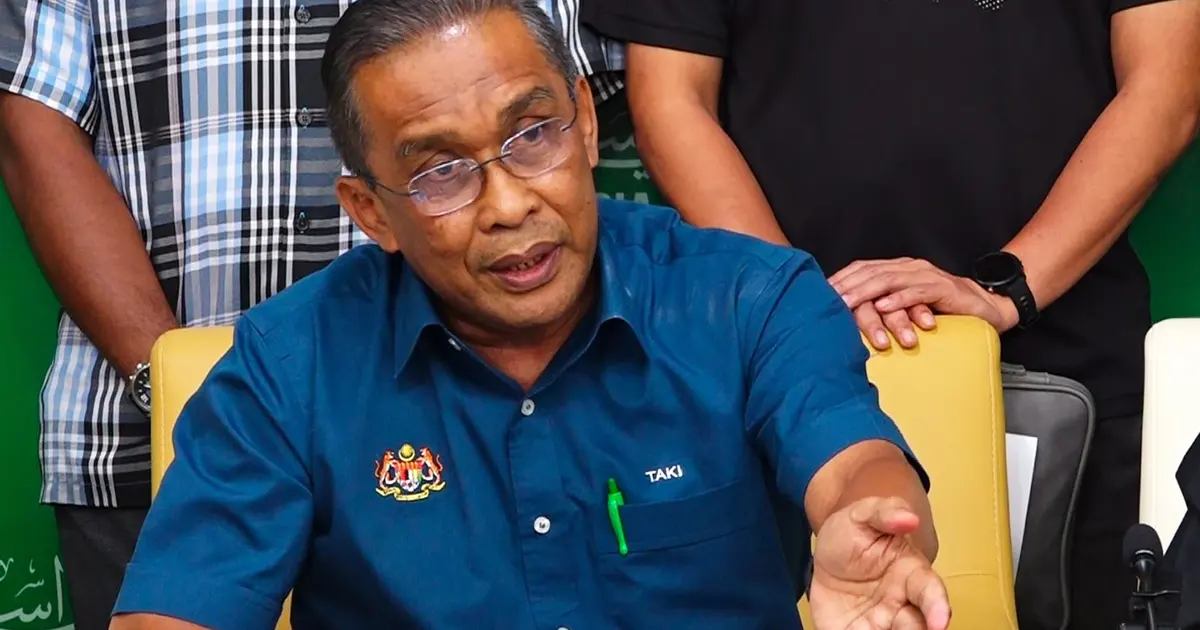
Takiyuddin Hassan, serving as chief whip for Perikatan Nasional, has submitted official notification to the Speaker of the Dewan Rakyat regarding Hamzah Zainuddin's appointment as the opposition leader. The transition marks a significant development in Malaysia's parliamentary mathematics, with 61 opposition members of parliament having formally agreed to the arrangement. The appointment became effective immediately upon notification, signalling a consolidated shift in the opposition's leadership structure.
Hamzah Zainuddin's elevation to the opposition leadership role represents a notable return to prominence for the former Bersatu deputy president. His trajectory through Malaysian politics has encompassed various high-profile positions, and this appointment underscores his continued influence within the broader opposition coalition. The consensus among the 61 MPs supporting his appointment suggests a degree of unity that opposition blocks in Malaysia often struggle to maintain, particularly given the fractious history of inter-party dynamics.
The move carries substantial implications for parliamentary proceedings and the dynamics of government scrutiny. As opposition leader, Hamzah assumes responsibility for coordinating legislative strategy, leading parliamentary questioning of the government, and directing the opposition's overall political narrative. These functions are critical in a Westminster-style parliamentary system, where the opposition serves as an institutional check on executive power. The formal notification through the chief whip ensures that parliamentary protocols are observed and that all procedural recognition devolves appropriately to the new leadership.
Penikatan Nasional's decision to orchestrate this transition reflects broader calculations within the opposition coalition regarding electoral positioning and internal consolidation. The successful coordination of 61 MPs around a single leadership candidate demonstrates organisational capacity that has historically eluded Malaysian opposition movements. This cohesion, even if achieved for a specific purpose, may provide a foundation for more coordinated opposition activity in subsequent parliamentary sessions.
The appointment also occurs within the context of Malaysia's political realignment following recent electoral cycles. Bersatu, the party from which Hamzah derives his previous position, has occupied shifting alliances across government and opposition benches. Hamzah's re-emergence as opposition leader may signal a consolidation of Bersatu's positioning within the opposition framework, particularly given the party's historical difficulty in maintaining consistent coalition arrangements.
For Malaysian parliamentary observers, this development highlights the continuing importance of numerical control in the Dewan Rakyat. The 61 MPs supporting Hamzah represent a substantial portion of the opposition benches, and their unified backing provides the opposition leader with a credible mandate for parliamentary operations. This numerical strength translates into increased leverage in parliamentary debates, more substantial representation in parliamentary committees, and greater capacity to influence legislative outcomes through procedural mechanisms.
The implications extend beyond immediate parliamentary procedure to encompass the broader political landscape heading toward future electoral contests. An organised opposition with coherent leadership can more effectively articulate alternative policy positions, conduct sustained government scrutiny, and mobilise electoral support. Hamzah's appointment thus carries significance for opposition prospects in potential general elections or state-level contests that may occur during his tenure.
Regional observers of Malaysian politics will note that stable opposition leadership structures remain relatively rare in Southeast Asia, where coalition fragmentation frequently undermines opposition effectiveness. The success in appointing Hamzah through consensus-building among a substantial parliamentary bloc suggests that Malaysian opposition parties have learned lessons from previous fragmentation. The capacity to identify acceptable leadership candidates and coordinate parliamentary voting behaviour indicates institutional maturation within the opposition framework.
The formal notification process through Takiyuddin and the chief whip's office demonstrates that procedural propriety accompanies this political transition. Malaysian parliamentary conventions require that opposition leader appointments be formally communicated to the Speaker's office, ensuring that official parliamentary records accurately reflect leadership transitions. This procedural formality adds legitimacy to the appointment and ensures that all parliamentary machinery acknowledges Hamzah's new status in coordinating opposition business.
Moving forward, Hamzah's effectiveness as opposition leader will likely determine whether the 61-MP coalition can sustain its unity and convert parliamentary support into policy influence. The opposition leader's role extends beyond symbolic authority to encompassing practical coordination of parliamentary strategy, management of internal coalition dynamics, and articulation of oppositional perspectives on government policy. Success in these areas could strengthen the opposition's electoral positioning and enhance its parliamentary relevance.
The appointment ultimately reflects Malaysian politics' perpetual tension between coalition-building imperatives and internal party competition. By securing consensus among 61 MPs, the opposition has demonstrated capacity for strategic coordination. However, whether this coordination persists beyond the immediate appointment period remains an open question. Historical precedent suggests that Malaysian opposition coalitions face constant pressure from internal rivalries and divergent policy preferences, challenges that even capable opposition leadership struggles to overcome.