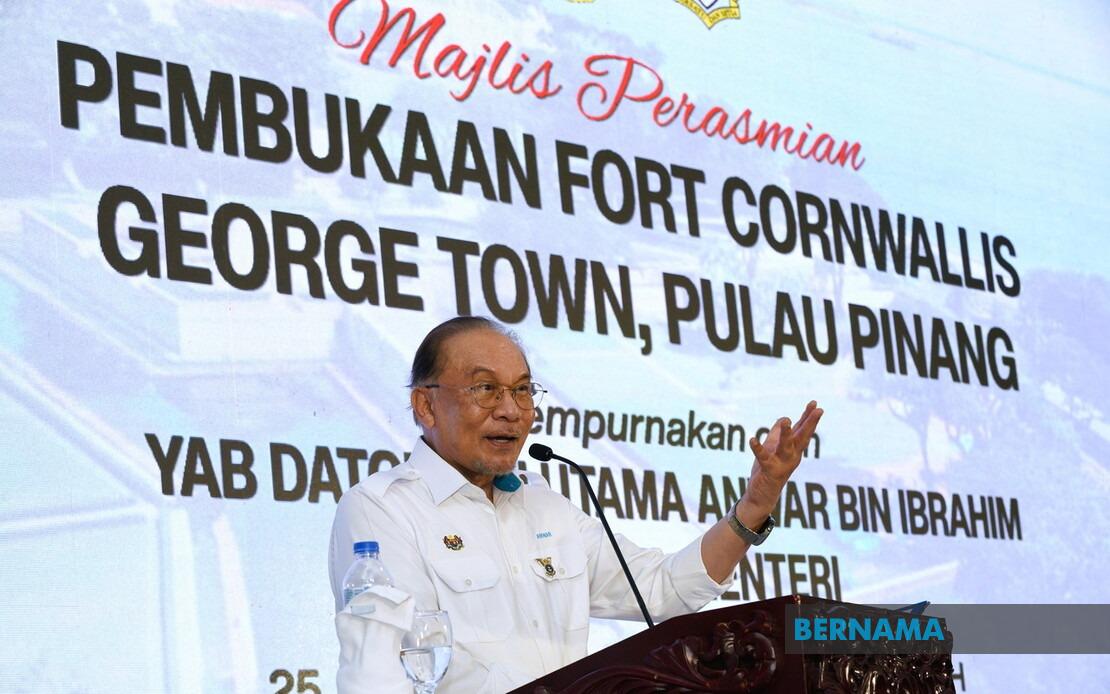
Prime Minister Datuk Seri Anwar Ibrahim has called for a fundamental shift in how Malaysia approaches its historical heritage, arguing that monuments and sites should serve primarily as classrooms for national consciousness rather than entertainment venues. Speaking at the opening ceremony of Fort Cornwallis in George Town on July 25, Anwar stressed that historical preservation must prioritise education about the nation's journey toward independence and the lessons of colonialism, moving beyond the superficial appreciation of architectural aesthetics that typically characterises heritage tourism.
The Prime Minister's remarks signal a deliberate pivot away from the conventional model of heritage conservation that has dominated Southeast Asia for decades. Rather than packaging historical sites as photo opportunities and consumer experiences, Anwar envisions these locations as platforms for transmitting deeper national narratives to younger Malaysians who have no lived memory of colonial rule or the independence struggle. This reframing reflects broader concerns across the region about generational disconnection from founding historical experiences and the risk of historical amnesia in societies increasingly oriented toward consumption and modernisation.
Anwar emphasised that young people visiting such sites should encounter structured educational content explaining the sacrifices made by earlier generations and the price paid for national sovereignty. He recommended that tour guides, curriculum designers, and heritage authorities work collaboratively to ensure that every youth visit to historical locations incorporates substantive historical lessons alongside visual appreciation. This approach requires investment in interpretive frameworks, trained educators, and age-appropriate pedagogical materials that can translate complex colonial histories into meaningful learning experiences.
A critical dimension of Anwar's argument centres on reclaiming historical narrative from colonial perspectives. He contended that Malaysia's history must be presented through the lens of local experience, resistance, and suffering rather than through interpretations established by former colonial powers. This decolonisation of historical discourse has gained momentum across Asia, with scholars and policymakers increasingly recognising that colonial-era narratives often minimised indigenous agency and framed colonialism as civilising rather than exploitative. By repositioning Fort Cornwallis and similar sites as venues for counter-narratives, Malaysia can shape how its citizens understand their own past.
The Prime Minister explicitly stated that preserving Fort Cornwallis was not intended to glorify colonialism but to facilitate critical engagement with that era. This distinction matters considerably because heritage conservation can inadvertently romanticise or sanitise troubling histories if not paired with candid educational messaging. By framing the fort's conservation as an opportunity to confront difficult history rather than celebrate it, Anwar positions Malaysia alongside other post-colonial nations attempting to balance preservation with moral clarity about colonial-era injustices.
Anwar's emphasis on unity holds particular resonance for Malaysia's multiethnic society. He suggested that historical education should underscore how external domination becomes possible when internal divisions weaken collective resistance. This message carries implicit contemporary relevance, suggesting that racial and communal harmony represent not merely desirable social goods but essential components of national resilience and independence. By anchoring national unity in historical experience rather than abstract principle, Anwar appeals to a shared understanding of struggle and sacrifice that transcends ethnic and religious boundaries.
The initiative also addresses what educators increasingly recognise as a gap in Malaysian curriculum. Formal schooling often treats history as a subject to be examined rather than as lived experience to be deeply understood. Heritage sites offer opportunity for experiential learning that can complement classroom instruction, allowing students to physically inhabit the spaces where historical events occurred and thereby develop more visceral connections to national narratives. This pedagogical approach has proven particularly effective with younger learners who respond to multisensory, immersive educational experiences.
For Malaysian policymakers and heritage authorities, Anwar's remarks establish a mandate to reconsider visitor management, interpretation strategies, and institutional priorities at historical sites across the country. This could translate into increased funding for educational programming, employment of trained historians and educators at heritage locations, development of curriculum-aligned educational materials, and integration of historical sites into the formal school system through organised educational visits with structured learning objectives. Such investment requires budget allocation that competes with other priorities in resource-constrained government contexts.
The broader implications extend beyond individual monuments to encompass how Malaysia positions itself as a nation with a distinctive history worthy of sustained attention and reflection. In an era when heritage tourism increasingly commodifies history into consumable experiences, Anwar's insistence on educational substance represents a countervailing vision prioritising citizenship formation and historical consciousness. This approach aligns with growing recognition across Southeast Asia that historical knowledge constitutes a form of cultural and political capital essential for informed democratic participation.
For regional observers, Malaysia's shift toward educational approaches to heritage conservation offers a model for other post-colonial societies grappling with similar questions about how to narrate national histories and use physical heritage as vehicles for contemporary nation-building. The model also reflects confidence that younger Malaysians exposed to candid historical education will develop deeper commitment to the values—unity, independence, and democratic governance—that the Prime Minister identifies as central to national survival and flourishing.

