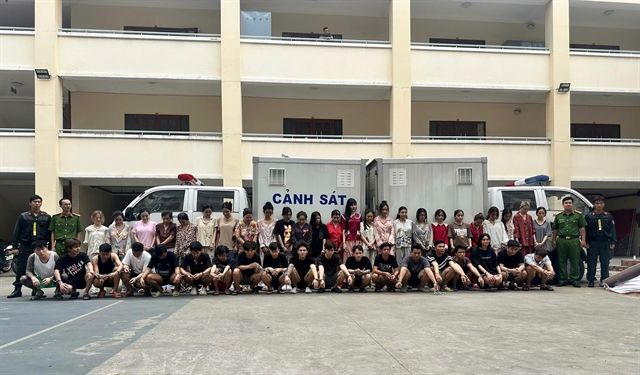
Ho Chi Minh City's drug enforcement division has dismantled what appears to be a sophisticated trafficking operation centred on disguising dangerous substances within everyday vaping devices. The arrest of 49 suspects, which concluded recently, represents a coordinated crackdown against what authorities characterise as a particularly insidious distribution network that deliberately targeted young people in entertainment venues. The scale of the operation, with 1,670 vape pods recovered alongside hundreds of grams of ketamine and methamphetamine, underscores the growing challenge Southeast Asian authorities face in policing novel drug delivery mechanisms.
The substance at the heart of the investigation is etomidate, a potent surgical anaesthetic that exists in a regulatory grey zone in many jurisdictions. Vietnam's government formally classified it as a controlled substance only in January, a relatively recent decision that reflects the speed at which criminal entrepreneurs adapt to exploit gaps in drug regulation. This short-acting sedative, normally administered only in hospital settings under strict medical supervision, has emerged as an attractive target for traffickers precisely because it falls outside the detection capabilities of standard street-level drug testing kits. The timing of its listing suggests Vietnamese authorities were playing catch-up with organised crime networks already well-established in distribution.
What distinguishes this operation from conventional drug trafficking is the deliberate marketing strategy employed. The seized vape pods carried brand names designed to appeal directly to recreational users seeking stress relief or sleep aids: "chill pod," "relaxation pod," "sleep-well pod," and "fly pod." This nomenclature reflects sophisticated understanding of consumer psychology and the normalisation of vaping among young Southeast Asians. The products were apparently sold at premium prices, suggesting the distributors understood their customer base well enough to position the offerings as luxury wellness items rather than illicit drugs. This branding strategy makes the operation resemble legitimate supplement marketing more than traditional narcotics trafficking, which likely aided its initial expansion.
The distribution infrastructure uncovered by police reveals a multi-layered supply chain extending across international borders. The investigation began with a relatively small-scale retailer, Nguyen Huu Huan, operating from An Duong Vuong Street, who was identified through street-level intelligence. His arrest on June 25, alongside his wife Ngo Thi Kim Chi, triggered investigations that exposed upstream suppliers. Two distinct networks fed product to Huan's operation, demonstrating the compartmentalisation typical of successful trafficking organisations. One network, headed by Huynh Ngoc Thuy Nhu and assisted by Hua Tuong Vy, operated within Ho Chi Minh City itself, suggesting local distribution infrastructure. The other, led by Le Quoc Duy from An Giang province, established a cross-border smuggling route through Cambodia, exploiting the porous frontier areas that have long challenged regional law enforcement.
The transnational dimension of the network highlights vulnerabilities in the Greater Mekong Subregion's drug control mechanisms. Le Quoc Duy's operation specifically trafficked products through small border crossings in his province, a methodical approach that suggests routine operations rather than one-off smuggling attempts. The recovery of 37 vape pods, 200 grams of ketamine, and 200 grams of methamphetamine from his premises indicates the operation maintained multiple drug lines simultaneously, a pattern consistent with professional criminal organisations rather than opportunistic dealers. Meanwhile, a fourth network led by Han Kiat, a Cambodian national, specifically targeted foreign residents in Ho Chi Minh City, suggesting sophisticated market segmentation and clientele cultivation.
The pharmacological danger posed by etomidate inhalation represents a critical public health consideration that extends beyond Vietnam's borders. Unlike nicotine, which affects the body gradually through the respiratory system, etomidate inhaled through vape devices bypasses normal absorption mechanisms entirely. The substance crosses directly from lung tissue into the bloodstream and reaches the brain within seconds, creating unpredictable pharmacokinetic effects. Initial users may experience what appears to be manageable symptoms: lightheadedness and mild hallucinations that could be mistaken for acceptable recreational effects. However, the window between these initial sensations and acute toxicity appears dangerously narrow. Neurotoxicity, severe drowsiness, muscle spasms, and loss of consciousness represent the acute phase, while the combination with alcohol or other central nervous system depressants creates genuine overdose risk with respiratory arrest and death as documented outcomes.
The marketing of etomidate as undetectable constitutes perhaps the most troubling aspect of the operation's methodology. Criminals explicitly advertised the substance as leaving no trace that rapid drug testing kits could identify, a claim with substantial technical validity. Standard field test kits available through legitimate suppliers detect traditional drugs by their characteristic chemical reactions, but etomidate's molecular structure simply does not trigger these reagent responses. Only sophisticated forensic analysis systems operated by specialised police laboratories can reliably identify the substance, a reality that criminals weaponised against both users and law enforcement. This created a situation where young people could convince themselves they possessed an undetectable product, removing a psychological barrier to consumption, while simultaneously rendering street-level intervention nearly impossible without advanced laboratory backup.
The appeal of etomidate-laced vapes to young consumers reflects broader trends in Southeast Asian drug use patterns that authorities in the region must confront. Vaping enjoys substantial normalisation and perceived legitimacy among younger demographics across the region, with e-cigarette devices integrated into youth culture and social settings. Combining this acceptance with a substance that produces sedative effects creates psychological conditions favourable to adoption. Entertainment venues, karaoke establishments, and rental apartments popular with young people represented the identified distribution points, venues where substances promising relaxation or enhanced social experiences would encounter receptive markets. The operation exploited exactly this intersection between technology adoption, recreational drug seeking, and social environments where substance use carries reduced perceived risk.
The operational sophistication displayed across the network suggests this represented established criminal enterprise rather than ad-hoc trafficking. The compartmentalisation of supply chains, the targeting of specific customer demographics, the use of border smuggling infrastructure, and the explicit marketing around legal vulnerabilities all indicate actors with substantial experience in drug distribution. The presence of organised criminal groups from neighbouring countries—specifically Cambodian and Chinese nationals—suggests connections to transnational organised crime syndicates rather than purely domestic operations. This pattern should concern not only Vietnamese authorities but regional law enforcement agencies throughout Southeast Asia, as it indicates the emergence of international networks capable of responding quickly to regulatory changes and exploiting regulatory gaps across jurisdictions.
The investigation's success in identifying and dismantling this network provides tactical intelligence valuable for regional law enforcement, yet also illustrates persistent structural challenges. The ease with which traffickers crossed borders at An Giang province's small crossing points, the rapid commercialisation of newly controlled substances, and the ability of marketing strategies to overcome public health warnings all suggest that Vietnam and regional neighbours face an ongoing adaptation cycle. As authorities develop detection capabilities and regulatory frameworks for etomidate, criminal networks will likely shift to alternative novel psychoactive substances or delivery mechanisms. The case demonstrates that supply-side enforcement, while operationally successful in individual instances, cannot alone address the underlying demand or the entrepreneurial capacity of organisations to innovate around legal restrictions. Comprehensive responses would require sustained cross-border cooperation, accelerated regulatory processes, consumer education campaigns specifically targeting young people, and continued investment in forensic capabilities across Southeast Asian law enforcement agencies.

