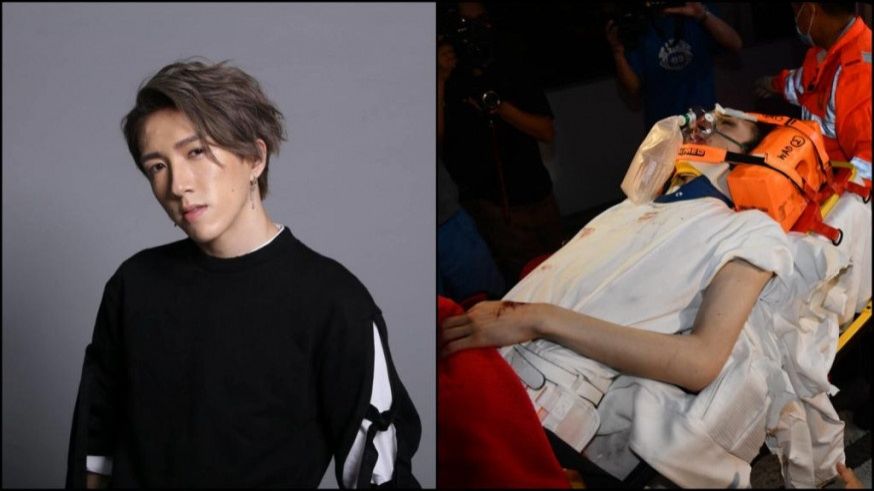
A Hong Kong District Court has awarded HK$6.29 million (equivalent to approximately RM3.32 million) in compensation to dancer Mo Li Kai-yin, who suffered catastrophic injuries when a four-by-four-metre LED panel collapsed during a concert performance. The June 15 ruling represents the maximum available damages across multiple compensation categories and provides some financial security for the 31-year-old, whose life has been irrevocably transformed by the accident. Mo's case has drawn regional attention as an unusual instance where the court delivered the full extent of damages sought, signalling the severity of the negligence that led to his permanent disability.
The incident occurred on July 28, 2022, during the fourth performance of a planned 12-concert residency by popular Cantopop boy band Mirror at Hong Kong Coliseum. During the show, the heavy screen detached from the ceiling and fell directly onto Mo, who was performing as a backup dancer. The impact caused severe spinal damage, leaving him paralysed from the neck down and requiring immediate emergency intervention. He was rushed to Queen Elizabeth Hospital for urgent surgery following diagnosis of cervical spine dislocation, beginning what would become an extensive and ongoing medical journey that continues to define his existence.
The District Court's judgment placed particular emphasis on the term "catastrophic disabilities," underscoring the profound nature of Mo's injuries and their permanent character. According to court findings, the dancer now requires three full-time caregivers available around the clock to assist with all aspects of personal care and daily living. The ruling explicitly noted that Mo has become entirely dependent on others and will never regain the capacity to live as an independent adult. This dependency extends across all domains of life, from basic hygiene and nutrition to mobility and medical management, making the requirement for 24-hour care both comprehensive and non-negotiable.
Beyond the headline compensation figure, the court awarded damages across several specific categories reflecting different dimensions of Mo's losses and ongoing needs. The judgment included maximum payments for permanent total incapacity, the substantial costs associated with round-the-clock caregiving, periodic payments to address his long-term requirements, and medical expenses both past and future. The structured nature of these awards reflects the court's recognition that Mo faces not a single financial impact but rather a lifetime of compounding costs related to his condition. Additionally, the court ordered Studiodanz, the dance company identified as his employer, to cover all legal costs incurred in pursuing the claim, effectively making the company bear the financial burden of the judicial process itself.
Studiodanz's employer liability became central to the case, with the District Court determining that the company bore responsibility for the accident. Notably, the company did not participate in the trial proceedings, a decision that may have limited its ability to contest liability findings. Beyond the civil compensation, Studiodanz had previously faced regulatory consequences, including a fine of HK$132,000 for violations of occupational safety regulations. The company's apparent failure to implement adequate safety protocols for stage equipment and performance environments contributed directly to the circumstances that injured Mo. The combination of civil damages and regulatory penalties suggests systemic safety failures rather than isolated negligence.
Prior to the accident, Mo had been building a professional dance career that spanned multiple performance contexts. He discovered his passion for dance while attending university between 2015 and 2019, and transitioned to full-time professional work in 2019. His portfolio included performances at concerts, television programmes, commercials, and music videos, complemented by dance instruction positions at four different studios including Studiodanz itself. This multifaceted career reflected both his talent and the versatility demanded by Hong Kong's entertainment industry, generating reasonable income and professional fulfilment that the accident completely eliminated.
Mo's recovery journey since the accident has involved continuous medical intervention and rehabilitation spanning multiple years and jurisdictions. Following initial emergency treatment at Queen Elizabeth Hospital, he transferred to private medical facilities across Hong Kong and internationally, where he has undergone repeated surgeries and intensive rehabilitation programmes. His treatment has incorporated advanced therapeutic technologies including regenerative medicine approaches and an implantable microstimulator designed to restore some functional capacity. These cutting-edge interventions represent significant financial investments reflecting the family's determination to explore every possible avenue toward recovery, investments that the compensation award helps sustain.
The personal toll on Mo's family has been substantial, particularly affecting his father, Reverend Derek Li Shing-lam. Initially residing in Canada, Reverend Li made the difficult decision to abandon his pastoral responsibilities and return to Hong Kong to serve as his son's primary caregiver. This self-sacrifice continued until Reverend Li's death on April 25, after which the care burden shifted to professional caregivers funded through a combination of the compensation award and ongoing family resources. The family's experience illustrates how catastrophic personal injuries ripple outward, disrupting the lives and plans of multiple family members across generations.
Despite the severity of his condition, Mo has achieved modest but meaningful functional gains through persistent rehabilitation efforts. He has regained some movement capacity in his right arm, a development that represents significant progress toward limited functional independence. Additionally, he has recovered sensation in bladder and bowel functions, improvements that reduce medical complications and enhance quality of life. A March video posted on his Instagram account documented him operating an electric wheelchair using his right hand, demonstrating that he has retained sufficient motor control to navigate independently within his immediate environment. These incremental improvements, though falling far short of full recovery, provide evidence that targeted rehabilitation continues producing measurable benefits.
The case carries broader implications for workplace safety standards throughout the entertainment industry, both in Hong Kong and across Southeast Asia. The accident exposed significant gaps in safety protocols for large-scale stage equipment, failures that affected not only Mo but could have endangered other performers and audience members. The court's maximum damages award sends a message about the serious consequences of such negligence, potentially encouraging entertainment venues and production companies to invest more substantially in equipment maintenance, safety inspections, and worker protection measures. For Malaysian readers, the case serves as a cautionary reminder about the importance of rigorous safety compliance in large-scale entertainment productions, particularly those involving heavy suspended equipment or complex staging.
The compensation award, while substantial by regional standards, represents only partial redress for Mo's permanent losses. No financial compensation can restore his mobility, independence, or the career trajectory interrupted by the accident. The HK$6.29 million will fund his care needs and medical treatments across what will likely be a normal lifespan, but it cannot reverse the fundamental life alteration that occurred in a single moment of negligence. Mo's case exemplifies the sometimes inadequate relationship between financial compensation and human loss, even when courts award maximum available damages. For those in the entertainment industry throughout Asia, it underscores the critical importance of safety culture and equipment maintenance as non-negotiable professional responsibilities.

