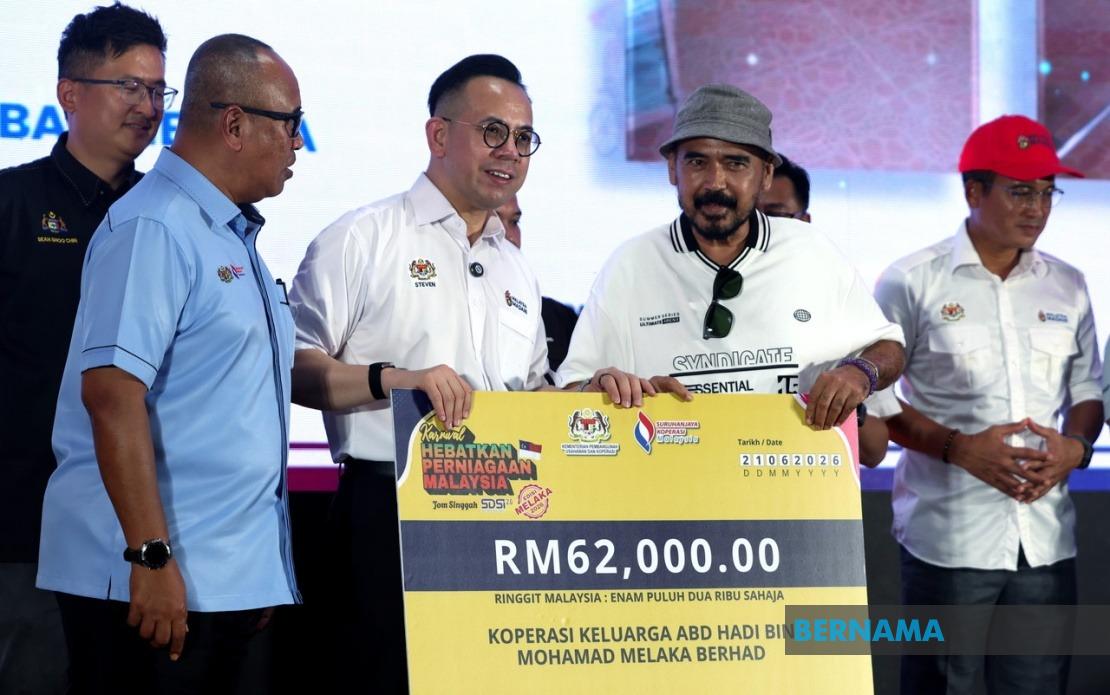
Malaysia's Empowering Malaysian Businesses Carnival (Karnival Hebatkan Perniagaan Malaysia 2026), a three-day initiative held in Melaka from June 19 to 21, has demonstrated significant momentum in supporting the nation's entrepreneurial ecosystem by generating RM8.45 million in combined business matching value and financing potential. The Ministry of Entrepreneur Development and Cooperatives confirmed that the event successfully attracted 70,000 visitors while simultaneously creating tangible commercial opportunities for participating enterprises and aspiring business owners.
The carnival's reach extended beyond mere foot traffic, as vendors recorded direct product sales totalling RM532,802.77 throughout the duration of the event. This figure underscores the event's practical value as a marketplace where entrepreneurs can directly engage with consumers and test market reception for their offerings. For small business operators particularly, such venues provide crucial opportunities to bypass traditional retail barriers and access wider customer bases without the substantial overhead costs associated with conventional storefronts. The direct sales component therefore represents not just revenue generation but also valuable market intelligence and customer validation for participating enterprises.
The cornerstone of the carnival's impact lies in its structured business matching programme, which created 72 dedicated sessions pairing 25 potential entrepreneurs with established business contacts and investors. Through these interactions, RM6.4 million in tangible business matching value was recorded—representing concrete partnerships, supply chain agreements, franchise opportunities, and collaborative ventures that extend beyond the carnival itself. These business matching sessions function as networking accelerators, enabling entrepreneurs to forge relationships that might otherwise take months or years to develop through traditional channels, thereby compressing the timeframe for business expansion and partnership formation.
Financing accessibility emerged as another crucial outcome of the carnival. Fifty-five micro, small and medium enterprises participated in dedicated financial interaction sessions that yielded RM2.05 million in potential financing commitments. This component directly addresses one of the most persistent challenges faced by Malaysia's MSME sector: capital accessibility. By bringing lenders, financial institutions, and government financing agencies together with borrowers under one roof, the carnival reduces information asymmetries and transaction costs that typically impede SMEs from securing adequate funding. The financing potential recorded during these sessions suggests that participating enterprises may soon gain improved access to credit for expansion, equipment acquisition, or working capital needs.
The HPM 2026 carnival series forms part of a broader strategic agenda termed Hebatkan Perniagaan Malaysia, championed by Minister Steven Sim Chee Keong of the Ministry of Entrepreneur Development and Cooperatives. This initiative operationalises the ABCD framework—Accelerating Productivity, Bureaucracy Reduction, Capital Accessibility and Developing Market Access—a comprehensive approach designed to address systemic constraints limiting local enterprise development. Rather than piecemeal interventions, the ABCD agenda recognises that Malaysian businesses face interconnected challenges requiring coordinated solutions spanning operational efficiency, regulatory simplification, funding availability, and market expansion.
From a regional perspective, the carnival's success carries implications for Southeast Asia's broader competitiveness. As nations compete to develop their entrepreneurial talent and create dynamic SME sectors, initiatives like HPM 2026 demonstrate Malaysia's commitment to institution-building in the private sector. The carnival model—combining matchmaking, financing opportunities, direct sales venues, and capacity-building—represents a cost-effective approach that other ASEAN countries may adapt. For Malaysian entrepreneurs and business associations, it signals that government support for private enterprise extends beyond regulatory frameworks to include proactive facilitation of business development opportunities.
The geographical sequencing of the carnival series also reveals strategic intent. Following the Melaka event, the third installment is scheduled for Penang from July 17 to 19 at the Penang Waterfront Convention Centre, extending the initiative beyond the central region. This multi-location approach ensures that entrepreneurs across different states can access the same opportunities without bearing substantial travel costs. Penang's position as an industrial and technology hub makes it a logical subsequent venue, potentially attracting different enterprise profiles and generating distinct business matching outcomes reflecting the state's economic character.
The carnival's integrated platform architecture—combining marketplace functions, mentoring, financing interactions, and business matching—reflects contemporary understanding that enterprise development requires ecosystem orchestration rather than isolated interventions. For participating MSMEs, the event provides what researchers term a "business support constellation," where multiple support functions become accessible simultaneously. An entrepreneur might simultaneously explore retail opportunities, network with potential partners, and investigate financing options—activities that would normally require separate engagements scattered across different locations and timeframes.
Looking ahead, the RM8.45 million in identified business potential will determine the carnival's true success based on conversion rates. The real measure lies in how many of the business matching opportunities translate into lasting partnerships, and how many financing commitments convert into actual disbursed capital supporting business growth. Monitoring these conversion metrics will provide crucial data for optimising future carnivals and identifying where enterprises encounter implementation barriers after initial matchmaking. For Malaysian policymakers and the entrepreneurial ecosystem, the Melaka carnival establishes a benchmark for measuring whether such initiatives effectively address the capital and partnership constraints limiting MSME expansion.
The initiative also reflects Malaysia's evolving approach to enterprise development policy. Rather than limiting government involvement to regulation and tax collection, the HPM carnival demonstrates active state participation in creating marketplaces and facilitating transactions. This represents a shift toward enabling frameworks where government becomes a platform provider—creating infrastructure and convening power to connect dispersed market participants who might otherwise operate in isolation. For entrepreneurs, particularly those in non-urban areas or emerging sectors, such platforms can prove transformative by rendering previously inaccessible opportunities tangible and proximate.

