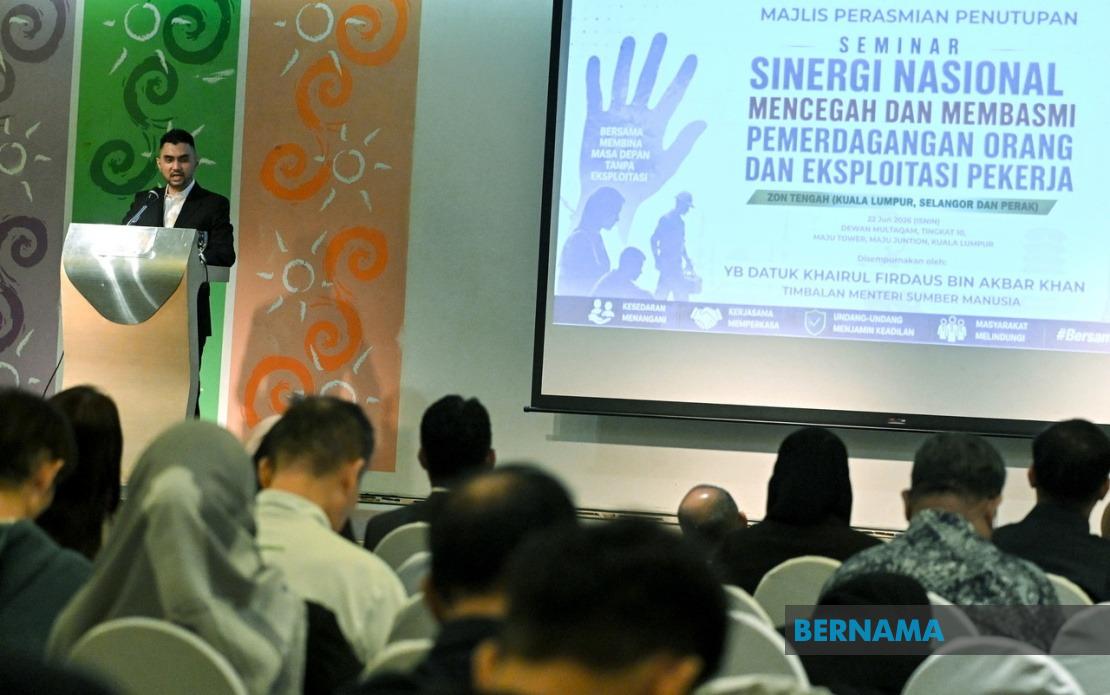
The number of human trafficking and labour exploitation victims rescued in Malaysia has trended downward over the past three years, according to Deputy Human Resources Minister Datuk Khairul Firdaus Akbar Khan, who attributes the improvement to intensified enforcement and prevention strategies deployed nationwide. Speaking after the closing ceremony of a major regional seminar on combating human trafficking in Kuala Lumpur, Khairul Firdaus highlighted statistical evidence suggesting that systematic government interventions are yielding measurable results in the fight against organised labour abuse.
Data compiled by the Peninsular Malaysia Manpower Department paint a picture of declining rescue operations across successive years. The department recorded 70 victims rescued during 2023, a figure that contracted sharply to just 10 in 2024. The trend reversed slightly with 17 rescues in 2025, though the pace has slowed considerably this year with only four cases reported between January and May 2026. While these numbers suggest progress, they raise important questions about the true prevalence of trafficking and exploitation occurring beyond official detection.
Khairul Firdaus exercised caution in interpreting the declining figures, cautioning that lower reported cases do not necessarily reflect a corresponding reduction in actual trafficking activity. The minister explicitly acknowledged the possibility that substantial numbers of victims remain hidden from authorities, either through lack of awareness, fear of deportation, linguistic barriers, or deliberate concealment by traffickers. This nuance is critical for policymakers and enforcement agencies across the region, as it underscores the danger of mistaking reduced reporting for genuine elimination of the problem.
The government's commitment to addressing forced labour has manifested in concrete operational measures throughout the first five months of 2026. Across Malaysia, authorities conducted 386 labour-related enforcement operations nationwide, resulting in the opening of 311 investigation papers. These figures demonstrate the scale of surveillance and investigative activity being directed at identifying and prosecuting those responsible for labour trafficking and exploitation. The breadth of operations suggests coordination across multiple jurisdictions and agencies, reflecting an institutional recognition of trafficking as a cross-border and complex criminal enterprise.
Malaysia's efforts align with international commitments made through the International Labour Organisation, whose protocols on forced labour the government has ratified. By tethering domestic anti-trafficking initiatives to global standards, the country positions itself within an international framework designed to harmonise prevention, prosecution, and victim protection approaches. This alignment matters particularly for a nation that serves as both a destination and transit point for migrant workers from across Southeast Asia and beyond, making coherent policy essential.
The National Synergy Seminar series represents the government's emphasis on awareness and inter-agency coordination as complementary tools to enforcement. The Central Zone gathering, held in Kuala Lumpur, constituted part of a broader national awareness campaign designed to educate stakeholders about the nature and consequences of human trafficking and labour exploitation. Prior regional seminars had convened participants in Sungai Petani, Kedah on May 18 and in Kluang, Johor on June 8, creating a distributed network of engagement across the peninsula.
These seminars drew nearly 1,000 participants in total, bringing together government officials, civil society representatives, labour unions, employers, and community leaders to discuss strategies for identifying and preventing trafficking. The forum-based approach acknowledges that combating trafficking requires sustained dialogue and information-sharing among diverse stakeholders, rather than enforcement alone. Participants used the platforms to exchange practical insights, relay local concerns, and develop collective solutions to challenges specific to their regions.
For Malaysian businesses and civil society, the declining rescue figures carry mixed implications. On one hand, fewer documented cases might suggest that heightened vigilance and enforcement pressure are making labour trafficking less viable or enticing for criminal networks. On the other hand, the persistence of even small numbers of rescues indicates that vulnerabilities in supply chains, labour recruitment processes, and workplace oversight remain unresolved. Companies engaged in industries with high migrant worker concentrations—such as manufacturing, agriculture, construction, and domestic service—should interpret these trends as a signal to strengthen internal compliance mechanisms and supplier audits.
The regional dimension cannot be overlooked. As Malaysian authorities intensify efforts against trafficking, adjacent countries within ASEAN face similar pressures and opportunities to coordinate action. The effective prosecution of trafficking networks often requires intelligence-sharing and mutual legal assistance, given that trafficking victims are frequently transported across borders as part of their exploitation. Malaysia's experience, reflected in these statistics and enforcement operations, offers both lessons and potential collaboration models for neighbouring nations wrestling with similar challenges.
Government messaging emphasising the decline in rescued victims must be received with the nuance that Khairul Firdaus himself articulated. The reduction reflects genuine progress, but it remains incomplete without systematic efforts to reach hidden victims and eliminate the underlying conditions—poverty, lack of regulatory oversight, demand for cheap labour—that create susceptibility to trafficking in the first place. The 386 enforcement operations and 311 investigation papers opened in just five months suggest sustained institutional commitment, yet their efficacy depends on consistent prosecution, victim support, and prevention work extending beyond formal rescues.
Looking forward, the challenge for Malaysia involves sustaining this enforcement intensity while expanding prevention work upstream. Community awareness, migrant worker education, employer accountability mechanisms, and stronger border controls all contribute to reducing trafficking occurrence rather than simply rescuing victims after exploitation has begun. The seminar series reflects this multi-layered approach, though translating awareness into systemic change requires long-term institutional investment and political will.

