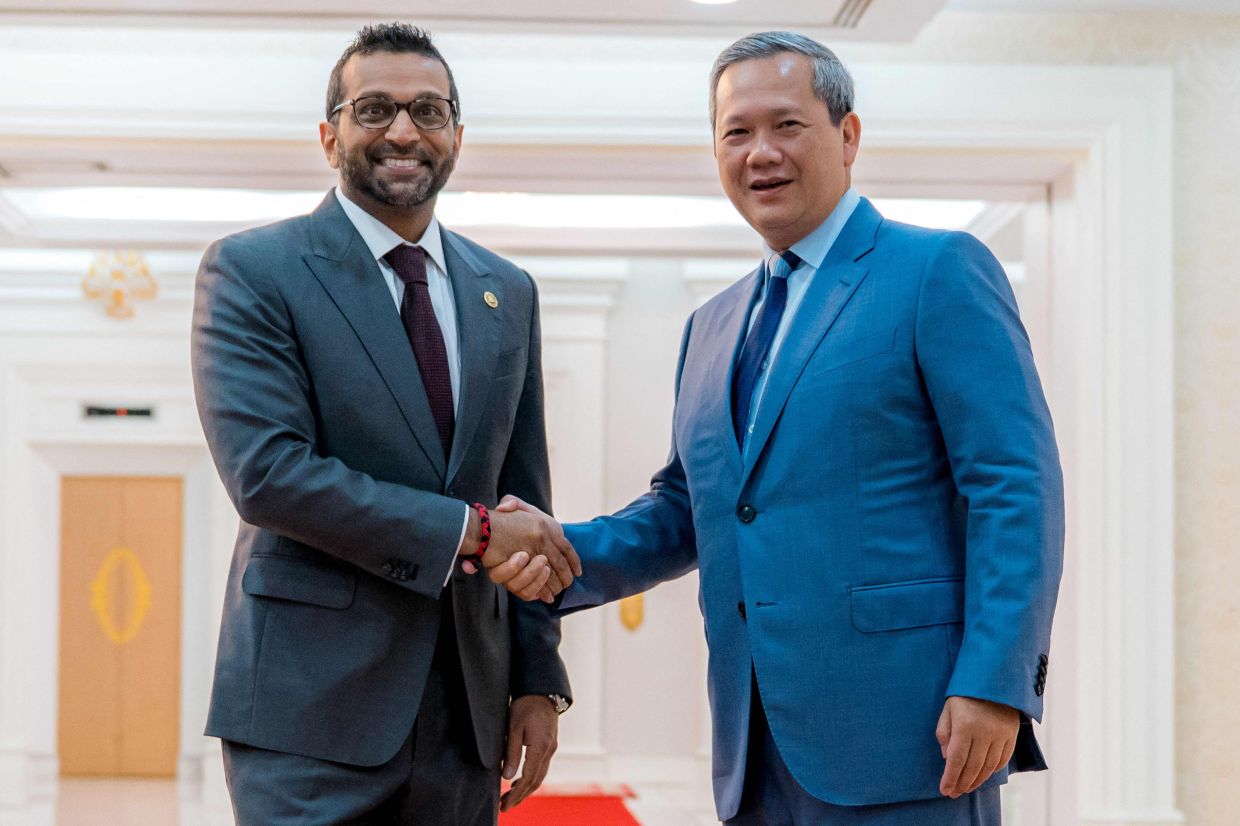
Cambodia's Prime Minister Hun Manet has intensified his government's commitment to dismantling the sprawling transnational scam networks that have transformed Southeast Asia into a global cybercrime epicentre, yet simultaneously acknowledged that criminal syndicates are growing more sophisticated by splintering into smaller, harder-to-track operational cells. Speaking during a recent interview with Bloomberg Television and following high-level discussions with US Federal Bureau of Investigation Director Kash Patel, Hun Manet indicated that Phnom Penh intends to render Cambodia an inhospitable environment for fraud operations, even as authorities grapple with the evolving nature of these criminal enterprises.
The Cambodian government has already dismantled more than 670 illicit scam operations, a figure Hun Manet highlighted as evidence of sustained enforcement action. Alongside this enforcement record, he emphasized that intelligence-sharing arrangements with major international law enforcement agencies have been expanded and deepened, reflecting Cambodia's recognition that cybercriminal networks operating across borders demand coordinated regional and global responses. This partnership framework, showcased by the recent FBI director's visit to Phnom Penh, signals American commitment to addressing what has become a multibillion-dollar criminal industry inflicting losses on citizens across multiple continents.
Hun Manet, a 48-year-old West Point graduate who assumed the premiership in August 2023, represents a generational shift in Cambodia's political leadership following his father Hun Sen's nearly four-decade tenure. The younger leader has cultivated an image emphasizing technocratic governance and modernization, yet has maintained firm political control through the ruling Cambodian People's Party, which has governed continuously since the Khmer Rouge's overthrow in 1979. Despite assuming the top executive position, Hun Sen retains considerable influence as President of the Senate and party chairman, illustrating Cambodia's transitional power dynamics.
The technological sophistication of contemporary scam operations poses particular challenges that conventional law enforcement struggles to address. Hun Manet acknowledged that criminal networks have adapted their structures and processes to exploit digital infrastructure, allowing geographically dispersed teams to coordinate fraudulent operations without maintaining centralized command structures. This decentralization strategy, he observed, fundamentally complicates the investigative and prosecutorial burden facing Cambodian and international authorities, as disrupting one operational node no longer necessarily collapses the entire network.
Cambodia, alongside Myanmar and Laos, has emerged as a primary regional hub for organized cybercrime following the pandemic's acceleration of digital adoption. These compounds, which combine sophisticated fraud operations with human trafficking and forced labour networks, have proliferated despite increased government enforcement. International human rights organizations and United Nations agencies have documented extensive involvement by individuals connected to Cambodia's political and commercial elite, suggesting that official protection and complicity enable the continued operation of these criminal enterprises at scale.
International pressure on Cambodia regarding scam compounds has intensified from both Washington and Beijing, reflecting the issue's significance to major powers. The United States has imposed sanctions against prominent Cambodian senators Ly Yong Phat and Kok An, citing their alleged involvement in human trafficking networks, forced labour schemes, and cyber fraud operations that have victimized American citizens. Hun Manet characterized these designations as ongoing legal matters subject to court processes, while asserting that state agencies actively investigate cases implicating both government officials and business executives regardless of their political connections.
The Prime Minister stated that his administration has pursued accountability measures including the dismissal and criminal prosecution of military generals and provincial governors implicated in scam-related activities. These claims require scrutiny against documented patterns suggesting that high-level political and military figures have historically maintained protective arrangements with organized crime networks. The specific individuals prosecuted and their proximity to ruling-party structures remain important details that would clarify whether current enforcement represents genuine systemic accountability or selective prosecution of rivals and lower-ranking officials.
The United Nations Office on Drugs and Crime released a report highlighting the staggering scale of these criminal operations, estimating combined losses from scams across East Asia, Southeast Asia, Australia and New Zealand reached approximately US$114 billion in the previous year. This figure underscores the economic devastation inflicted by networks that Cambodia and neighbouring countries host, with implications extending far beyond the region as victims span wealthy developed nations. The financial magnitude explains intensified international engagement and pressure on Cambodia to demonstrate substantive progress.
Beyond the scam issue, Hun Manet addressed the protracted boundary tensions with Thailand, urging immediate resumption of joint demarcation negotiations to facilitate the return of more than 20,000 internally displaced persons to their homes in contested border provinces. Although a ceasefire has held since conflict erupted approximately one year ago, the Prime Minister cautioned that the situation remains precarious given the continued deployment of thousands of troops in face-to-face configurations along the frontier. This military standoff perpetuates humanitarian costs and regional instability that directly impact Malaysian and broader Southeast Asian security architecture.
Disputing Thai assertions that Cambodia's pursuit of United Nations maritime conciliation proceedings justifies suspension of land-boundary negotiations, Hun Manet characterized such claims as factually inaccurate and diplomatically inappropriate. He emphasized that land demarcation and maritime dispute resolution operate as legally distinct matters under established bilateral frameworks, arguing that progress on terrestrial boundaries need not await resolution of maritime questions. This position reflects Cambodia's strategy of compartmentalizing different negotiation tracks to maintain diplomatic momentum despite fundamental disagreements.
Hun Manet's emphasis on compartmentalized negotiation and renewed engagement reflects broader Southeast Asian diplomatic patterns where states attempt advancing cooperation on specific issues despite unresolved tensions in other domains. For Malaysia and the broader region, Cambodia's trajectory regarding scam network dismantling carries direct implications, as these criminal operations frequently target Southeast Asian residents alongside international victims. The success or failure of Hun Manet's crackdown efforts will indicate whether regional states can collectively address transnational cybercrime or whether current enforcement remains insufficient against networks adapting through fragmentation and technological sophistication.

