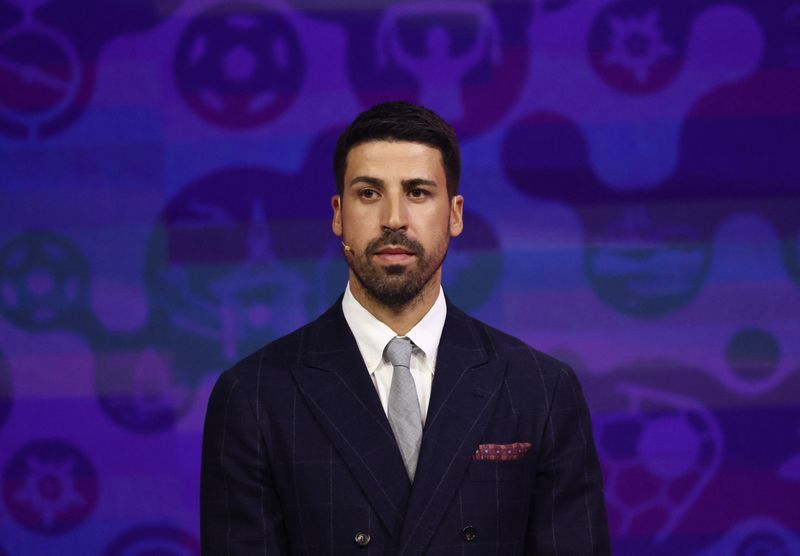
Sami Khedira, a stalwart of Germany's 2014 World Cup triumph, has weighed in on one of contemporary football's defining phenomena: siblings wearing different national jerseys at the global stage. Speaking at the Home of Football museum in New York, the midfielder offered a perspective coloured by his own lived experience straddling two cultures and two nations. Rather than viewing brothers competing for separate countries as an identity crisis or a dilution of national spirit, Khedira frames it as an authentic portrait of how modern families navigate belonging in an increasingly interconnected world.
Khedira's own journey informs this worldview. Born and raised in Germany to a German mother and Tunisian father, he carries both heritages as an integrated whole rather than as competing allegiances. His brother Rani currently represents Tunisia at the World Cup, the land of their paternal ancestry, while Sami chose Germany, his birthplace and childhood home. Yet Khedira insists this arrangement reflects neither confusion nor conflict, but rather the natural complexity of contemporary global identity. He acknowledges that his appearance and surname have occasionally prompted questions about his authenticity as a German, just as he might be perceived as foreign in Tunisia. His answer remains consistent: both nations claim space in his heart, and both are equally legitimate.
The 2026 World Cup will feature an unprecedented gathering of dual-nationality siblings, with eight sets of brothers competing across the tournament. Four pairs will play alongside each other for the same nation—Theo and Lucas Hernandez for France, Jurrien and Quinten Timber for the Netherlands, and Leandro and Juninho Bacuna for Curaçao. The other four represent a more intricate mosaic. Iñaki and Nico Williams, both Athletic Bilbao players, have chosen Ghana and Spain respectively, while Guela and Désiré Dué split between Ivory Coast and France. Derrick Luckassen and Brian Brobbey, brothers through their mother but carrying their fathers' surnames, represent Ghana and the Netherlands. Australia and Scotland will claim Harry and John Souttar, and Cape Verde will have both Laros and Deroy Duarte on its roster.
Khedira's perspective gained particular resonance during a recent friendly between France and Ivory Coast, where he witnessed Guela and Désiré Dué sing both national anthems before kick-off. That moment crystallised for him what football's multicultural dimension can communicate to the world. Far from diminishing the sport's meaning, such scenes amplify it by showcasing the emotional complexity that modern families navigate. For Khedira, this visibility matters profoundly. Football possesses a unique platform to broadcast messages beyond the ninety minutes, and when brothers stand united in acknowledging their dual heritage through simultaneous anthems, the sport transcends its competitive framework to become something more meaningful.
The expanded 48-team World Cup format has created additional opportunities for smaller footballing nations to compete on the world's grandest stage. Countries like Cape Verde, Curaçao, and Haiti now have realistic pathways to qualification that were previously foreclosed by the old 32-team structure. Khedira sees this expansion as beneficial not only for these nations but for global football's competitive health. He notes that African and Asian federations are progressively narrowing the traditional gap separating them from established European and South American powerhouses. Improved coaching infrastructure, more sophisticated player development programmes, and enhanced financial investment in grassroots facilities have all contributed to this levelling effect.
However, Khedira tempers this optimism with a critical observation about responsibility. Whilst developed European nations benefit substantially from accessing talented dual-nationality players, they must reciprocate by investing in football's development at the source rather than simply extracting talent. The responsibility flows both ways: wealthier federations should strengthen capacity in emerging footballing regions rather than viewing multicultural recruitment primarily as a tool for competitive advantage. This interconnected system only functions equitably when its privileged participants acknowledge their obligation to uplift the broader ecosystem.
The most challenging aspect of this landscape, Khedira contends, falls upon young players caught between competing claims from multiple federations. Teenagers and adolescents must navigate extraordinarily complex decisions at an age when they lack the maturity to fully comprehend the long-term implications of their choices. Political pressure, family heritage, national pride, and federation incentives all converge on these young athletes, creating an emotionally overwhelming environment. Khedira recalls his own experience at eighteen, when he confronted this decision with limited life experience to anchor such a consequential commitment.
For Khedira, the solution cannot be imposed through institutional pressure, political calculation, or ancestral obligation alone. Rather, the choice must emerge from something deeper and more personal—what he describes as a gut feeling that transcends geography or bureaucracy. Young players should be empowered to follow their internal compass rather than be coerced into serving others' agendas. Yet he simultaneously acknowledges the legitimacy of federations engaging respectfully with prospects, recognising that interest from a national programme can carry genuine significance.
This tension between autonomy and responsibility reflects football's broader evolution. The sport now encompasses not merely competition but also the articulation of identity, belonging, and cultural expression. When young players make international commitments, they engage in acts rich with personal, familial, and social meaning that extend far beyond tactical considerations. Khedira's intervention in this conversation stems from a recognition that football has become a vehicle through which contemporary questions about multicultural identity, national belonging, and personal authenticity find expression and resolution.
Ultimately, Khedira's message presents a hopeful vision of football as a space where complexity is embraced rather than eliminated. He celebrates the reality that modern players, increasingly born to parents from different nations and cultures, bring that diversity to the pitch as a strength rather than a complication. His own career, and his brother Rani's path, stand as testament to the possibility of carrying multiple flags authentically and without internal contradiction. For Malaysian and Southeast Asian readers observing players with similar multicultural backgrounds—increasingly common across the region—Khedira's perspective offers validation: navigating dual heritage need not represent a loss or a compromise, but rather an enrichment of football and of human experience itself.

