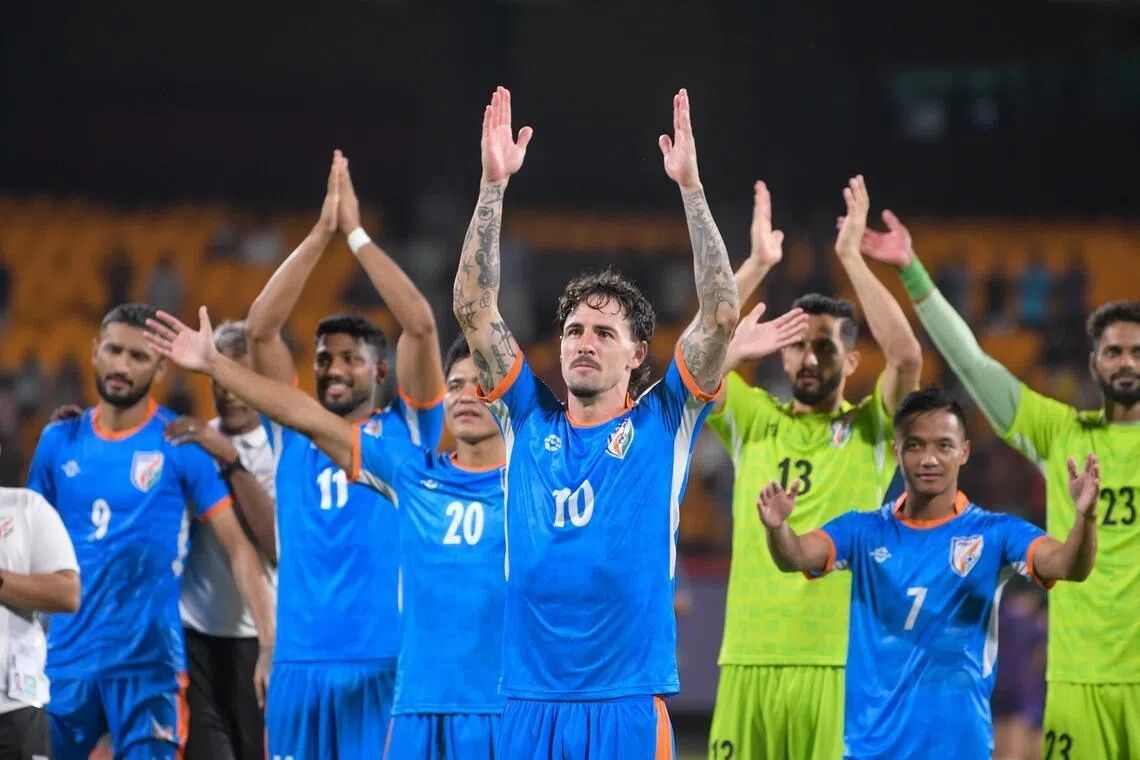
India is contemplating a radical shift in its sporting eligibility rules that could reshape the country's performance on the global stage. The Ministry of Youth Affairs and Sports has submitted a proposal to the Prime Minister's Office for a Sports Passport framework designed to permit Indian-origin athletes holding foreign citizenships—specifically Overseas Citizens of India and Persons of Indian Origin—to represent India in international sports without acquiring full Indian nationality. The initiative emerges from frustration within India's sporting community, where fans have watched Indian-descended athletes compete for other nations while the Indian football team languished outside major tournaments, ranked 139th globally in men's football and 69th in women's football.
The catalyst for this proposal lies partly in recent FIFA World Cup observations, where social media accounts tracked Indian-origin players competing for other nations. Tahsin Mohammed Jamshid, a 19-year-old Keralite forward playing for Qatar, made headlines as the first Indian passport holder to feature in a World Cup, doing so through Qatar's Mission Passport system. His achievement highlighted a paradox: while Indian-origin talent flourished elsewhere, India's own teams struggled to qualify for major tournaments. Other notable examples abound—Diogo Costa, Portugal's goalkeeper with Goan ancestry; Sarpreet Singh, New Zealand's Punjabi-descended midfielder; and Samuel Moutoussamy, a Democratic Republic of the Congo player with Tamil heritage. Each represented a brain drain in reverse, where sporting talent of Indian extraction strengthened rival nations.
India's current citizenship framework presents the core structural obstacle. Unlike numerous countries including Singapore, Malaysia, and Japan that permit dual citizenship, India mandates that anyone acquiring foreign nationality must immediately relinquish their Indian passport. The Overseas Citizen of India status offers lifetime visa privileges but confers no citizenship rights. This rigid approach has governed sports recruitment since 2008, when the Ministry of Sports mandated that only Indian passport holders could represent national teams. That decision, intended to protect domestic players' opportunities against overseas competition, inadvertently closed the door on millions of talented individuals scattered across the global diaspora.
Historically, India hosted no such restriction. Decades prior to 2008, overseas Indians competed for the nation in swimming, rugby, and tennis, enriching the national sporting profile. The 2008 reversal reflected legitimate concerns about local athletes being sidelined, yet contemporary circumstances have shifted dramatically. Sports lawyer Nandan Kamath, managing trustee of the GoSports Foundation, articulated the fundamental disconnect: Indian law forbids dual nationality, yet international sporting governing bodies like FIFA explicitly permit players to represent nations where they possess ancestral or residential connections. The proposal seeks to resolve this contradiction by carving an exception for sports alone—a targeted measure rather than wholesale citizenship reform.
The scale of opportunity is substantial. The Indian diaspora represents the world's largest immigrant population at over 37 million individuals, concentrated in wealthy nations with developed sporting infrastructure. India's National Sports Policy 2025 explicitly identifies diaspora engagement as strategic priority, recognizing that channeling this talent toward national representation could accelerate performance metrics across multiple disciplines. The proposal reportedly emphasizes football, basketball, and tennis—sports where India's relative weakness is most conspicuous despite the nation's 1.4 billion population. Officials indicated the Prime Minister's Office could reach a decision within six to eight months, suggesting serious governmental consideration.
Cricket's overwhelming dominance has historically starved resources from other sports, creating a structural disadvantage that talent recruitment alone cannot entirely remedy. India's low rankings across most Olympic disciplines stem from bureaucratic inefficiency and inadequate grassroots development infrastructure, problems that importing foreign-born players could partially circumvent. However, sports management experts view the Sports Passport primarily as enabler for football, where the sport has professionalized significantly through the Indian Super League and where foreign talent integration would represent most immediate impact. Kunaal Majgaonkar, former head of content at JSW Sports, noted that acquiring quality foreign-born players in professional football could prove transformative, particularly for a nation struggling to qualify for World Cups and continental championships.
Precedent exists within India's own recent history. Ryan Williams, an Australian forward with Indian heritage through his Anglo-Indian mother, played for Bengaluru in the Indian Super League for five years before renouncing his Australian citizenship to play for the Indian national team. Williams' remarkable achievement—scoring the fastest goal in Indian men's football history on debut—vindicated his potential, yet acquiring an Indian passport required over a year of bureaucratic processing. Majgaonkar acknowledged that while Williams justified his investment, such lengthy naturalization procedures deter other qualified candidates from pursuing similar paths. A Sports Passport would essentially streamline this process, removing permanent citizenship requirements as a prerequisite for national team representation.
The proposal's timing connects to India's strategic ambitions beyond immediate World Cup qualification. The nation is preparing a bid to host the 2036 Olympic Games, a status that would amplify international sporting visibility and create enormous domestic pressure for improved performance. Medal counts matter for host nations, both for prestige and for justifying hosting expenditures. The Sports Passport framework aligns with this Olympic strategy, allowing India to accelerate competitive improvement across multiple sports simultaneously. Similarly, India's cricket-dominated sporting culture has faced mounting criticism for neglecting other disciplines, and the government appears determined to redress this imbalance before hosting Olympic events.
Global practice validates such approaches. Bahrain, Spain, and Turkey operate analogous systems that permit foreign-born or foreign-origin athletes to represent national teams through specialized documentation that confers sporting eligibility without accompanying citizenship rights. Qatar's Mission Passport, utilized by Tahsin, exemplifies this model—granting World Cup eligibility while withholding permanent residency, social benefits, or financial entitlements standard to full national status. These precedents demonstrate that nations can attract diaspora talent without fundamentally compromising immigration or citizenship frameworks. India's proposal essentially follows an established playbook, adapted to Indian legal and administrative circumstances.
Criticism, however, raises legitimate concerns about team cohesion and player motivation. Arata Izumi, a Japanese midfielder who surrendered his Japanese passport to acquire Indian citizenship in 2012, warned against importing foreign players as shortcut solutions to structural deficiencies. Izumi's perspective suggests that parachuting internationally-recruited athletes into national teams risks undermining domestic player development and team unity, potentially creating resentment among Indian-born athletes who sacrificed other opportunities for national representation. The question of whether imported talent would truly inspire Indian sporting culture, or merely mask systemic failures in grassroots coaching, infrastructure, and resource allocation, remains unresolved.
Yet the demographic and competitive mathematics prove compelling. Nearly a quarter of all players at the 2026 FIFA World Cup now represent nations of non-birth origin, compared to merely 10 percent during the early 2000s. Global sporting competition increasingly permits such flexibility, and India's rigidity increasingly appears anomalous. The sports passport proposal represents acknowledgment that rigid nationalism in athletics contradicts contemporary realities of global labor mobility, dual heritage, and transnational identity. Should the Prime Minister's Office approve the framework, India would join an expanding list of nations leveraging diaspora talent to compete effectively on international stages.
Implementation would nevertheless require careful calibration. Eligibility criteria would need definition—how many ancestral generations warrant sporting representation? Which visa categories qualify applicants? Would players compete for India exclusively, or could they switch allegiances if rejected initially? These administrative questions could prove as consequential as the policy itself. Malaysia, Singapore, and other Southeast Asian nations with substantial diaspora populations might similarly contemplate comparable measures, potentially reshaping regional sporting competition across football, badminton, and other disciplines. India's decision could establish regional precedent for how developing nations strategically mobilize diaspora capital to enhance international sporting standing.

