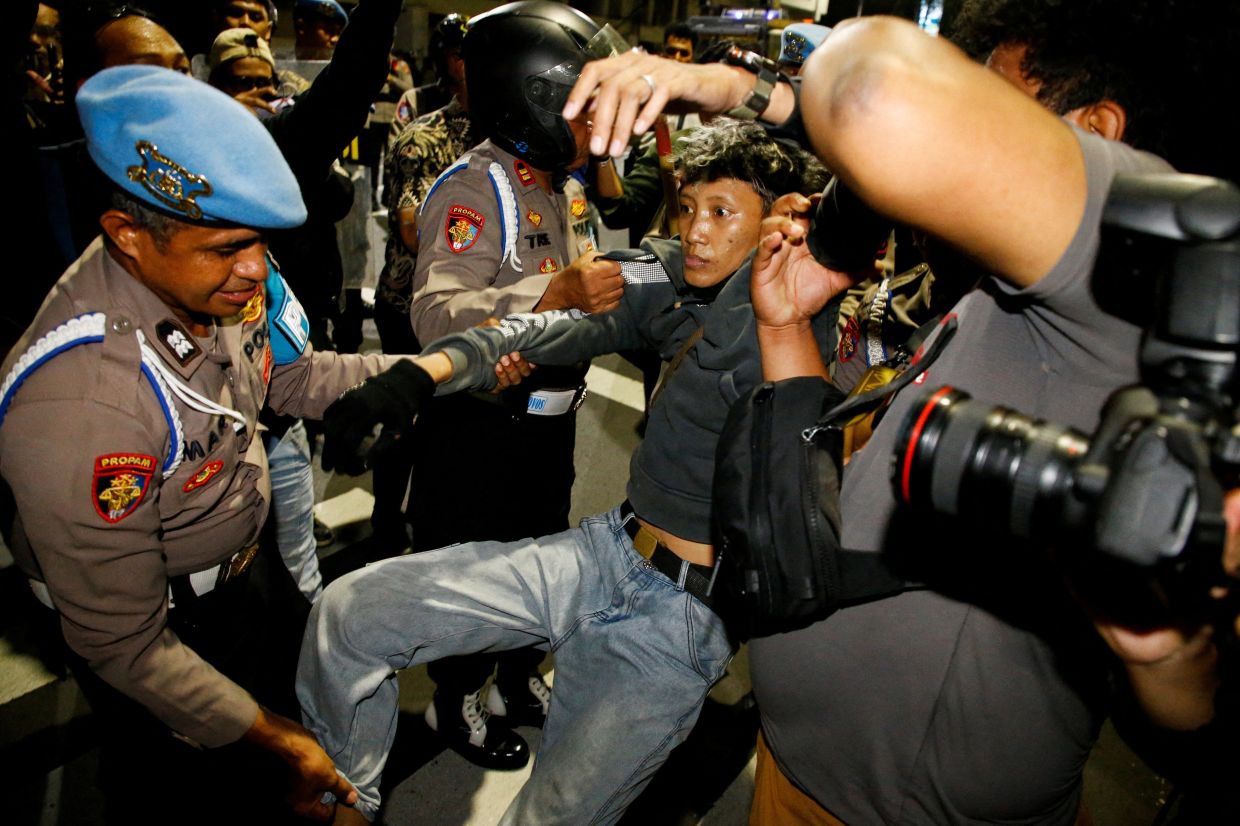
Indonesian law enforcement has pressed charges against four individuals arrested during an anti-government gathering in Surabaya, the nation's second-largest city, marking the latest consequence of intensifying public discontent over economic policies and social programme failures. The charges, announced by Surabaya police chief Luthfie Sulistiawan on Sunday, centre on allegations of property destruction and assault against police officers during Friday's demonstration near a government building.
The Surabaya protest drew approximately 100 participants who assembled to voice opposition to two significant government initiatives that have sparked widespread controversy across Indonesia. The gathering represented part of a broader wave of demonstrations sweeping through major urban centres as citizens express frustration with the government's decision to raise fuel prices for non-subsidised petrol by roughly 30 per cent. Additionally, demonstrators targeted the controversial free school meals programme, which the government championed as a solution to childhood malnutrition but has instead become mired in corruption allegations and food poisoning incidents affecting tens of thousands of people since its rollout.
Friday's demonstration escalated when some attendees began throwing objects at police, including firecrackers and rocks, prompting law enforcement to adopt what officials characterised as "firm actions" to disperse the crowd. The police operation resulted in the temporary detention of 24 individuals, though most were released without formal charges. The four people now facing prosecution represent a small fraction of those arrested, but their cases highlight the authorities' determination to address what they view as unlawful conduct during the demonstration.
The fuel price decision that triggered the Surabaya protest stems from Indonesia's attempt to ease mounting budgetary pressures as geopolitical tensions in the Middle East create upward pressure on global oil markets. As Southeast Asia's largest economy and a major oil producer, Indonesia maintains heavily subsidised domestic fuel prices—a policy designed to protect consumers but one that strains government finances. The paradox of Indonesia's energy situation underscores a fundamental economic tension: despite being an oil-producing nation, Indonesia remains a net importer of petroleum products, making it vulnerable to international price fluctuations and complicating efforts to manage domestic inflation.
Beyond the four formal charges, police continue investigating six additional individuals detained at the Surabaya rally after authorities detected controlled substances in their systems. This secondary investigation suggests that law enforcement is pursuing a broader investigative strategy, potentially attempting to demonstrate that the protest involved criminal elements beyond simple political expression. The distinction between those formally charged and those under investigation for drug possession underscores the multifaceted nature of the police response and the authorities' interest in establishing various grounds for potential prosecution.
The unrest in Surabaya reflects broader national discontent that has been particularly acute in Jakarta, where thousands of students have mobilised to oppose both the fuel price increases and the government's free meals initiative. Student-led movements in the capital demonstrate that opposition to these policies crosses demographic boundaries and has mobilised younger generations who might otherwise remain politically disengaged. The convergence of economic grievance and food security concerns has created an unusually potent catalyst for protest activity.
The government's free school meals programme epitomises the challenges facing ambitious social welfare initiatives in developing economies. While conceived as addressing malnutrition—a genuine public health priority affecting child development and educational outcomes—the scheme has been compromised by implementation failures and systemic corruption. Mass food poisoning incidents affecting tens of thousands of students have fundamentally undermined public confidence in the programme's safety and administration, transforming what should have been a popular welfare measure into a focal point for broader criticism of government competence.
For Malaysia and other Southeast Asian nations with comparable economic structures and social welfare ambitions, the Indonesian experience offers instructive lessons. Both fuel subsidy systems and large-scale food or nutrition programmes require robust administrative capacity, transparent procurement processes, and adequate oversight mechanisms to prevent the kind of failures witnessed in Indonesia. The Surabaya protests underscore how policy implementation failures can rapidly cascade into broader loss of public confidence and political instability, particularly when multiple grievances intersect around economic pressure and food security.
The charging of the four Surabaya protesters also reflects wider questions about how governments balance the legitimate need to maintain public order with citizens' rights to peaceful political expression. The decision to prosecute some demonstrators while releasing most others without charge may face scrutiny from human rights monitors and civil society groups concerned about whether law enforcement responses are proportionate to alleged offences. Indonesia's record on managing protest activity and protecting freedoms of assembly remains closely watched, especially as public discontent over economic policies shows signs of intensifying.

