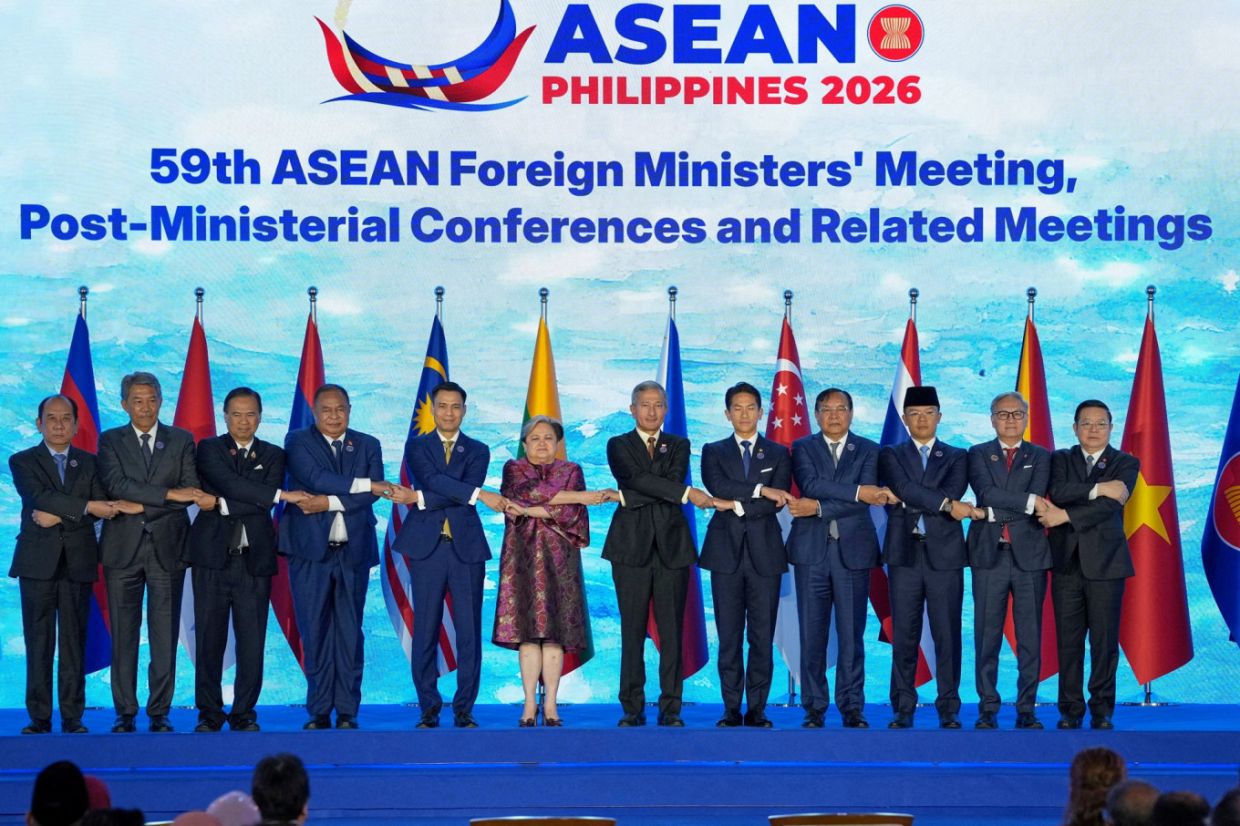
Indonesia delivered a pointed message to its Asean peers this week: the time for grand declarations has passed, and the bloc must now prove it can deliver tangible outcomes. Speaking at the 59th Asean Foreign Ministers Meeting in Manila on Tuesday, Indonesian Foreign Minister Sugiono framed the challenge starkly, asking whether the organisation could finally "deliver on its promises" after years of incremental progress and unfulfilled commitments. His intervention came as diplomats from all eleven member states convened to coordinate positions ahead of Wednesday's engagements with external partners, underscoring growing pressure on Southeast Asia's premier regional organisation to demonstrate relevance amid cascading global crises.
The timing of Sugiono's remarks proved particularly significant given the constellation of challenges now confronting the region. The ongoing conflict in the Middle East has injected fresh economic uncertainty into Asean economies while simultaneously complicating the bloc's ability to negotiate from a position of strength with major powers. Ministers issued a joint statement expressing concern about the conflict's ripple effects—rising energy costs, threats to nationals working in affected countries, and broader socio-economic disruption. Yet the statement's cautious tone reflected a deeper anxiety: that Asean's window for collective action may be narrowing precisely when unity is most needed.
The Middle East crisis has exposed structural vulnerabilities in Asean's strategic posture that reach far beyond energy markets. Several member states have intensified their energy procurement from China in response to supply disruptions caused by tensions in the Strait of Hormuz, a shift that carries significant implications for regional negotiating dynamics. The Philippines, which holds the Asean chair this year, nearly doubled its solar panel imports from China in the first five months of 2024 compared to the same period last year—a metric that reflects broader patterns of increased energy dependency on Beijing. This reorientation of supply chains threatens to weaken Asean's collective bargaining position precisely as it attempts to finalise a long-stalled Code of Conduct governing the South China Sea, a document that would establish rules-based mechanisms in one of the world's most strategically important waterways.
The South China Sea Code of Conduct remains perhaps the clearest test of Asean's ability to convert diplomatic aspirations into binding agreements. Negotiations have dragged on for nearly two and a half decades, with member states struggling to reconcile competing territorial claims and divergent interests. Sugiono emphasised that the moment for completion has arrived, noting that "our people have waited 24 years for rules at sea. They should not wait for another year." His statement reflected growing frustration within Indonesia and other claimant states that delay itself serves the interests of those opposing a binding accord. By contrast, a rules-based framework governing maritime conduct would theoretically constrain coercive behaviour and provide Southeast Asian nations with clearer legal grounds to resist unilateral actions by larger powers.
The philosophical distinction Sugiono drew between a region governed by rules and one controlled by power deserves closer examination, particularly for Malaysian readers familiar with ongoing South China Sea disputes. A binding Code of Conduct would establish mutual obligations for all signatories, including China, creating accountability mechanisms that a framework based purely on power dynamics cannot provide. Yet achieving this outcome requires Asean members to maintain disciplined negotiating positions despite their increasing energy dependence on Beijing—a feat that grows more difficult as economic pressures mount. The current geopolitical moment, paradoxically, may represent both Asean's best opportunity to finalise the code and its weakest bargaining position.
The Myanmar crisis added another layer of complexity to Tuesday's proceedings, with ministers convening in closed retreat to assess implementation of the Five-Point Consensus, Asean's roadmap for resolving the country's political impasse. The consensus framework has proven largely ineffective since the 2021 military coup, with divisions among member states reflecting fundamentally different views about how to engage the junta. Vietnam and Thailand have maintained stronger ties with the military government, while Indonesia and Malaysia have called for firmer pressure. Philippine Foreign Secretary Theresa P. Lazaro announced that ministers had agreed to review how progress on the consensus is measured and had discussed possible reforms to Asean's special envoy mechanism, with completion targeted for November's leaders' meeting. The very fact that Asean feels compelled to revisit the measurement framework suggests acknowledgment that current metrics have failed to capture meaningful progress.
These three regional flashpoints—the Middle East's economic spillovers, the South China Sea's governance vacuum, and Myanmar's humanitarian deterioration—collectively illustrate why Indonesia's call for accountability matters so profoundly. Asean was founded on the principle that regional stability serves all member states' interests better than great power competition. Yet that foundational logic appears increasingly strained. When individual members can improve their economic circumstances through closer bilateral ties with major powers, the incentive to maintain collective discipline weakens. Indonesia's intervention represented an attempt to reinvigorate commitment to collective action by appealing to the bloc's charter principles and its long-term strategic interests.
The amendment of the Asean Charter to admit Timor-Leste as the eleventh member, completed at the May summit, offered Sugiono concrete evidence of the bloc's capacity to undertake substantive institutional reform. Yet expansion without demonstrable progress on core issues risks hollowing out Asean's credibility. Timor-Leste joined an organisation facing serious questions about its ability to shape regional outcomes on issues that directly affect member state security and prosperity. This contradiction—growing institutional scope coupled with apparent declining capacity to resolve major disputes—forms the backdrop to Indonesia's current pressure campaign.
The Wednesday meetings with Asean's dialogue partners would test whether the bloc could articulate coherent positions to external actors. The participation of the United States, China, and Russia meant that Asean would confront directly the great power dynamics that increasingly constrain its room for manoeuvre. For Malaysian observers, the significance lies in recognising that Asean's effectiveness in managing external relationships depends fundamentally on maintaining internal cohesion. When member states pursue divergent energy partnerships or take conflicting approaches to Myanmar, the bloc presents an inconsistent negotiating front to major powers, diminishing its leverage.
Sugiono's emphasis on the charter's commitments to safeguarding "regional political, economic and social stability" highlighted how broadly these foundational principles extend. The bloc is not merely tasked with resolving discrete territorial disputes or managing diplomatic incidents; rather, its fundamental obligation encompasses the systemic conditions for shared prosperity and security. This expansive interpretation of Asean's mandate suggests that failures on any of the major current issues—South China Sea governance, Myanmar stabilisation, or economic resilience in the face of external shocks—represent failures of the charter itself. By framing the question in these terms, Indonesia elevated the debate from tactical diplomatic negotiation to fundamental questions about Asean's continued relevance.
Looking forward, the bloc faces a compressed timeline for delivering concrete results. The November leaders' meeting will provide the next opportunity to measure progress on Myanmar consensus implementation. Meanwhile, the Code of Conduct negotiations demand closure sooner rather than later if the accord is to have meaning before geopolitical circumstances shift further. Indonesia's call for delivery represents both a diagnosis of Asean's current predicament and an attempt to galvanise the political will necessary to reverse course. Whether member states can subordinate immediate bilateral interests to collective regional benefit remains the central question confronting Southeast Asia's premier organisation.

