President Prabowo Subianto's centrepiece nutritious meal initiative faces mounting scrutiny as direct beneficiaries reveal their willingness to abandon the assistance if it means forcing the government to tackle serious quality and accountability deficiencies. The programme, conceived to combat childhood stunting across Indonesia, has become mired in controversy over food safety, kitchen management, and the apparent misalignment between budgetary allocation and actual nutritional delivery to intended recipients.
The crisis crystallised recently when a mother in Kediri, East Java, posted images of her eight-month-old infant's meal—described as an unidentifiable clump of white paste—prompting her to feed it to her chickens instead. The incident struck a chord with thousands of social media users, garnering over 11,000 engagements and highlighting the disconnect between the programme's stated nutritional objectives and what arrives at family tables. The beneficiary, Nesti Nagari, subsequently rejected continued participation, asserting she could provide adequate nutrition independently and would rather see resources redirected toward education and healthcare infrastructure.
Parallel concerns have emerged from Diah Farika, a breastfeeding mother in Semarang, Central Java, who documented months of declining meal standards including unripe produce and inadequate portions. Her repeated complaints to the nutrition fulfillment service units responsible for meal preparation were dismissed, prompting her withdrawal from the scheme. Notably, she expressed conditional support for the programme itself but demanded a temporary suspension to allow the National Nutrition Agency to conduct comprehensive kitchen inspections and identify systemic failures in meal preparation standards.
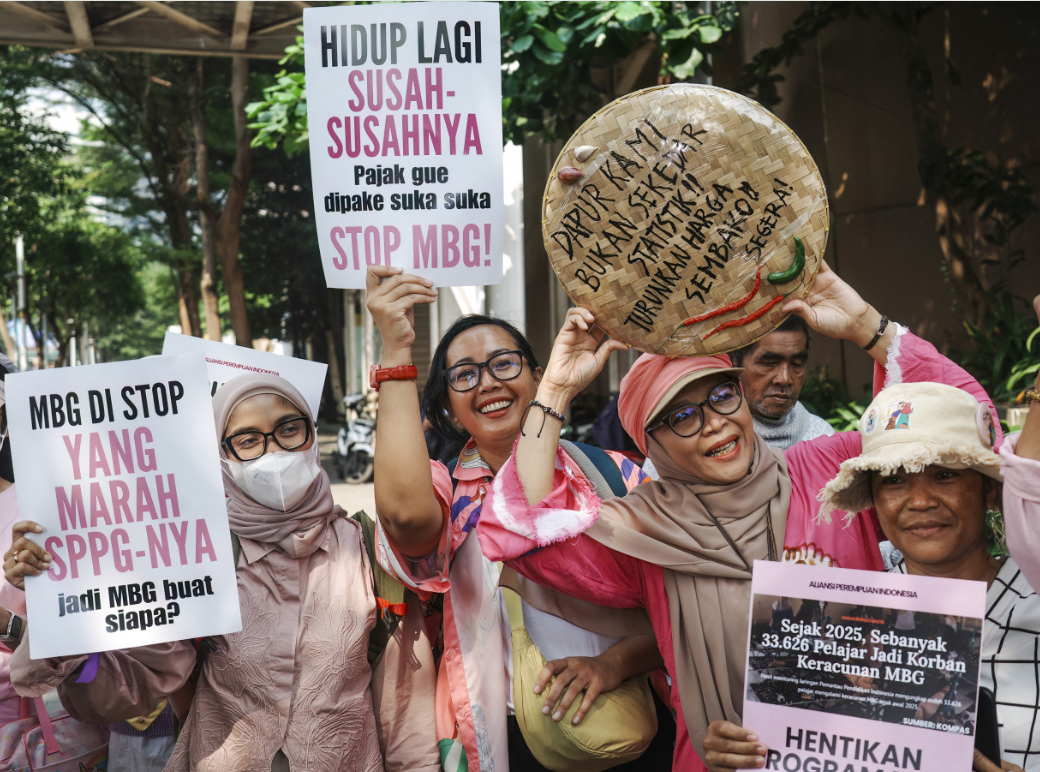
The discontent extends well beyond household level grievances. Women's rights organisations, including the Indonesian Women's Alliance, staged public demonstrations in Central Jakarta calling for programme suspension and thorough governmental review. These interventions reflect broader public anxiety about the initiative's governance structure and its apparent vulnerability to mismanagement and corruption. The activism underscores how beneficiary dissatisfaction has crystallised into demands for institutional accountability and transparent evaluation processes.
However, the political economy surrounding the scheme reveals competing pressures that complicate straightforward reform. Hundreds of investors have reportedly constructed approximately 27,000 kitchens under the SPPG framework after injecting hundreds of billions of rupiah into infrastructure development. These stakeholders now demand assurances over investment recovery should the programme face restructuring or contraction. Several kitchen operators experienced temporary closures in June attributable to delayed government funding, intensifying investor anxiety about the scheme's viability and their financial exposure.
A corruption scandal involving former National Nutrition Agency leadership precipitated the current freeze on network expansion, signalling internal governance failures at the supervisory level. This institutional crisis has compounded beneficiary concerns and investor uncertainty, creating a tripartite impasse between households demanding quality improvements, operators seeking financial security, and government authorities attempting damage control. The scandal's revelation suggests that systemic corruption may have compromised both meal quality oversight and transparent budget allocation.
Independent civil society monitoring through platforms like MBG Watch has articulated a fundamental legitimacy question: what tangible social benefit accrues from multi-billion-dollar budget allocation when beneficiaries question meal nutritional content and governance appears compromised? Researchers at the Center of Economic and Law Studies, including policy analyst Isnawati Hidayah, emphasise that approximately 34 per cent of current beneficiaries—roughly 61 million children and pregnant women—fall outside the most vulnerable cohorts, suggesting significant budgetary leakage toward economically secure households with adequate independent nutritional access.
The original 2026 budget allocation of Rp 335 trillion underwent substantial trimming to Rp 268 trillion following public pressure regarding opportunity costs for education spending. This budgetary compression, while addressing fiscal efficiency concerns, occurred amid mounting evidence that implementation failures rather than insufficient funding underlay quality deficiencies. The situation illustrates how political commitment to flagship social programmes can override rigorous needs-based targeting and quality assurance mechanisms.
In response to mounting criticism, the National Nutrition Agency initiated beneficiary reselection processes, removing recipients judged capable of independent nutritional sufficiency. As of mid-June, the agency had dropped 76 schools across Java, affecting over 39,000 beneficiaries. Deputy agency head Agustina Arumsari characterised this recalibration as essential refocusing, emphasising that the programme must concentrate resources on genuinely vulnerable populations requiring government intervention. This narrowing reflects acknowledgement that programme architecture had drifted from its stated poverty-targeting objectives.
Simultaneously, the agency introduced austerity measures including elimination of kitchen incentive payments during non-operational periods and performance evaluations targeting underperforming facilities. These adjustments suggest internal recognition that operational inefficiencies and quality control failures require structural correction. Yet such measures arrive belatedly, after public confidence erosion and beneficiary withdrawal had already occurred, raising questions about institutional responsiveness and monitoring capacity.
For Malaysian and broader Southeast Asian observers, the Indonesian case illuminates governance challenges facing large-scale social welfare programmes aimed at nutritional improvement. Successful implementation requires not merely substantial budget allocation but robust quality assurance mechanisms, transparent kitchen management oversight, and beneficiary accountability channels. The willingness of Indonesian beneficiaries to forgo assistance rather than tolerate poor-quality meals suggests that public trust and programme legitimacy depend fundamentally upon demonstrated nutritional efficacy and institutional integrity, not merely announcement of good intentions or expansive financial commitments.
The unfolding situation indicates that President Prabowo's flagship initiative, despite addressing legitimate stunting concerns, has stumbled precisely where implementation matters most: the actual delivery of nutritious meals that beneficiaries can trust and rely upon. Restoration of programme credibility demands not only kitchen inspections and beneficiary recalibration but also institutional accountability for the corruption scandals and investment-driven distortions that appear to have compromised the scheme's foundational nutritional mission. Without demonstrated commitment to quality and transparent governance, even temporary suspension may prove preferable to beneficiaries and policymakers seeking evidence-based nutritional intervention effectiveness.

