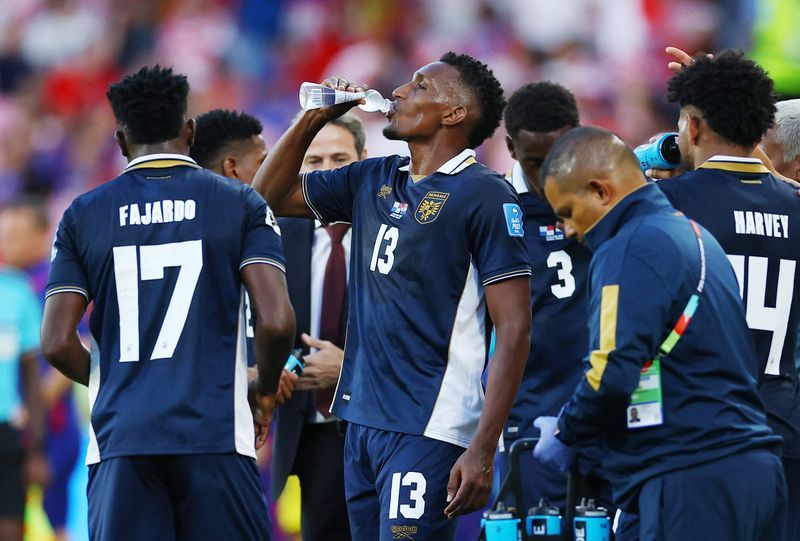
FIFA President Gianni Infantino has mounted a spirited defence of the mandatory hydration breaks introduced at the World Cup, rejecting suggestions that commercial considerations underpin the controversial rule. Speaking on Wednesday, Infantino stressed that the three-minute stoppages mandated in the 22nd and 67th minutes of every match respond exclusively to sporting imperatives, with no financial benefit accruing to FIFA or its commercial partners.
The introduction of these breaks has proved contentious since the tournament's opening fixtures, drawing complaints from coaches, players, and viewers worldwide. While the stoppages ostensibly provide players respite during matches played in hot North American conditions, broadcasters have capitalized on the interruptions by inserting additional advertising segments. This commercial dimension has fuelled public scepticism about FIFA's stated rationale, with many questioning whether player welfare or profit maximisation truly drives the decision.
Infantino moved swiftly to address this perception, emphasising that FIFA secured all broadcast and commercial agreements well before implementing the rule. "There is no additional revenue for FIFA, as all commercial agreements were signed well in advance. So, this is not a financial issue for us. For us, it is purely a sporting matter," the FIFA chief declared. This assertion, while categorical, confronts a fundamental credibility challenge: the breaks demonstrably create advertising opportunities regardless of FIFA's underlying motivation, raising questions about institutional opacity.
Beyond the revenue dispute, the hydration breaks have ignited deeper philosophical debate about football's essential character. The stoppages enable coaching staff to deliver tactical instructions during play, a feature that transforms match dynamics and fundamentally restructures how teams compete. England manager Thomas Tuchel articulated this concern pointedly, arguing that the interruptions "interrupt and change the identity of the football match." Uruguay's Marcelo Bielsa extended this critique, contending that fragmenting matches into shorter segments erodes what he considers the sport's defining characteristic—continuous, uninterrupted engagement between teams.
Yet Infantino's defence rested on a more nuanced argument than simple heat mitigation. He acknowledged that while extreme temperatures prompted the rule's introduction, the exceptional demands of World Cup competition justified the measure beyond climatic factors alone. Over 39 days, competing teams potentially play eight matches, creating cumulative physical stress that conventional football structures fail to address. The hydration break consequently serves a restorative function within an extraordinarily compressed tournament schedule, providing essential recovery time that protects player welfare across multiple fixtures.
Infantino further grounded his position in principles of competitive equity. He contended that without standardized breaks, coaching staffs in hotter venues would gain tactical advantages unavailable to counterparts in cooler conditions or climate-controlled stadiums. This asymmetry, in his view, fundamentally compromises fair competition. "It's very difficult to accept that a coach might have the opportunity to influence a match by making adjustments simply because it's hotter, while in another match, where the temperature is slightly lower, the same coach doesn't have the same opportunity," Infantino explained. This argument resonates within institutional logic: ensuring identical competitive conditions across all matches represents a legitimate FIFA objective.
Some coaches and players have acknowledged this reasoning. Spain manager Luis de la Fuente and Netherlands captain Virgil van Dijk expressed measured support for the rule's underlying intent, particularly in genuinely extreme heat conditions. However, both figures questioned whether blanket application across all venues and climatic conditions made practical sense. Their concerns highlight a reasonable middle position: hydration breaks might serve legitimate purposes in sweltering conditions while proving unnecessary or even disruptive in cooler locations or enclosed venues.
Infantino additionally refuted suggestions that the breaks degrade match quality or intensity. He asserted that players maintain high performance levels throughout contests despite the interruptions, implying that match entertainment value remains uncompromised. This claim warrants scrutiny among Malaysian and Southeast Asian football audiences accustomed to viewing World Cup matches across time zones that may not align with convenient local schedules. Any degradation in match flow or intensity could significantly impact viewership engagement across the region, where football commands enormous cultural significance.
The hydration break controversy reflects broader tensions within modern professional football regarding institutional authority, commercial interests, and sporting integrity. FIFA's capacity to implement substantial rule modifications unilaterally, while defending them through institutional reasoning that prioritizes player welfare and competitive equity, demonstrates the governing body's considerable structural power. Yet this authority operates within an environment where public scepticism about FIFA's financial motivations runs deep, particularly following years of governance controversies and corruption allegations.
For Malaysian viewers and football enthusiasts throughout Southeast Asia, the hydration break question touches on familiar concerns about how international sports bodies balance sporting principles against economic imperatives. Whether Infantino's assurances fully satisfy critics remains uncertain, but his willingness to articulate detailed justifications beyond simple player welfare considerations demonstrates FIFA's recognition that the issue demands comprehensive explanation. The debate ultimately illuminates how football's continued evolution as a global entertainment phenomenon intersects with traditional conceptions of the game's competitive structure and integrity.

