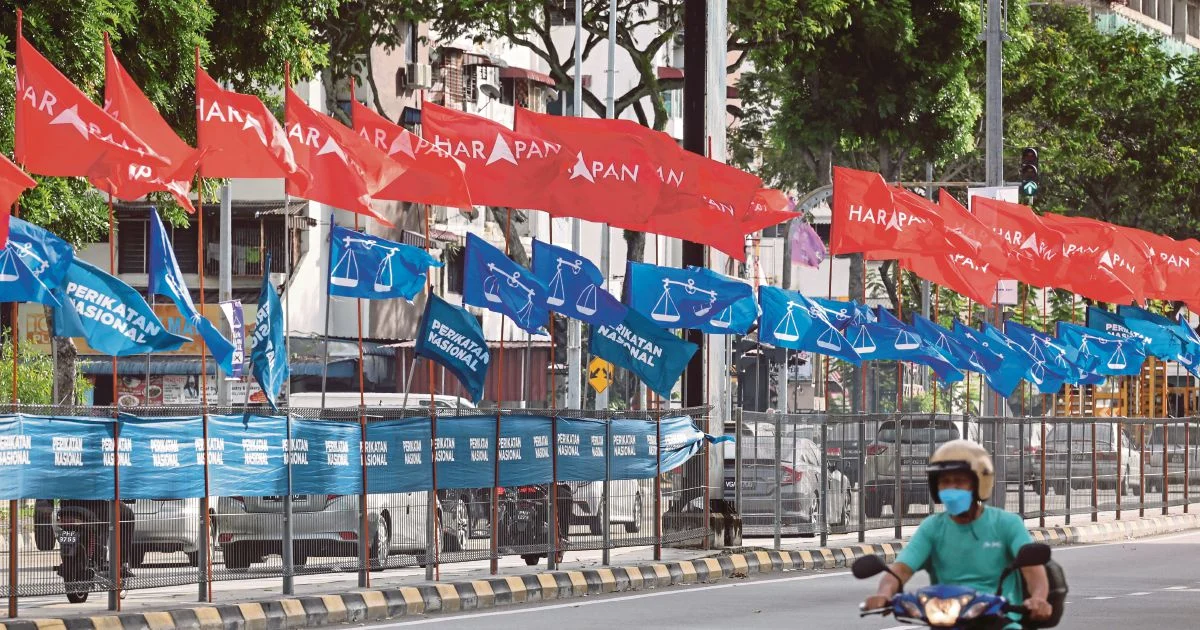
The forthcoming Johor state election is shaping up as a closely contested three-way battle, with Barisan Nasional, Pakatan Harapan and Perikatan Nasional expected to compete directly across nearly 60 percent of the state's 56 legislative seats. This concentration of triangular contests in 33 constituencies represents a significant shift from previous electoral patterns and underscores the volatile state of Malaysian politics at the regional level.
The prevalence of three-cornered fights across Johor reflects the fragmentation of the political opposition over recent years. Rather than facing a unified challenge, Barisan Nasional must now contend with rivals from both the Pakatan Harapan coalition and the more recently formed Perikatan Nasional alliance. This division of opposition votes potentially benefits the incumbent BN, which has dominated Johor politics for decades, though the dynamics remain unpredictable given changing voter sentiments and the rise of populist movements.
For Pakatan Harapan, which includes the Democratic Action Party and Amanah among other parties, the 33 contested seats represent both opportunity and risk. While direct clashes offer a platform to challenge Barisan Nasional's traditional stronghold, the simultaneous presence of Perikatan Nasional candidates means vote-splitting could undermine their chances in closely contested marginal seats. The coalition must therefore calibrate its campaign messaging to consolidate opposition voters while maintaining organisational discipline across these diverse battlegrounds.
Perikatan Nasional's aggressive expansion into Johor marks a notable development in the coalition's national strategy. Led by Parti Islam SeMalaysia and the Malaysian United Indigenous Party, the alliance is seeking to establish itself as a credible alternative across multiple states. The presence of PN candidates in 33 constituencies demonstrates their ambition to transform from regional power broker into a genuine national force capable of competing at the highest levels of Malaysian politics.
Johor holds immense strategic importance within Malaysia's federal framework. As the nation's second-most populous state and an economic powerhouse with significant manufacturing and port infrastructure, the outcome will reverberate beyond state politics. The state government controls vast revenue streams and development projects that shape economic opportunities for nearly 4.2 million residents. Control of the state assembly therefore translates directly into influence over resource allocation, infrastructure development and socioeconomic policy across the southern corridor of Peninsular Malaysia.
The electoral landscape in Johor has traditionally favored Barisan Nasional, which has governed the state continuously since independence. However, the 2022 federal election results and subsequent shifts in voter behaviour suggest the political ground has become decidedly more treacherous for the ruling coalition. Urban voters, particularly younger demographics, have demonstrated willingness to support opposition parties, while rural and traditional constituencies remain more inclined toward established authority structures. This urban-rural divide will likely determine outcomes in several of the 33 contested seats.
Geographic distribution of the three-way contests will play a crucial role in determining the election outcome. Seats clustered in urban centres around Johor Baru, Kota Tinggi and Batu Pahat present different competitive dynamics than rural constituencies inland. Urban areas generally favour Pakatan Harapan's progressive policy agenda, while Perikatan Nasional has cultivated support among conservative Muslim voters concerned with religious and cultural issues. Barisan Nasional's challenge lies in maintaining its traditional coalition of Malay-Muslim voters whilst retaining support from the crucial Indian and Chinese communities who have increasingly drifted toward opposition parties.
The concentration of multi-candidate races reflects broader trends in Malaysian electoral politics where coalition-building and seat negotiations have become increasingly difficult. Unlike the past when opposition parties largely consolidated around single candidates, the proliferation of politically active coalitions means voters across Johor now face genuinely contested elections in most constituencies. This heightened competition potentially increases voter engagement whilst simultaneously complicating voter choice and potentially fragmenting electoral support.
Campaign dynamics will be shaped by national political developments as much as local issues. Federal government policies on subsidies, infrastructure spending and religious matters will influence how voters approach state-level choices. Economic concerns, particularly rising cost of living and employment opportunities, will feature prominently in campaigning. Perikatan Nasional's messaging around religious governance and cultural preservation may resonate particularly strongly in constituencies with higher concentrations of religiously-observant voters, whilst Pakatan Harapan is likely to emphasise good governance and economic reform.
For Johor voters, the presence of genuine three-way contests across 33 seats represents an unprecedented opportunity to influence political outcomes through meaningful electoral choice. However, the fragmentation also creates complexity around coalition formation if no single party or alliance secures a clear majority. The mechanics of post-election government formation in a divided parliament could prove as significant as the balloting itself, potentially determining which coalition partners gain critical cabinet positions and policy influence.
The Johor election ultimately serves as a crucial test of voter sentiment ahead of potential federal elections. The state's economic significance and political weight within Barisan Nasional's traditional power base means results will either validate or challenge assumptions about coalition support heading into national polling. Whether the three-way contests favour consolidation around one bloc or further fragmentation of the electorate remains the central question as campaigning intensifies across the state.

