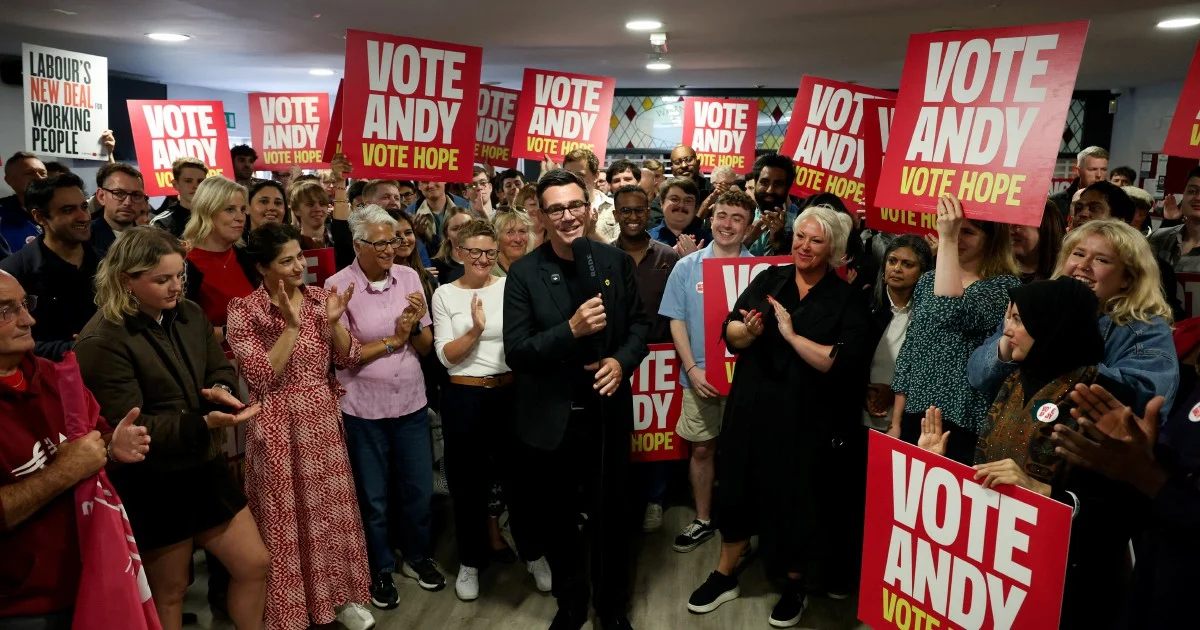
Andy Burnham's electoral prospects in Thursday's Makerfield by-election have been unexpectedly bolstered by the fragmentation of Britain's right-wing political landscape. The Labour contender, who harbours ambitions of one day challenging Prime Minister Keir Starmer for the nation's top job, stands to benefit from a bitter rivalry dividing populist conservative forces at a critical moment in the electoral calendar. Rather than his own political machinery or personal appeal proving decisive, analysts suggest that the mutual antagonism between competing right-wing movements may effectively hand him victory by dividing what would otherwise constitute a consolidated opposition bloc.
The Makerfield constituency represents more than a routine parliamentary contest. As a seat Labour must retain to sustain its governing majority, the by-election carries symbolic weight for Starmer's administration and will test the government's resilience amid economic headwinds and policy challenges that have eroded public support since the party's general election triumph. For Burnham, a former Greater Manchester mayor with significant regional power and national profile, victory provides essential momentum for his longer-term leadership aspirations within Labour ranks. His performance in the by-election will inevitably shape conversations about succession planning and influence within the party hierarchy.
The collapse of unified right-wing opposition stems from deepening tensions between established conservative politics and newer populist movements that have emerged in response to disaffection with traditional party structures. This ideological and organisational split mirrors similar fractures observed across Europe and North America, where anti-establishment sentiment has fractured previously monolithic centre-right coalitions. In Britain's context, the phenomenon weakens the aggregate anti-Labour vote at precisely the moment when government unpopularity might otherwise consolidate opposition support behind a single banner.
These divisions carry particular significance for Malaysian and Southeast Asian observers tracking global political trends. The capacity of fragmented opposition movements to inadvertently strengthen governments they oppose demonstrates how electoral mathematics can produce counterintuitive outcomes. Nations experiencing multi-party systems or contested political landscapes may find instructive lessons in how vote-splitting dynamics ultimately determine legislative outcomes and political trajectories, even when underlying public sentiment favours change.
Burnham's trajectory from local government to potential national leadership candidacy exemplifies a pathway increasingly common among contemporary Labour figures. His success in Manchester's devolved governance structures provided a platform for building independent political capital, creating distance from Westminster's centralised apparatus whilst maintaining party affiliation. This model of combining local executive authority with national political ambitions appeals to voters sceptical of career politicians yet seeking experienced administrators capable of translating local success into national governance.
The right-wing faction's internal quarrels extend beyond tactical vote-splitting in individual contests. They reflect competing visions of populism, economic policy, and Britain's international positioning that have proven irreconcilable within existing organisational frameworks. These schisms intensify during periods when anti-government sentiment runs high, as rival movements vie for leadership of anti-establishment forces and struggle to articulate distinctive platforms capable of attracting disillusioned voters.
For Starmer's government, the Makerfield by-election outcome provides a barometer of voter intentions and party discipline heading toward the next general election. Though polls suggest substantial Conservative weakness and fragmentation on the right, whether such divisions persist sufficiently to maintain Labour's parliamentary advantage remains uncertain. By-elections can signal emerging political realignments or prove merely episodic, making each contest a crucial data point for strategists assessing long-term electoral viability.
The phenomenon also illuminates broader questions about democratic representation and electoral systems. When opposition fragmentation artificially inflates governing party support despite underlying public discontent, it raises questions about whether existing electoral mechanisms adequately reflect voter preferences. First-past-the-post systems particularly amplify such distortions, enabling parties with minority popular support to command parliamentary majorities whilst genuinely competitive opposition forces cancel each other's electoral prospects through internal division.
Burnham's personal political narrative gains additional dimension from this context. Rather than earning Makerfield through overwhelming local endorsement or transformative policy proposals, his victory may arrive by benefiting from opponents' inability to present unified alternatives. This circumstance presents both opportunity and vulnerability—it provides breathing room for Labour consolidation and Burnham's leadership positioning, yet simultaneously leaves exposed the government's fundamental unpopularity and the volatile nature of its parliamentary position.
For regional Southeast Asian readers, the Makerfield by-election exemplifies how electoral outcomes depend upon complex interactions between voter sentiment, institutional design, and opposition coordination. Nations managing multi-party competition or nascent democratic transitions may observe how fragmented anti-government movements can inadvertently strengthen governments they oppose, suggesting that effective political opposition requires both popular support and sufficient organisational cohesion to concentrate votes efficiently. Thursday's result will test whether Britain's right-wing factions can overcome their current antagonisms to pose meaningful challenges to Labour's governing position.