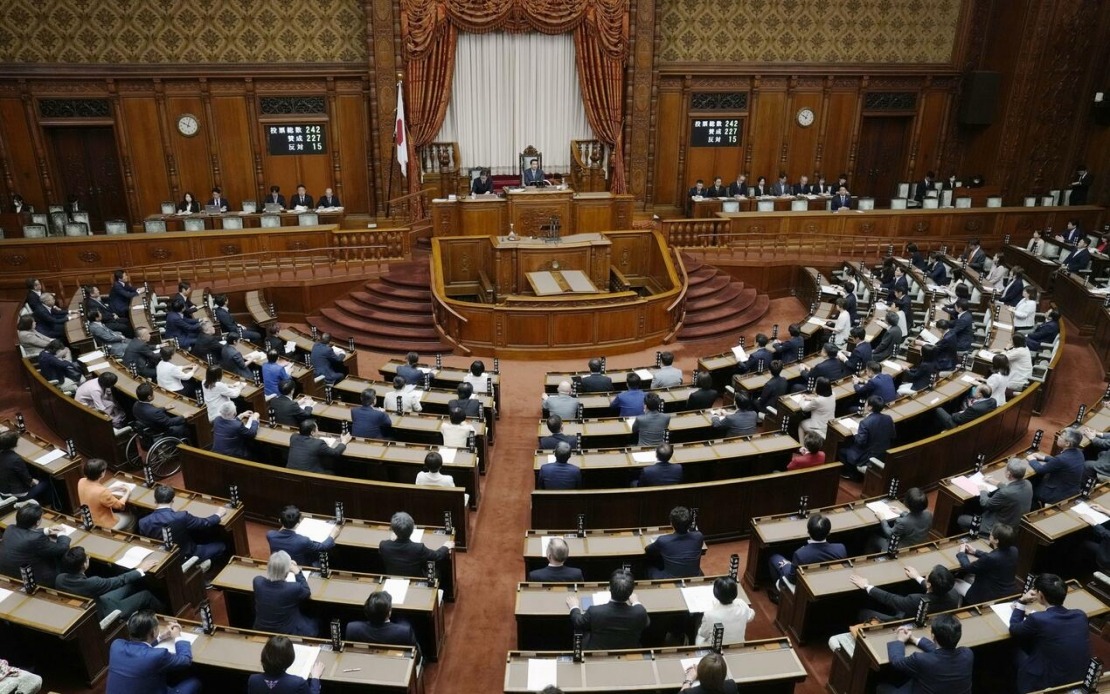
Japan's parliament has passed significant defence legislation that fundamentally reshapes the country's military structure, with space emerging as a central pillar of the nation's security framework. The House of Councillors approved the measures on Friday, June 26, setting in motion a reorganisation of the Air Self-Defence Force that will incorporate space operations into its official mandate and title. The restructured force, scheduled to become operational during the fiscal year concluding in March 2027, represents Tokyo's strategic response to an increasingly complex threat environment in East Asia, where technological advancement and great-power competition have elevated space to a critical domain for national defence.
The centrepiece of this reform involves establishing a dedicated space operations group under a lieutenant general's command, tasked with enhancing Japan's space domain awareness and satellite surveillance infrastructure. This institutional restructuring acknowledges the reality that modern military and civilian operations depend overwhelmingly on space-based systems. Defence Minister Shinjiro Koizumi underscored this reality at a press conference, noting that contemporary society cannot function without space infrastructure. The ubiquity of satellite technology in everyday Japanese life—from navigation systems guiding commuters through Tokyo's streets to weather forecasting informing agricultural decisions across rural prefectures—demonstrates why space security has transcended traditional military concerns to become essential for national resilience.
The legislation's passage carries particular significance for Southeast Asia and the broader Indo-Pacific region. Japan's enhanced space capabilities will strengthen regional awareness of maritime movements and potential security threats, including the monitoring of activities in contested waterways. For countries like Malaysia, Singapore, and Vietnam that share concerns about assertive naval activities in the South China Sea and beyond, Japan's investment in advanced satellite surveillance and space domain awareness contributes to a more transparent security environment. The integration of space operations into Japan's formal defence structure signals Tokyo's intention to develop capabilities that extend monitoring reach far beyond its immediate territorial waters.
Beyond space matters, the legislation also addresses pressing challenges facing Japan's Self-Defence Forces, particularly recruitment and retention. The approved measures include enhanced post-retirement benefits for SDF members, a targeted response to recruitment difficulties that have persisted as Japan faces demographic headwinds and competing career opportunities in the civilian sector. Given that mandatory retirement ages for SDF personnel typically occur earlier than equivalent civil service positions, improved benefit structures represent a necessary adjustment to maintain force quality and experience levels. This dimension of the reforms reflects a broader pattern across developed nations struggling to attract and retain military talent amid changing employment preferences among younger generations.
The legislation also establishes a second senior vice defence minister position, expected to be appointed as early as summer. This administrative enhancement aims to distribute workload during crises and natural disasters, allowing for more sophisticated coordination of defence policy and response operations. The move acknowledges Japan's multi-layered security challenges, which encompass not only military threats but also responsibility for coordinating responses to earthquakes, typhoons, and other natural disasters that periodically devastate the archipelago. The expanded ministerial structure will facilitate deeper defence engagement with security partners, particularly the United States, strengthening alliance coordination during contingencies.
Perhaps most immediately consequential for regional stability is the upgrade of the Ground Self-Defence Force's 15th Brigade in Naha, Okinawa Prefecture, to full divisional status. This elevation reflects Japan's deliberate strengthening of defensive capabilities across its southwestern remote islands—territories that have assumed heightened strategic importance as maritime assertiveness intensifies in the region. Okinawa and surrounding islands occupy a geopolitical frontline position, and enhanced military presence there demonstrates Tokyo's commitment to maintaining deterrence and defending territories in what many analysts view as a potential flashpoint.
China's maritime activities have directly prompted this strategic pivot. Japanese military planners assess that strengthened southwestern defences are necessary to protect the nation's territorial integrity and maintain freedom of navigation in adjacent waters. For Malaysia and other Southeast Asian nations equally concerned about maritime security, Japan's military modernisation represents a counterbalance to growing power concentrations elsewhere in the region. The divisional upgrade translates bureaucratic categorisation into tangible military capacity—more personnel, expanded command authority, and enhanced logistical support for remote island garrisons.
The comprehensive nature of these reforms underscores Japan's systematic approach to addressing 21st-century security challenges. Rather than ad-hoc responses to specific incidents, Tokyo is building institutional architecture designed for long-term competition and cooperation in an era where threats emerge simultaneously across multiple domains—space, cyber, maritime, and conventional. This institutional maturation reflects lessons learned from decades of alliance management with the United States and increasing sophistication in threat assessment.
For Malaysia and the broader Southeast Asian region, these Japanese reforms carry several implications worth monitoring. First, enhanced Japanese space surveillance capabilities will contribute to improved maritime domain awareness beneficial to all regional states seeking to maintain situational awareness in crowded shipping lanes and disputed waters. Second, Japan's demonstrated commitment to defence modernisation may encourage allied nations to accelerate their own military development, potentially triggering regional dynamics worthy of careful diplomatic management. Third, the substantive focus on space capabilities indicates how comprehensively great-power competition has permeated defence planning even among technologically advanced nations with advanced existing capabilities.
The timing of these reforms, advancing through parliament during a period of elevated regional tensions, reflects Japan's assessment that strategic windows for force development remain open but may narrow. The legislation's passage signals that Tokyo views current circumstances as demanding rather than merely opportune for defence transformation. Implementation over the next two years will determine whether the restructured force delivers the enhanced capabilities Japanese planners envision, particularly in the technically demanding space domain where operational experience remains limited compared to traditional military specialties.
As regional security competition intensifies, Japan's comprehensive defence modernisation serves as a reminder that even wealthy, technologically advanced nations must continually adapt military structures and capabilities to remain effective. The integration of space operations into formal defence structures, the strengthening of southwestern garrisons, and the expansion of ministerial capacity represent cumulative adjustments that, taken together, meaningfully alter Japan's defence posture. For Southeast Asia, these developments underscore the reality that regional security dynamics remain firmly intertwined with broader great-power competition shaping the entire Indo-Pacific neighbourhood.

