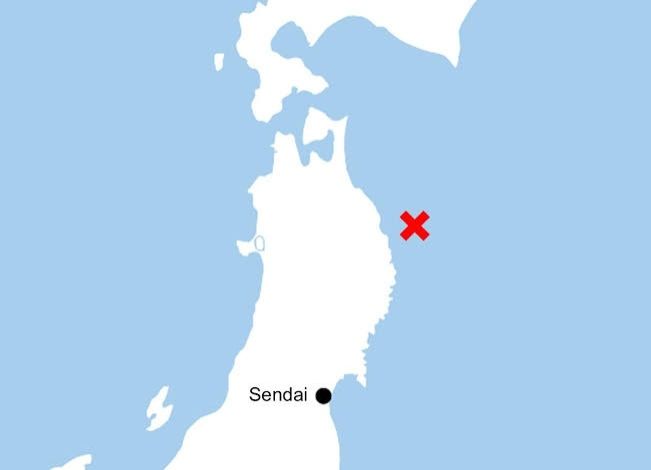
A powerful 7.2-magnitude earthquake jolted northern Japan on Thursday morning, disrupting daily routines across the region but leaving communities largely unscathed. The tremor, which struck in waters off Iwate prefecture on the main island of Honshu at 7:30 am local time, was initially measured at 6.9 magnitude by the Japan Meteorological Agency before being revised upward. The epicentre lay approximately 44 kilometres below the seafloor, a depth that helped limit surface damage despite the considerable energy released. Residents reported minor incidents—kitchen cupboards disgorging their contents, picture frames sliding from walls, and loose items tumbling from shelves—but nothing approaching a genuine structural crisis. No tsunami warning was issued following the event, and authorities detected no damage to nuclear facilities in the affected area.
The earthquake's reach extended well beyond the immediate epicentre, with tremors felt as far away as Tokyo, several hundred kilometres to the south. In Aomori and Iwate prefectures, the shaking registered at the upper sixth level on Japan's seven-point Shindo intensity scale, a classification indicating conditions where unsecured furniture topples and people may struggle to remain upright without support. Eyewitnesses described the moment with a mixture of alarm and relief. Mutsumi Shimohata, a 61-year-old employee at a food processing company in Hashikami, recalled that her smartphone's earthquake alert activated almost instantaneously after the ground began moving. "The quake occurred when I was at home, and an alarm went off an instant later. I was surprised, and it felt a bit long," she recounted, noting that her own residence sustained negligible damage beyond a fallen picture frame.
While residential impacts remained modest, the earthquake created scattered disruptions to public infrastructure and services. Some shinkansen bullet train services were temporarily suspended as automated safety systems engaged, a precautionary measure standard across Japan's rail network. A primary school in Hashikami closed temporarily as administrators assessed conditions. Emergency response teams fielded calls throughout the morning: reports included at least four emergency calls to Hashikami and Hachinohe's fire department, one incident involving passengers temporarily trapped in a lift, stuck automatic doors at office buildings, and a tanker truck that overturned. Television footage captured the everyday chaos of the earthquake's immediate aftermath—grocery store shelves half-emptied of merchandise, loose items scattered across floors, kitchen wares creating small piles beneath open cupboards. Yet the very ordinariness of traffic flows resuming and traffic lights functioning normally in Hachinohe city underscored the relative mildness of the overall impact.
Japanese authorities moved swiftly into assessment mode. Chief Cabinet Secretary Minoru Kihara issued a statement emphasizing that no human casualties had been confirmed at that early stage, while pledging continued monitoring of the situation. Prime Minister Sanae Takaichi instructed ministries and government agencies to coordinate closely with local authorities, reflecting the Japanese establishment's well-rehearsed response protocols to seismic events. Through the X platform, Takaichi urged residents in heavily shaken areas to prepare for possible aftershocks of comparable intensity, a prudent warning given that major earthquakes frequently generate significant secondary tremors in the hours and days following the main event. The Nuclear Regulation Authority released findings showing no abnormalities at any nuclear power stations in the region, a reassurance of particular significance given Japan's deep anxiety about atomic facilities since the Fukushima catastrophe.
Japan's relationship with earthquakes reflects its precarious geological position straddling the world's most seismically volatile region. The archipelago sits atop four major tectonic plates converging along the western edge of the Pacific Ring of Fire, a circumstance that condemns the nation of approximately 125 million people to endure hundreds of seismic events annually. Statistically, Japan accounts for roughly 18 percent of all earthquakes recorded globally—an extraordinary concentration of tectonic activity in a relatively confined area. Most tremors prove benign, causing negligible disruption, yet the nation's earthquake risk depends heavily on unpredictable variables: the location of the epicentre, the depth at which rupture occurs, local geological conditions, and the density of human settlement in affected areas.
The memory of catastrophe shapes contemporary Japanese emergency preparedness. The magnitude 9.0 undersea earthquake of March 2011 remains seared into national consciousness, both as a seismic milestone and as a human tragedy. That event triggered a tsunami that killed or left missing approximately 18,500 people and devastated the Fukushima nuclear plant, creating the worst atomic disaster since Chernobyl. The 2011 earthquake fundamentally altered how Japanese society thinks about disaster preparedness, building codes, and nuclear safety. Schools conduct regular earthquake drills; buildings incorporate sophisticated shock-absorption technology; evacuation procedures have become part of the cultural fabric.
Thursday's earthquake arrived less than three months after another significant seismic event tested northern Japan's readiness. On April 20, a 7.7-magnitude tremor struck the country's north, injuring at least ten people and shaking large buildings in Tokyo with sufficient force to generate concern among seismologists. That earlier April event prompted authorities to issue a special advisory warning of elevated risk for earthquakes measuring 8.0 magnitude or stronger—a serious enough concern that such warnings typically attract substantial media attention and prompt enhanced building inspections. The advisory remained in effect for approximately one week before being lifted, an assessment suggesting that the immediate risk had declined to background levels. The frequency of significant seismic activity during spring and early summer 2024 underscores the unpredictability that defines Japan's seismic environment.
For Malaysia and other Southeast Asian nations, Japan's earthquake response offers instructive lessons in disaster management at scale. While Malaysia sits on a more stable tectonic platform than Japan, the region remains vulnerable to distant earthquakes that can propagate through water and rock to cause unexpected impacts. Indonesia, which lies along the Sunda Strait and other high-risk zones, confronts earthquake hazards as acute as those facing Japan, making Japanese emergency protocols and building standards internationally relevant. The absence of major damage from Thursday's 7.2-magnitude earthquake despite its power and proximity to population centres reflects decades of investment in earthquake-resistant infrastructure, rigorous building codes, and public education. For regional planners and policymakers, Japan's experience demonstrates that advanced preparation, rapid assessment, and coordinated response can substantially mitigate the human cost of powerful seismic events. The contrast between the largely manageable disruption from Thursday's earthquake and the catastrophic 2011 event illustrates how building standards and emergency systems genuinely save lives, a principle with profound implications for rapidly developing Asian economies investing in infrastructure resilience.

