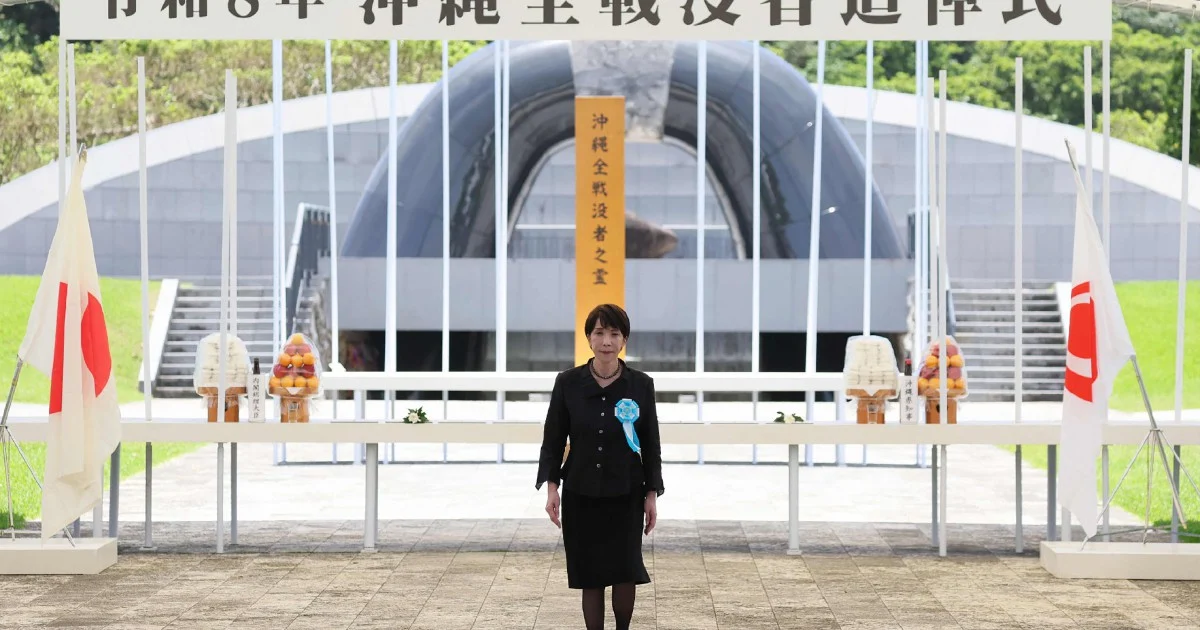
Prime Minister Sanae Takaichi encountered vocal opposition during a commemoration event at a World War II memorial in Tokyo, where protesters challenged her government's direction on military matters. Television coverage captured the disruption as attendees objected to what they view as a fundamental departure from the pacifist principles that have guided Japan's foreign policy for decades.
The incident underscores deepening divisions within Japanese society over the nation's security posture and military preparedness. Takaichi, who assumed office recently, has signalled support for strengthening Japan's defense capabilities—a position that aligns with broader regional tensions in East Asia but clashes sharply with the anti-war sentiment that remains influential among significant segments of the Japanese population.
Japan's postwar pacifism, enshrined in its constitution, has been a defining feature of the nation's identity since 1945. Article 9 of the Japanese Constitution renounces war and limits military capabilities, reflecting the trauma of WWII and the international commitment to prevent future aggression. For nearly eight decades, successive governments have generally operated within this framework, though interpretations have gradually expanded the scope of what the military can do under constitutional constraints.
The protest at the memorial reflects concern among citizens who fear that incremental policy shifts could fundamentally alter Japan's character. Critics worry that modernizing defense capabilities—ostensibly to counter regional threats from China and North Korea—represents a slippery slope toward remilitarization. For them, WWII remains a cautionary tale about how military establishments can acquire outsized political influence.
Takaichi's government has advocated for increased defense spending and broader military capabilities as geopolitical tensions escalate across East Asia. China's military modernization and assertiveness in the Taiwan Strait, combined with North Korea's ongoing weapons development, have created an environment where Japan's security establishment argues forcefully for stronger armed forces. Regional allies, particularly the United States, have also encouraged Japan to play a more active security role in the region.
The timing of the disruption at a WWII memorial carries symbolic weight. These commemorative events serve as platforms where Japanese political leaders address historical memory and national identity. Protesters used this occasion to voice their conviction that moving away from pacifism dishonors the millions who perished during the war and contradicts the lessons their nation was supposed to learn from defeat and occupation.
This ideological conflict reflects a broader demographic split in Japanese politics. Younger generations, while not uniformly pacifist, are less emotionally invested in WWII trauma and may view military capability as a pragmatic necessity in a competitive region. Older voters and peace activists, by contrast, retain vivid historical consciousness and worry that any weakening of constitutional constraints opens the door to militarism's return.
The Takaichi government must navigate this competing pressure. Domestically, opposition to military expansion remains potent enough to disrupt high-profile events. Internationally, Japan's allies expect Tokyo to shoulder greater defense responsibilities as China rises and American commitment to regional stability faces questions. This squeeze—between pacifist constituencies at home and strategic demands abroad—has complicated Japanese politics for years, and recent government moves have intensified the tension.
For Malaysian and Southeast Asian observers, Japan's internal security debate carries significance. As regional powers monitor China's military growth and navigate the balance between Beijing and Washington, they watch how Tokyo manages its own military modernization within domestic constitutional and political constraints. Japan's experience offers lessons about the difficulty of shifting security strategies while maintaining democratic legitimacy and managing historical sensitivities.
The incident also illustrates how WWII memory remains a live political issue in East Asia, where competing narratives about the war persist across nations. Japan's efforts to strengthen its military occur against a backdrop where historical grievances—both Japan's defeat and its wartime actions—shape how neighbors view Tokyo's security role. Managing this requires careful diplomacy and domestic consensus-building.
Takaichi's response to the heckling and her administration's broader approach to public engagement on defense matters will likely determine whether her government can build sufficient domestic support for its security agenda. Previous Japanese leaders have succeeded in gradually expanding military roles through incremental changes that built enough consensus. Whether Takaichi can manage this without provoking sustained domestic resistance remains an open question as her tenure begins.
The fundamental tension—between Japan's historical commitment to pacifism and contemporary strategic necessity—will not resolve quickly. Incidents like the memorial disruption serve as reminders that significant portions of the Japanese electorate view this shift with apprehension and remain willing to voice opposition publicly.

