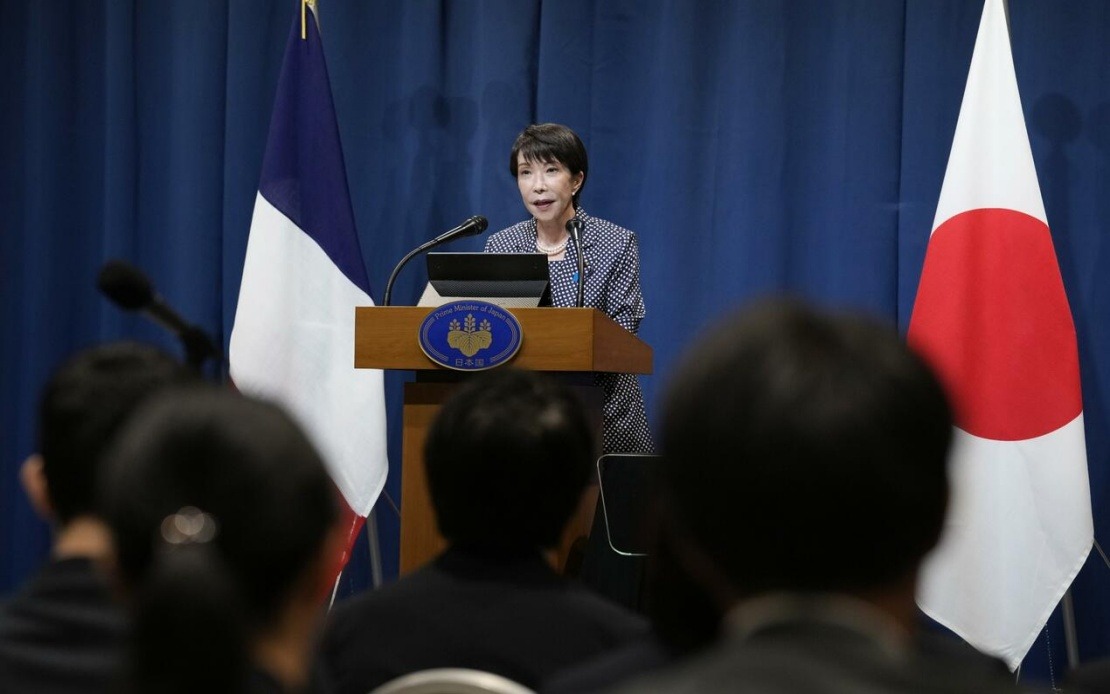
Japan's political landscape faces mounting headwinds as Prime Minister Sanae Takaichi's cabinet approval rating has deteriorated to 55.8 per cent, according to a Kyodo News poll conducted over the weekend. This represents the lowest endorsement level the administration has experienced since Takaichi assumed office in October, signalling growing public dissatisfaction with her government's handling of critical domestic and international challenges.
The timing of this decline coincides with ongoing anxieties affecting Japanese households, which continue to contend with persistently elevated consumer prices across essential categories. The inflation burden has become a lightning rod for political criticism, with voters increasingly questioning whether the government's current economic policies adequately address their purchasing power concerns. This domestic economic context frames the political environment in which Takaichi must operate, as citizens weigh her administration's responsiveness to bread-and-butter issues against other policy considerations.
On the international security front, significant division characterises public opinion regarding Japan's potential military engagement in the strategically vital Asia-Pacific region. When surveyed about whether Japan should deploy the Self-Defence Forces to secure commercial shipping lanes through contested waterways, 54.7 per cent of respondents expressed opposition to such involvement. In contrast, 36.6 per cent supported sending military assets to ensure safe maritime passage for merchant vessels. This substantial majority against military deployment suggests the Japanese electorate remains cautious about overseas defence commitments, particularly in regions distant from direct Japanese territory.
The survey's timing offers important geopolitical context for understanding public sentiment. Respondents were polled following announcements that the United States and Iran had negotiated a preliminary peace agreement that would include Tehran's reopening of the Strait of Hormuz. This development theoretically reduces the immediate necessity for third-party military intervention to maintain shipping security, potentially explaining why opposition to Self-Defence Forces deployment registers so heavily in the polling data. However, the margin between supporters and opponents also reflects deeper Japanese unease about entanglement in Middle Eastern conflicts, particularly given Japan's historical emphasis on pacifism and its constitutional limitations on overseas military operations.
Consumption tax policy has emerged as perhaps the most visceral issue affecting household finances and electoral sentiment. The poll reveals nuanced public preferences regarding potential tax relief on food and beverages, a category that directly impacts daily household budgets. Notably, 43.9 per cent of respondents indicated that reducing the consumption tax on food and beverages from the current 8.0 per cent to 1.0 per cent would be acceptable, provided such a reduction enabled faster implementation of broader economic measures. This largest plurality suggests pragmatic voters willing to accept modest tax relief as a stepping stone to more comprehensive fiscal reform, rather than holding out for maximum reductions.
Meanwhile, 22.6 per cent of survey participants advocated for eliminating the consumption tax entirely on food and beverages, aligning with campaign promises made by Japan's ruling coalition parties. This minority preference reveals that while some voters enthusiastically support the most ambitious tax reduction proposals, a larger segment of the electorate appears to prioritise rapid policy implementation over maximalist demands. The distribution of responses indicates tactical complexity in selling economic policy reforms to an increasingly sceptical public.
For Malaysian and Southeast Asian observers, Japan's political turbulence carries important implications. Japan remains a crucial economic partner and security guarantor throughout East and Southeast Asia, and domestic political weakness constrains Tokyo's ability to pursue regional initiatives or maintain robust engagement with ASEAN partners. A weakened Takaichi administration may prove less assertive in articulating Japan's regional interests or coordinating multilateral responses to shared challenges such as maritime security, supply chain resilience, and great power competition.
The convergence of economic dissatisfaction with foreign policy reservations creates a challenging governing environment. Japanese voters appear unwilling to grant their government a blank cheque on either economic management or international military commitments. This political constraint reflects broader post-pandemic adjustments, as households recalibrate expectations following years of disruption and assess whether governmental responses adequately protected their interests.
Looking forward, the Takaichi administration faces critical decisions about policy emphasis and communication strategy. The cabinet's ability to stabilise approval ratings may depend partly on tangible progress addressing consumer prices and demonstrating fiscal responsibility. Simultaneously, any expansion of overseas military commitments would face substantial public resistance, requiring careful diplomatic framing and clear articulation of national interest calculations to secure broader public buy-in for such controversial moves.

