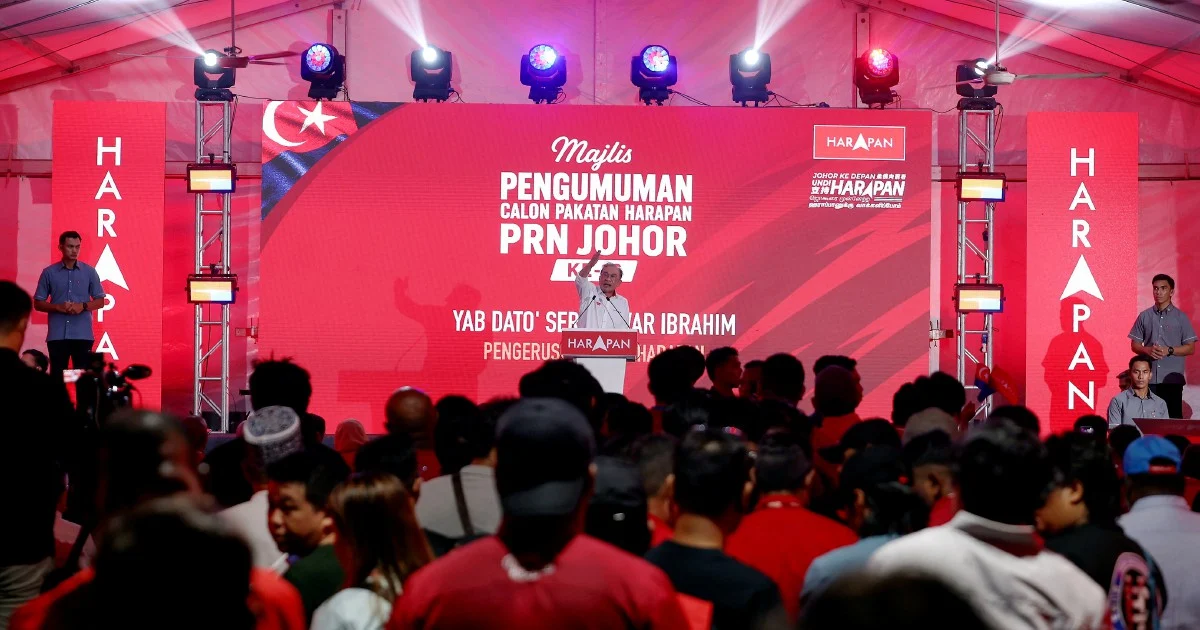
Pakatan Harapan (PH) chairman Datuk Seri Anwar Ibrahim has drawn a firm line regarding the upcoming Johor state election, calling for the campaign to remain confined to political discourse without involving the state's royal institutions. Speaking in Tangkak, Anwar emphasised the importance of maintaining a clear separation between electoral competition and the constitutional role of the Malay Rulers, a stance that underscores growing concerns about the boundaries between politics and traditional authority in Malaysian governance.
The remarks represent a significant positioning by the PH leader as the coalition prepares for the Johor polls, reflecting broader anxieties within opposition circles about potential interference from established power structures. By explicitly drawing this distinction, Anwar appears to be preemptively addressing concerns that royal influence or institutional backing could shape the electoral landscape in ways that disadvantage his coalition. The statement carries particular weight given Johor's status as a crucial electoral battleground with significant implications for national political realignment.
Anwar's insistence on maintaining institutional boundaries reveals the delicate political ecosystem in Malaysia's relationship between monarchy and electoral democracy. The Malay Rulers hold immense cultural and constitutional significance throughout the country, yet their public positioning during electoral contests remains contentious. By calling for their institutions to remain separate from campaign politics, Anwar is articulating a principle that arguably strengthens democratic norms by preventing traditional authorities from becoming perceived as partisan actors.
The timing of these remarks reflects the intensifying political competition in Johor, where control of the state government carries implications extending far beyond local administration. As a historically significant political base with its own complex power dynamics, Johor represents both an opportunity and a challenge for any coalition seeking to consolidate or expand influence in the peninsula. The state has witnessed dramatic political shifts in recent years, making its electoral trajectory closely watched across Malaysia.
For Pakatan Harapan specifically, the emphasis on keeping royal institutions separate from electoral competition serves multiple strategic purposes. It establishes a framework emphasising fair play and democratic legitimacy rather than reliance on institutional or traditional backing. This positioning may appeal to voters concerned about the quality and integrity of the electoral process itself, rather than merely the outcomes. By distinguishing between legitimate political contestation and institutional interference, Anwar frames the opposition as defenders of proper democratic procedure.
The statement also carries implications for how different political coalitions are perceived in relation to institutional power structures. In Malaysian politics, perceived proximity to or distance from established authorities often shapes voter sentiment and coalition viability. Anwar's clarification attempts to establish that Pakatan Harapan competes on the strength of its policies and political appeal rather than institutional privileges. This rhetorical framing becomes particularly important for an opposition coalition seeking to present itself as a viable alternative government.
Johor's unique constitutional arrangements give the royal institution particular prominence in state governance. The Sultan's role extends beyond ceremonial functions to substantive executive influence in certain domains. These structural realities make it essential for political actors to address how electoral competition occurs within a framework where royal authority remains constitutionally significant. Anwar's comments acknowledge this reality while simultaneously arguing that electoral campaigns themselves should not become vehicles for institutional power projection.
The broader regional context makes Malaysia's approach to separating political and institutional spheres noteworthy among Southeast Asian democracies. Many regional nations struggle with precisely these boundaries, and Malaysia's experience offers instructive lessons. By articulating clear principles about institutional separation during elections, Malaysian political leaders contribute to ongoing conversations about how traditional authority structures can coexist with modern democratic practice.
For voters in Johor, Anwar's remarks signal a commitment to contested politics decided on electoral merits rather than institutional alignment. This message resonates particularly with constituencies concerned about fair representation and competitive electoral processes. The emphasis on keeping royal institutions removed from campaign politics reassures voters that the contest will turn on policy platforms, leadership quality, and coalition performance rather than privileged access to traditional power.
Looking forward, this positioning may influence how campaigns unfold across Johor constituencies. Political actors from various coalitions may feel encouraged or constrained by these principles, affecting the tenor and content of electoral debates. If Anwar's framing gains traction, it could elevate discussions beyond personality-driven politics toward substantive policy engagement, potentially strengthening the overall quality of democratic deliberation in the state.
The statement ultimately reflects Anwar's careful navigation of Malaysia's complex political terrain, where democratic processes and traditional institutions must coexist without compromising the legitimacy of either. By insisting that Johor's electoral battle remain strictly political, he advocates for democratic integrity while acknowledging the enduring constitutional role of royal institutions in Malaysian governance.

