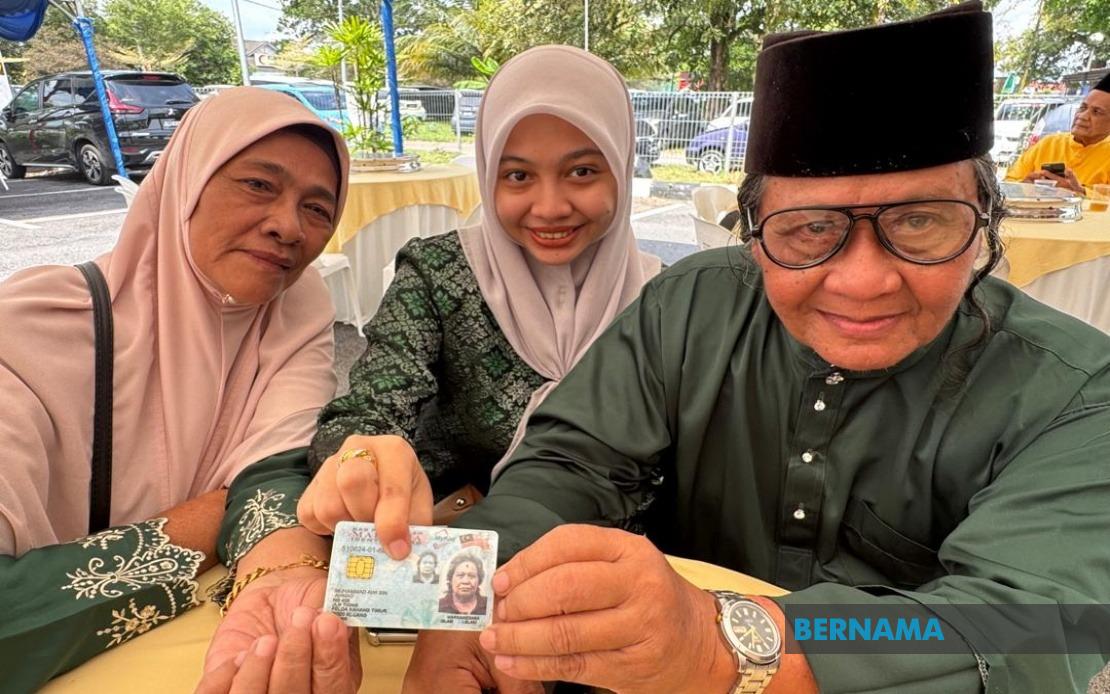
A milestone moment arrived yesterday in Kluang as 210 Felda settlers formally received ownership titles to their land through a state government handover ceremony, bringing closure to a struggle that has stretched across multiple decades for some of Malaysia's agricultural pioneers. The achievement represents a significant victory for communities whose livelihoods have long been clouded by legal uncertainty, despite their continuous cultivation and stewardship of plantation holdings across Johor's rural districts.
Among those celebrating was Muhammad Awi Ahmad, who turned 75 today and received ownership recognition for his nearly 4.2-hectare plantation and residence in Felda Kahang Timur. His journey illustrates the frustration many settlers endured: he first applied for a title in 1990, then again a decade later in 2000, only to face rejection on both occasions. The approval of his third application, processed by the current Johor administration led by Menteri Besar Datuk Onn Hafiz Ghazi, finally vindicated his patience and persistence.
The reversal in processing timelines is notable and suggests administrative improvements at the state level. Under previous administrations, applications could languish for years without resolution or clear feedback. Muhammad Awi's most recent application received approval within approximately twelve months, a dramatic acceleration compared to the 10-year gaps between his earlier submissions. This efficiency gains credence to suggestions that streamlined bureaucratic processes, possibly aided by digitisation or dedicated task forces, have begun to tackle the historical backlog.
The human dimension of land ownership proves particularly poignant when viewed through the experiences of younger settlers. Norliyani, Muhammad Awi's 25-year-old daughter, represented the second generation at yesterday's ceremony and articulated concerns that extend beyond her father's relief. She emphasised that while first-generation settlers maintain cultural and family connections to ancestral villages, younger Felda residents have nowhere else to call home. For them, securing family land ownership is not a symbolic gesture but an existential necessity, determining whether they can build permanent futures or face displacement.
The intergenerational stakes underscore why this administrative resolution matters profoundly. Without formal titles, second and third-generation settlers operate in precarious circumstances. Inheritance becomes complicated, bank loans for agricultural improvements remain difficult to secure, and the prospect of land transfers to outsiders looms as a real threat. Norliyani's warning that unresolved ownership issues would perpetuate hardship across generations speaks to how legal ambiguity compounds across time, affecting more people with each passing year.
Another beneficiary, Mohd Farhan Mohamad of Felda Pasak in Kota Tinggi, waited nearly 20 years for approval. He had initiated the application process in 2006, motivated by his father Mohamad Masek's desire to formalise ownership of land cultivated since the 1980s. The family's most recent submission last year yielded an unexpected approval, suggesting the state's current institutional capacity has genuinely improved and is working through the accumulated queue of pending applications.
The scale of this resolution becomes apparent when examining the overall statistics. As of the latest count, 99.9 percent of the 27,642 Felda settlers in Johor who submitted applications—totalling 27,639 individuals—have now received ownership titles. This near-complete success rate represents an extraordinary administrative achievement and suggests that the remaining handful of cases likely involve unusual circumstances or documentation complexities rather than systemic resistance.
For Malaysia's agricultural sector and rural development policy, the Johor precedent carries implications worth monitoring. Felda settlers represent a crucial cohort in the nation's agricultural heritage, established through a planned settlement scheme intended to develop smallholder farming. However, institutional arrangements around land tenure have historically created friction between settlers' expectations and formal ownership structures. Resolving these tensions, as Johor has begun doing, strengthens security of tenure and potentially enables more productive use of agricultural land through improved access to credit and extension services.
The ceremony at Dewan Dato' Onn in Sembrong, attended by Menteri Besar Onn Hafiz, carried symbolic weight beyond the immediate handover. It publicly acknowledged a historical grievance and signalled political commitment to resolving rural administrative issues. Such visibility matters, particularly in strengthening trust between state institutions and settler communities, many of whom had previously experienced application rejections without clear explanations.
Beyond Johor, other states administering Felda schemes may face similar backlogs of unresolved land title applications. The Johor government's demonstrated capacity to process 27,639 applications efficiently could serve as a model for replication, whether through shared administrative frameworks or policy benchmarking. States like Pahang, Perak, and Terengganu, which also host significant Felda populations, might benefit from examining whatever procedural improvements Johor has implemented.
The resolution also carries broader implications for Malaysia's rural equity agenda. Land security represents a foundational element of rural prosperity, enabling farmers to access credit markets, invest in productivity improvements, and plan for intergenerational wealth transfer. When land titles remain uncertain, rural development initiatives underperform, and generational poverty becomes difficult to escape. Johor's progress in eliminating this particular barrier suggests that political will and administrative focus can address long-standing institutional problems.
For settler families like Muhammad Awi's, the titles represent far more than legal documents. They symbolise recognition of decades of labour, vindication of patience through years of rejection, and secured futures for children and grandchildren. On his 75th birthday, Muhammad Awi told Bernama that all worry and uncertainty had finally dissolved. That sentiment, multiplied across more than 27,000 settler households, constitutes a genuine transformation in rural tenure security that will likely generate ripple effects across Johor's agricultural economy for years to come.

