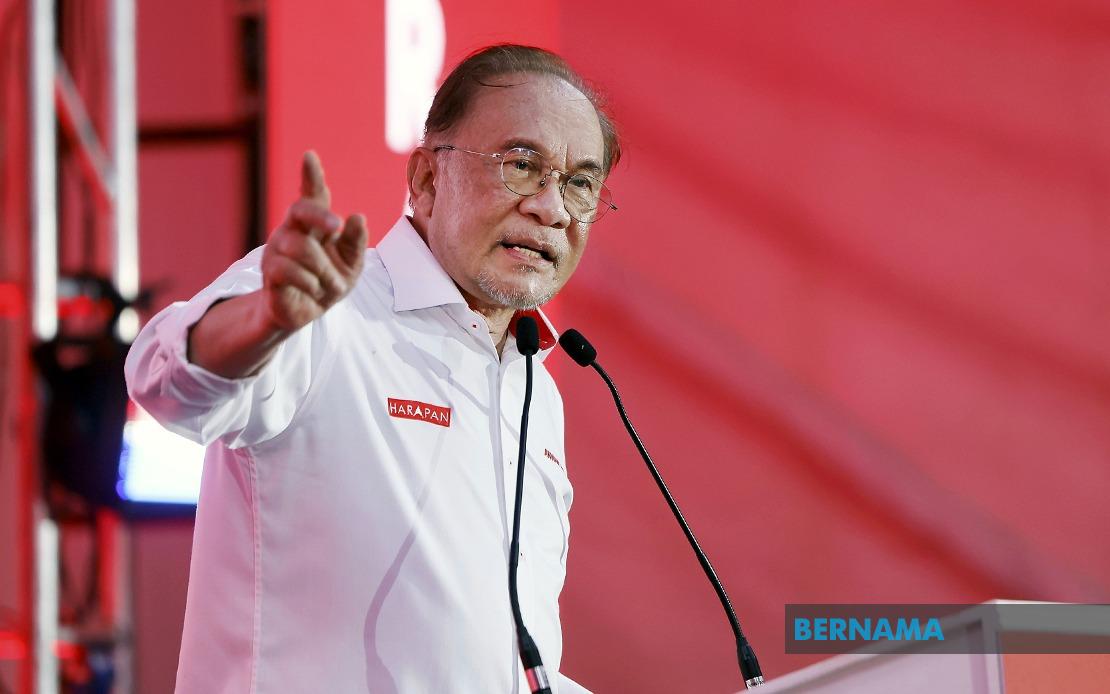
Prime Minister Datuk Seri Anwar Ibrahim asserted at a campaign event in Tangkak on Saturday that the Federal government has channelled more resources to Johor than the state has paid into national coffers, underscoring what he characterized as the MADANI administration's commitment to the economically vital state. Speaking at an announcement ceremony for Pakatan Harapan candidates contesting the Johor state election, Anwar pointed to Finance Ministry figures showing that Johor contributed approximately RM14 billion in revenue to federal coffers during the three-year period spanning 2023 to 2025.
However, Anwar maintained that the Federal government has returned RM16 billion to Johor through a combination of infrastructure projects, operational funding, and social assistance programmes. The RM2 billion differential represents a net inflow of federal resources to the state, a narrative the Prime Minister evidently sought to reinforce among Johor voters ahead of the state election. As Finance Minister, Anwar emphasized the importance of communicating this financial relationship clearly to the public, arguing that such data provides an accurate representation of Kuala Lumpur's developmental priorities for the peninsula's southernmost state.
Anwar further bolstered his argument by contrasting the allocations Johor received under the previous government with those disbursed since the MADANI administration assumed office in late 2022. During the tenure of the previous administration, Johor received annual operating expenditure allocations ranging between RM6 billion and RM7 billion. This quantum has expanded materially under the current government, reaching RM8.7 billion annually, representing an increase of between RM1.7 billion and RM2.7 billion per annum depending on the baseline year used for comparison.
The elevation in operational spending mirrors broader changes in how the Federal government distributes development resources across states. According to data Anwar presented for the 2026 fiscal year, Johor ranks as the third-largest recipient of combined operating and development expenditures after the East Malaysian states of Sabah and Sarawak. This ranking reflects the substantial fiscal demands of Johor, Malaysia's most populous peninsular state and a major contributor to national economic output through its petrochemical, manufacturing, and logistics sectors.
Development expenditure allocations to Johor have climbed particularly steeply over the past four years. The state's development allocation rose from RM2.3 billion in 2022 to RM4.8 billion in 2026, more than doubling the quantum of capital investment the Federal government directs toward long-term infrastructure projects within Johor. This trajectory aligns with the MADANI framework's stated emphasis on delivering tangible improvements in living standards and economic infrastructure, particularly in states that have historically voted for the coalition government.
Beyond conventional development and operational budgets, Johor has also benefited substantially from the Federal government's direct cash assistance schemes. The state was identified as the second-largest recipient of combined allocations under two major welfare programmes: the Sumbangan Tunai Rahmah (STR) and Sumbangan Asas Rahmah (SARA) initiatives. Only Selangor exceeded Johor in receiving assistance through these channels, a distribution pattern that reflects population size and the concentration of lower-income households in both states.
Anwar's detailed presentation of these figures represents a deliberate attempt to reframe the Federal-state fiscal relationship in terms favourable to the government he leads. The timing of his remarks, delivered directly at a campaign event for PH candidates, underscores the political stakes surrounding perceptions of fairness in resource allocation. Electoral contests frequently pivot on such grievances, with voters evaluating whether their state receives proportionate investment relative to its economic contributions and population.
For Malaysian political observers, Anwar's emphasis on the RM16 billion figure carries significance beyond mere budgetary accounting. The statement implicitly challenges any narrative suggesting that Johor, as a major economic engine and historically significant state, has been neglected or marginalized by the current federal administration. Given Johor's electoral importance and its history as a stronghold of various political coalitions, demonstrating fiscal commitment through concrete resource allocation constitutes a crucial component of political messaging.
The comparison between previous and current allocations also serves to distinguish the MADANI government's approach from that of its predecessors, a central theme in PH's campaign strategy. By quantifying the increase in operational and development funding, Anwar implicitly argues that voting for PH candidates in the state election will maintain and extend these elevated spending levels. Conversely, he suggests, a change in state administration might jeopardize access to Federal resources, a common electoral argument in Malaysian state elections where Federal-state relations determine infrastructure capacity.
Johor's fiscal profile reflects both its economic importance and its political sensitivity. As the gateway to Singapore and home to major ports, refineries, and manufacturing clusters, the state's economic health directly influences national growth projections. The elevated development spending Anwar highlighted likely targets transport infrastructure, water and energy systems, and industrial parks designed to sustain this productivity. Understanding these expenditure patterns matters for Malaysian investors and businesses assessing the regulatory environment and infrastructure quality in major economic zones.
The data Anwar presented also illustrate how Federal allocations have shifted within the Malaysian federation over recent years. The substantial increases directed toward Johor must be contextualized against overall fiscal constraints and competing demands from other states and sectors. In this sense, Anwar's remarks attempt to demonstrate selectivity in resource distribution, positioning the MADANI government as strategic in directing capital toward high-productivity states while simultaneously maintaining social safety nets through welfare programmes.
Looking forward, Johor's electoral outcome will partly determine whether these elevated spending patterns continue. A PH-led state government would likely maintain alignment with the Federal administration, facilitating continued coordinated investment. A state government led by a different coalition might create friction in accessing Federal resources or result in shifting priorities. These structural incentives help explain why Prime Ministers customarily invest considerable effort in campaign messaging centered on fiscal generosity toward specific states during electoral campaigns.

