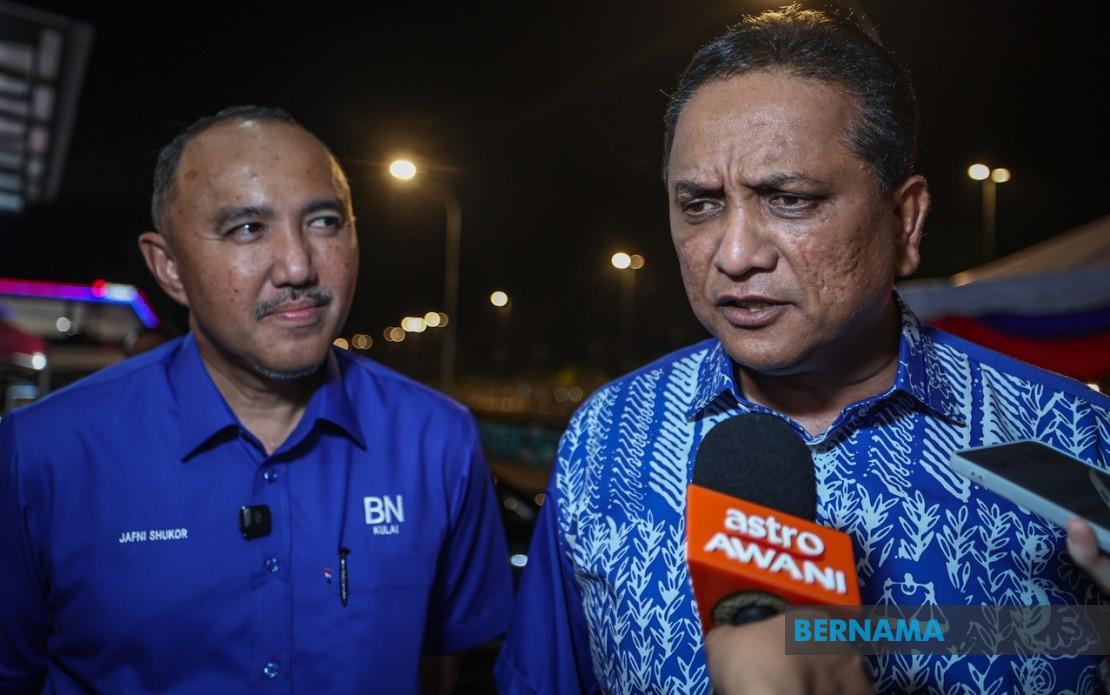
Datuk Seri Reezal Merican Naina Merican, a senior UMNO figure, has firmly rejected accusations that Johor's Regent, Tunku Mahkota Ismail, has inappropriately seized control of the state administration, describing such claims as grossly exaggerated and without substantive foundation. Speaking in Johor Bahru on June 25, the UMNO Supreme Council member characterised the allegations as a misreading of the Regent's role and responsibilities within Johor's governance structure.
The controversy centres on recent statements from Datuk Dr Mohd Puad Zarkashi, a former Speaker of the Johor State Legislative Assembly, who departed from the party claiming that Menteri Besar Datuk Onn Hafiz Ghazi had become subordinate to palace influence. Puad's departure and accompanying accusations have injected a delicate institutional question into Johor's political discourse at a sensitive moment, with the state preparing for imminent elections scheduled for July 11.
Reezal Merican's defence of the Regent's position rests on a distinction between constitutional authority and political interference. He argued that Tunku Mahkota Ismail's interventions on developmental matters reflect his legitimate mandate to represent the interests of Johor's population, not an overreach into executive domains. The UMNO leader framed the Regent's activism as a healthy institutional check, comparing it to the balancing role that upper houses play in parliamentary systems elsewhere. According to his reading, the Regent's directiveness should be understood as conscientious stewardship rather than puppet-mastering.
The assertion that such complaints have never circulated within UMNO's highest decision-making bodies adds institutional weight to Reezal Merican's pushback. By emphasising that the party's Supreme Council has never entertained suggestions that Johor UMNO operates under palace control, he seeks to establish that the party itself does not experience the situation as problematic. This claim, however, reflects the formal position of party machinery rather than addressing whether individual members hold differing private views.
The timing of Puad's departure raises questions about the political calculations underlying his decision and the reception his allegations receive. With nomination day scheduled for June 27 and polling set for July 11, the Johor state election campaign is in its most consequential phase. Introducing questions about the constitutional propriety of executive-palace relations at this juncture could be interpreted as an attempt to shift campaign narratives toward institutional governance rather than policy platforms and electoral competition.
Reezal Merican explicitly questioned Puad's motivations for drawing the Royal institution into Johor's partisan political arena. This criticism suggests that attempting to weaponise palace-government relations for electoral advantage crosses an important line in Malaysian political practice. The implied rebuke acknowledges that dragging constitutional and monarchical questions into state election discourse threatens the consensual distance typically maintained between the throne and electoral contestation in Malaysian federalism.
From a constitutional perspective, the Regent's role in Johor's governance remains defined by both convention and written law. The Sultan or Regent holds significant authority over matters of state concern and serves as formal executive repository, yet contemporary practice in most Malaysian states requires the Menteri Besar to retain functional control over day-to-day administration. The precise boundary between constitutional supervision and administrative interference remains contested and contextual, varying according to individual relationships and the discretion exercised by office-holders.
For Malaysian observers of state politics, the Johor situation illustrates broader tensions within Malaysia's constitutional monarchy system. The Regent's capacity to influence policy outcomes depends partly on the political strength and autonomy of the Menteri Besar. When elected leaders possess clear electoral mandates and firm party support, palace influence tends toward advisory channels. When state governments face internal division or weak electoral positioning, palace intervention may become more visible and consequential.
The accusation against Menteri Besar Onn Hafiz Ghazi carries particular weight given his relatively recent appointment and the internal dynamics within Johor UMNO. If Puad's departure reflects genuine concern about governance structures among UMNO parliamentarians and assemblymen, the party may face internal questioning during and after the election campaign. Conversely, if the complaint proves isolated, it could be dismissed as individual grievance rather than systemic dysfunction.
Regional observers across Southeast Asia track these Malaysian palace-government relations closely, as they offer instructive examples of constitutional monarchy in practice within diverse democracies. Johor's governance model and the mechanisms through which the Regent influences policy have consequences beyond the state itself, contributing to broader debates about executive authority and institutional checks within Malaysia's federal framework.
Reezal Merican's rebuttal represents the official position of UMNO's leadership and by extension the coalition government that depends on Johor's electoral outcome. Whether his characterisation satisfies public concerns or resolves the underlying tensions about governance structures will likely depend on election results and the subsequent conduct of the winning administration. The question of appropriate palace influence in state administration will not disappear merely because senior politicians deny its existence; rather, concrete governance outcomes will determine whether such concerns prove justified.

