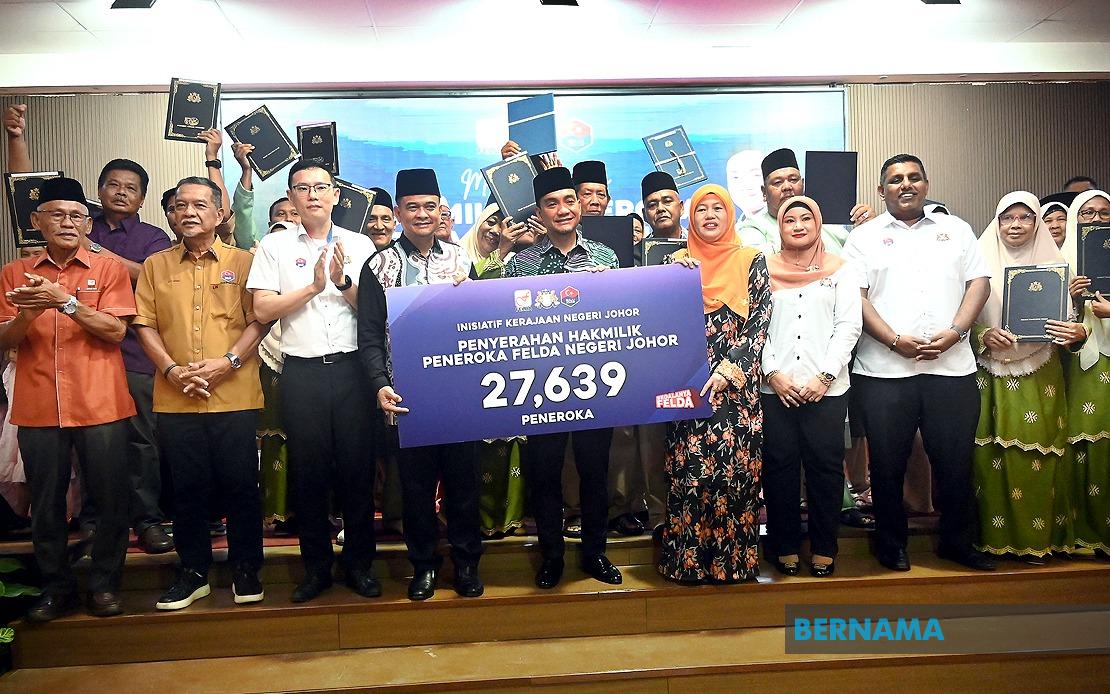
A protracted administrative challenge confronting Federal Land Development Authority settlers in Johor has reached effective completion, with the state government reporting that nearly all outstanding land title applications have now been processed and approved. The Johor Menteri Besar, Datuk Onn Hafiz Ghazi, announced the breakthrough during a formal land title presentation ceremony held in Kluang, where 210 settlers from three districts formally received their documentation confirming ownership of agricultural and residential properties.
The scale of this resolution effort becomes apparent when examining the figures: across the entire state, 27,639 applications out of 27,642 have been successfully adjudicated and processed, representing a 99.99 per cent completion rate. This near-total clearance of a backlog that had accumulated over years represents a significant achievement in addressing grievances that have long troubled FELDA communities throughout the region. The three districts where ceremonies were conducted—Kluang, Kota Tinggi, and Mersing—represent some of the state's most important agricultural zones, where FELDA schemes have historically provided settlement opportunities for rural Malaysians.
For the settlers themselves, this development carries considerable practical significance. Land titles represent far more than bureaucratic documents; they constitute formal proof of ownership that enables residents to secure financing, conduct property transactions, and establish stable assets that can be passed to subsequent generations. Many FELDA settlers had languished in a state of administrative limbo, unable to fully exploit their properties or plan for their futures while official recognition remained pending. The ceremony proceedings underscored the recognition that this uncertainty had created genuine hardship within these communities.
The Menteri Besar's remarks during the event emphasised continuity of state government commitment to FELDA matters, signalling that resolution of this particular issue represents merely one component of broader efforts to address agricultural sector concerns. His statement that FELDA settlements would continue to be treated as priority areas suggests acknowledgment that these communities require sustained government attention beyond simple land title resolution. The agricultural base of these settlements and their importance to rural livelihoods means that broader support mechanisms—including infrastructure development, market access, and technical assistance—remain integral to the development agenda.
This resolution sits within the context of Johor's articulated rural development strategy, according to government officials present at the ceremony. The state administration has positioned land tenure security as foundational to broader rural prosperity objectives. By clearing the backlog of applications, the government removes a significant impediment to investment, both by individual settlers seeking to improve their properties and by financial institutions evaluating lending proposals. Agricultural development becomes more feasible when property rights are legally secure and universally acknowledged.
The historical accumulation of unresolved applications reflects common administrative challenges that afflict land registration systems across Southeast Asia. Delays in processing, gaps in documentation, changes in regulatory frameworks, and shifts in personnel and priorities can create situations where legitimate claims remain trapped in bureaucratic systems for extended periods. The FELDA scheme itself, established to facilitate agricultural settlement and rural development, carries complex overlapping administrative requirements that compound processing difficulties. Clearing such backlogs therefore demands not merely administrative will but sustained coordination between multiple government departments and agencies.
The achievement carries implications extending beyond immediate benefits to the 27,639 affected families. When large populations gain formal property rights, broader economic effects follow. Settlers become more willing to invest in improving their properties, agricultural productivity often increases as tenure security encourages longer-term planning, and banking sector participation expands as collateral becomes available. These effects, while difficult to quantify precisely in advance, historically contribute to rural economic dynamism when implemented successfully.
The presence of the Johor Agriculture, Agro-based Industry and Rural Development Committee chairman at the ceremony further underscores the integration of this initiative within broader sectoral policy. FELDA settlements exist within agricultural development frameworks, and tenure security directly affects sectoral productivity. Committee participation signals coordination across government bodies responsible for these interconnected portfolios.
While the 99.99 per cent resolution rate represents near-complete success, the remaining 0.01 per cent—three cases—remains unresolved. The circumstances surrounding these outstanding applications remain unclear from available information, though complex ownership disputes, missing documentation, or competing claims might explain their persistence. The government has not indicated timelines for resolution of these final cases, suggesting they may involve complications that simpler administrative processing cannot address.
Looking forward, this resolution provides foundation upon which more ambitious rural development initiatives might be constructed. With fundamental questions of land ownership and recognition addressed, government and settlers can increasingly focus on issues of agricultural modernisation, cooperative development, market linkage, and sectoral transformation. The administrative clearance thus represents a necessary prerequisite rather than a final endpoint in the trajectory of FELDA community development.
For Malaysian policymakers monitoring FELDA management nationally, Johor's achievement offers both model and challenge. Other states with FELDA settlements confront similar backlogs of unresolved applications. The Johor government's success in clearing 27,639 cases demonstrates that systematic, sustained effort can resolve even deeply entrenched administrative problems. Yet the timeframe required and resources necessary for this particular resolution effort remain undisclosed, leaving questions about replicability and cost-effectiveness in other jurisdictions. The political commitment displayed here may constitute the most readily transferable element of the approach.

