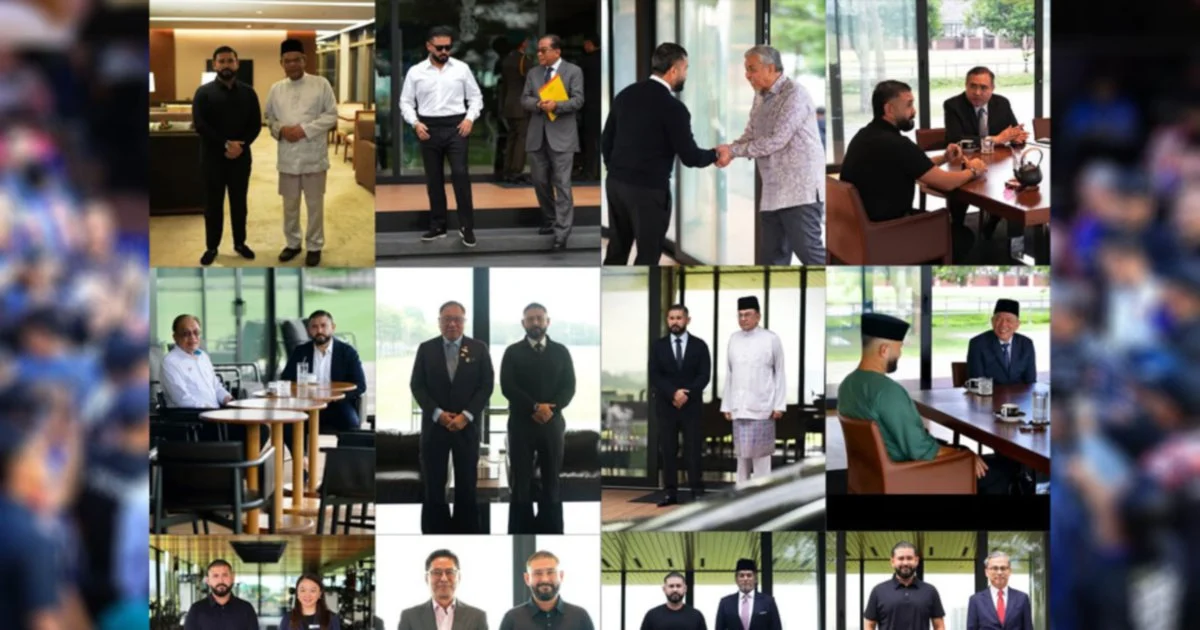
The Johor royal household has positioned itself as a crucial stabilising institution within Malaysia's complex political landscape, actively engaging with leaders across the political spectrum to foster unity and strengthen democratic institutions. This diplomatic role reflects the constitutional importance of the monarchy in Malaysia's parliamentary system, where the Sultan of Johor serves not merely as a ceremonial figurehead but as a genuine political broker capable of convening diverse stakeholders around shared national interests.
The Johor royal family's approach to political engagement represents a departure from the purely ceremonial involvement often associated with traditional monarchies in other democracies. Instead, the royal household has adopted a proactive stance, initiating dialogue with political parties both within and outside the ruling coalition. This strategy acknowledges the fundamental reality of Malaysian politics: deep polarisation along ethnic, religious, and party lines can undermine governance and institutional credibility. By maintaining open channels of communication with leaders of varying political persuasions, the Johor royal house signals that national unity transcends party affiliation and that institutional stability depends upon respectful dialogue rather than winner-take-all confrontation.
The significance of this role becomes particularly apparent when viewed against Malaysia's recent political turbulence. The nation has experienced multiple changes of government at the federal level, shifting coalition arrangements, and occasionally acrimonious inter-party disputes that have tested public confidence in democratic institutions. In such circumstances, the monarchy's traditional position as a symbol of continuity and national identity acquires heightened importance. The Johor royal household's explicit engagement in bridge-building demonstrates how constitutional institutions can provide ballast during periods of political uncertainty, helping to preserve the fabric of governance even as political alignments shift.
This stabilising function operates through multiple channels. The royal household hosts formal and informal gatherings where political leaders can meet and exchange perspectives in neutral, dignified settings. Such encounters, particularly when convened by respected royal figures, often create space for more candid discussion than might occur in formal party settings. The implicit message conveyed by royal-hosted dialogue is that national interests supersede partisan advantage, and that leaders who engage in constructive conversation demonstrate statesmanship worthy of respect. This soft power mechanism, rooted in the monarchy's constitutional status and historical legitimacy, proves remarkably effective in promoting political civility.
For Malaysian readers, particularly those concerned about democratic stability, this royal engagement carries practical implications. Malaysia's system depends upon the voluntary cooperation of political actors who accept constitutional rules of the game even when their party is in opposition. The monarchy's traditional role as guardian of the Constitution, combined with the Johor royal house's active political engagement, reinforces respect for these foundational principles. When political leaders accept invitations to meet with royal patrons, they implicitly affirm their commitment to constitutional governance rather than extra-institutional power-seeking.
The international dimension of this role should not be overlooked. Southeast Asia has witnessed democratic backsliding in several nations where institutional checks on executive power eroded, often aided by public cynicism about institutions and the breakdown of civil dialogue among elites. Malaysia's monarchy, by maintaining its position as a trusted institution that engages thoughtfully with political actors, helps preserve the institutional pluralism that distinguishes functioning democracies from authoritarian systems. The Johor royal household's approach reinforces confidence that Malaysia possesses countervailing centres of power and respect capable of moderating political excess.
The monarchy's stabilising influence also extends to questions of inter-ethnic and inter-religious harmony, matters of fundamental importance in Malaysia's multiethnic, multi-faith context. By engaging with leaders across the political spectrum, the royal household sends powerful signals about inclusive national identity. This is particularly important given how Malaysian politics sometimes weaponises identity issues for electoral advantage. When royal figures, custodians of Malay-Muslim heritage yet constitutional stewards of a multifaith nation, maintain substantive engagement with all communities' political representatives, they reinforce the constitutional promise that Malaysian democracy encompasses all citizens regardless of ethnicity or religion.
The effectiveness of this role depends critically upon the royal household's perceived neutrality and constitutional propriety. The Johor royal house has generally been careful to engage with political leaders without appearing to favour particular parties or to exceed constitutional boundaries. This restraint strengthens rather than weakens the stabilising function, as it preserves the monarchy's legitimacy as an impartial institution. Political leaders across the spectrum can engage with the royal household without accusations of partisan capture, precisely because the monarchy maintains constitutional distance from any single party.
Looking forward, the Johor royal house's stabilising role likely becomes more important rather than less so. Malaysia faces substantial challenges including economic pressures, climate vulnerabilities, and the ongoing need to strengthen multicultural democracy in a region where democratic institutions face external and internal pressures. Institutional mechanisms that promote elite cooperation and respect for constitutional governance thus represent genuinely strategic national assets. The royal household's patient, dignified engagement with political leaders across party lines exemplifies how traditional institutions can adapt to serve contemporary democratic needs.
For Southeast Asia more broadly, Malaysia's approach offers instructive lessons. The region contains multiple constitutional monarchies and traditional institutions that might play similar stabilising roles if properly understood and respected. Malaysia's experience demonstrates that constitutional monarchies need not be irrelevant museum pieces in modern democracies; instead, they can serve essential functions in moderating political conflict and reinforcing commitment to democratic rules. The Johor royal house's engagement strategy thus represents not nostalgic reverence for tradition but rather sophisticated institutional innovation adapted to contemporary political challenges.
The ongoing value of this stabilising role underscores deeper truths about democratic resilience. Nations do not maintain functional democracies through institutions alone, but through networks of respected actors who genuinely believe in constitutional governance and who invest time and prestige in defending democratic norms. The Johor royal household's commitment to political engagement, rooted in constitutional duty and historical legitimacy, exemplifies precisely this commitment to sustained democratic practice. By engaging constructively with political leaders across divisive lines, the royal house advances the quiet, essential work of maintaining democratic stability in an increasingly complex and polarised world.

