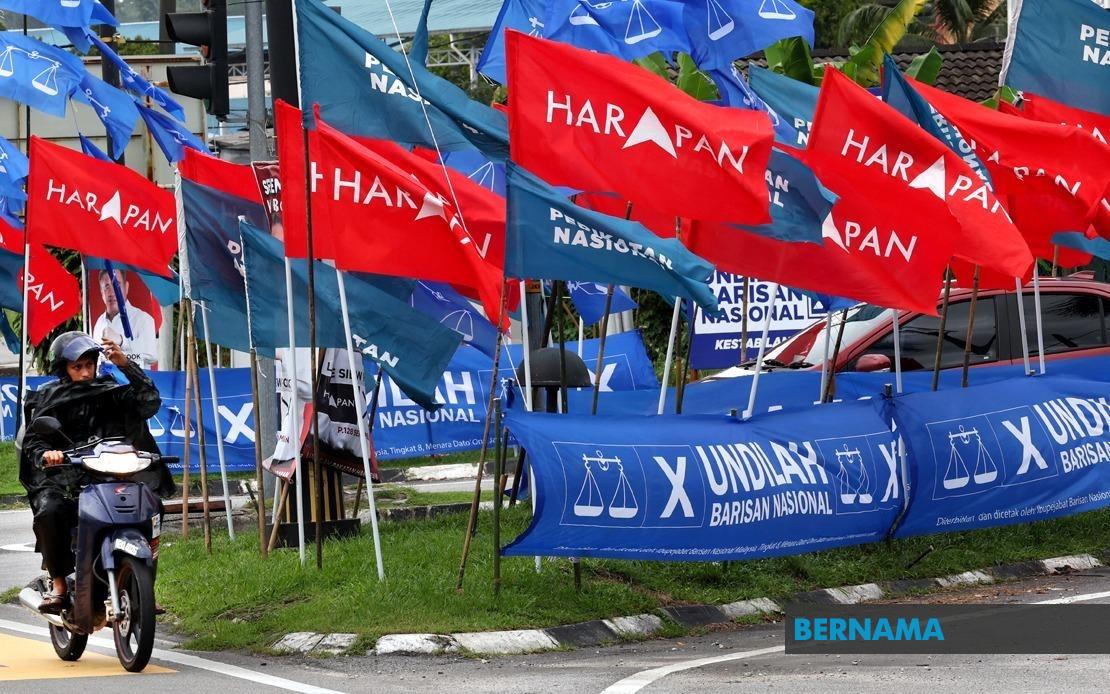
The 16th Johor state election has reached a critical juncture, with less than two days of campaigning remaining before the official cutoff at midnight tomorrow. After nearly two weeks of intensive political mobilisation, the 172 candidates vying for the 56 state seats are making their final push to connect with voters before Saturday's polling day, reflecting the high stakes involved in this crucial peninsular state contest.
Across the political spectrum, parties have abandoned any pretence of restraint, launching an unprecedented barrage of large-scale rallies, grassroots canvassing, and targeted constituency visits designed to influence undecided voters at the eleventh hour. The campaign intensity has only accelerated in recent days, with ground-level activities complemented by a visible deployment of heavyweight political figures aiming to energise party faithful and secure marginal victories in closely contested areas.
Pakatan Harapan's strategy has centred on leveraging Prime Minister Datuk Seri Anwar Ibrahim's popularity and leadership credentials. Tonight, he is scheduled to appear at three significant locations, with particular emphasis on the competitive Puteri Wangsa constituency. The coalition's candidate there, Maszlee Malik, has adopted a youth-oriented social media approach, explicitly invoking the concept of fear of missing out on his Instagram platform to mobilise supporters for the "Grand Finale Harapan Johor Selatan" rally. This blend of traditional political gatherings and digital engagement reflects how Malaysian electoral campaigns have evolved to reach voters through multiple channels simultaneously.
PH's broader ground game demonstrates organisational resilience and tactical flexibility. Dr A. Ruban, contesting the Paloh seat, returned to campaign activities after a brief medical break, symbolising the relentless pace these candidates maintain. In Kemelah, PH's Johor chair Datuk Seri Dr Zaliha Mustafa participated in a mechanised convoy involving 120 motorcyclists through Felda Redong, illustrating how the coalition harnesses community-based mobilisation networks to reach dispersed rural voters. These efforts underscore the importance of the Felda constituencies, which historically represent crucial voting blocs in Johor's electoral calculus.
Barisan Nasional's campaign apparatus has similarly gone into overdrive, with coalition chairman Datuk Seri Dr Ahmad Zahid Hamidi undertaking direct visits to the Endau and Kempas constituencies to galvanise both candidates and party machinery. As the incumbent administrative force in Johor, BN faces the classic challenge of defending its turf against resurgent opposition while maintaining grassroots enthusiasm. Johor Menteri Besar Datuk Onn Hafiz Ghazi, the BN standard-bearer in Machap, has employed multimedia tactics including Instagram video messaging to appeal to a broader demographic beyond traditional rally attendees. Meanwhile, in the Larkin constituency, BN candidate Mohd Hairi Mad Shah's personalised "Ziarah Kasih" programme—essentially neighbourhood goodwill visits—demonstrates how the coalition is attempting to build voter familiarity through intimate, one-on-one engagements that emphasise developmental achievements.
Perikatan Nasional, positioning itself as an alternative force, is projecting maximum visibility through its scheduled mega rally in Endau tonight, featuring party chairman Datuk Seri Ir Dr Ahmad Samsuri Mokhtar and PAS president Tan Sri Abdul Hadi Awang. This concentration of top-level figures in a single location signals PN's determination to make inroads in constituencies where its candidates have realistic competitive prospects. PN's Kahang candidate Mazlan Bujang's Facebook messaging emphasises the scarcity of remaining campaign time and the perceived value of direct voter contact, a rhetorical framing that attempts to convert limited remaining hours into motivational urgency for supporters.
Smaller parties have likewise activated their campaign machinery with notable innovation. Parti Bersama Malaysia's "Bersama Tour Truck" initiative, deployed with Kota Iskandar candidate Sahrudin Omar, represents an unconventional approach to reaching scattered voters across diverse urban and semi-urban areas. Similarly, Larkin candidate Norsinah Abu's emphasis on small-group community dialogues suggests a recognition that intimate conversations with carefully selected community stakeholders may yield greater persuasive impact than large rallies for certain voter segments.
The proliferation of these diverse campaign tactics reflects the heterogeneity of Johor's electorate across urban centres like Johor Bahru, semi-urbanised areas, and substantial rural constituencies with significant Felda settlements. No single approach dominates—instead, sophisticated parties are layering multiple engagement strategies to address different demographic and geographical realities. The visibility of national leaders alongside ground-level candidate activity indicates that parties perceive this election as consequential for national political dynamics, not merely a state-level contest.
The 172 candidates competing across 56 seats represent an unusually fragmented electoral landscape in Malaysian terms, suggesting that traditional two-coalition dominance is being challenged by emerging forces and independent-minded candidates. The final 48 hours will determine whether BN can maintain its historical Johor stronghold, whether PH's national momentum translates into state-level gains, or whether PN's Islamist-nationalist positioning finds sufficient traction in this economically developed and ethnically diverse state. The campaign's final phase will largely determine these outcomes as voters make their ultimate calculations.
For Malaysian political analysts and observers, the Johor election carries implications extending well beyond state politics. As one of the nation's largest and most economically significant states, Johor's electoral verdict will signal voter sentiment regarding the broader national political trajectory, the durability of coalition structures, and the viability of alternative political arrangements. The intensity of this final campaign sprint underscores the perceived stakes, with all major players recognising that Saturday's results could reshape Malaysian politics for years ahead.

