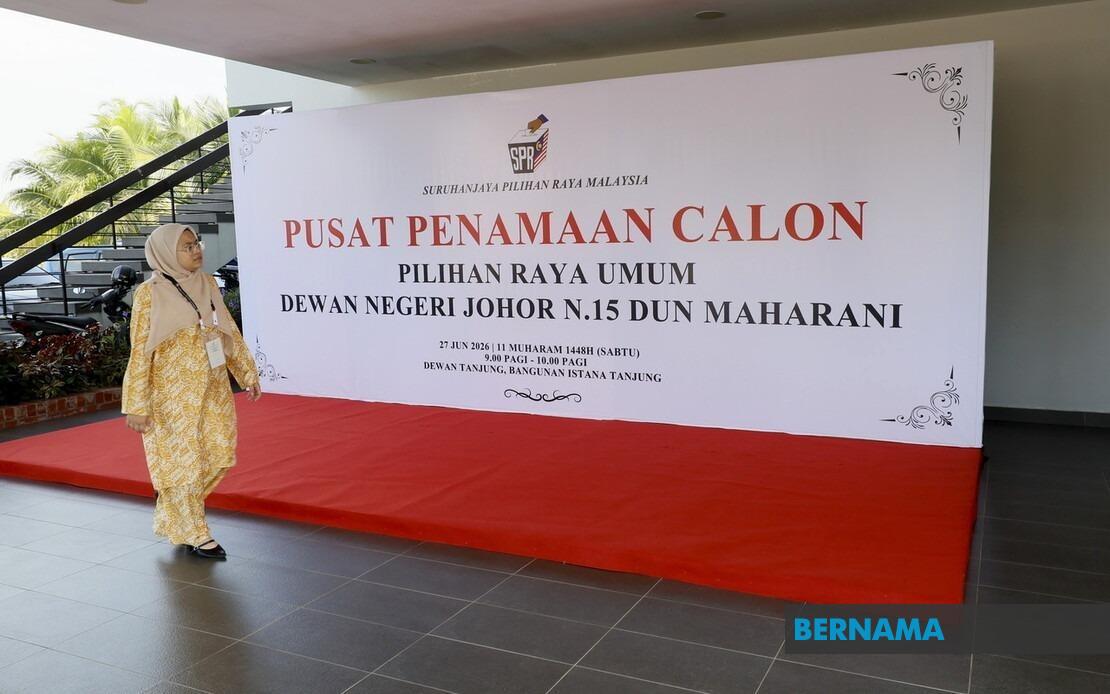
The machinery of Johor's 16th state election moved into motion on June 27, as nomination day unfolded across all 56 state constituencies. Beginning at 9 am, prospective candidates rushed to submit their nomination papers within a strictly enforced one-hour window ending at 10 am, marking the formal commencement of what is shaping up to be a fiercely contested electoral battle. The state's 56 nomination centres buzzed with activity as party representatives, supporters and independent hopefuls converged to secure their place on the ballot, setting the stage for a high-stakes political contest that will reshape Johor's legislative landscape.
The Election Commission's machinery has orchestrated an ambitious timeline for the campaign period. Following the formal announcement of eligible candidates, the official 14-day campaign window extends until 11.59 pm on July 10, giving competing coalitions and parties a fortnight to mobilise their ground operations, court voters and articulate their policy visions. Early voting has been scheduled for July 7, allowing workers and those unable to vote on the main day to cast their ballots in advance. Polling day itself falls on July 11, roughly six weeks after the state assembly's dissolution on June 1 triggered the electoral process.
The election encompasses an expansive electoral roll that reflects Johor's substantial population and economic significance within Malaysia. Approximately 2.73 million registered voters are eligible to participate, comprising 2.7 million ordinary citizens alongside 12,041 military personnel and their spouses and 12,710 police officers and their dependents. This voter base makes Johor one of the country's largest electoral battlegrounds, with results carrying considerable weight in national political calculus. The sheer scale of the electorate underscores why both major coalitions and emerging parties have committed substantial resources to the contest.
In the days preceding nomination, 593 nomination forms had already been distributed to prospective candidates, while 133 individuals had formally committed to running by paying the mandatory election deposits. This preliminary data suggests robust participation across multiple political formations, indicating that voters will face meaningful choices across most, if not all, constituencies. The diversity of candidates and parties reflects broader shifts in Malaysia's political landscape, with traditional powerholders confronting challenges from both established opposition movements and newly registered political entities.
Pakatan Harapan enters the election with a unified slate across all 56 seats, distributing candidacies among its three component parties: PKR contesting 20 seats, Amanah fielding 19 candidates and DAP putting forward 17. This coordinated approach demonstrates the coalition's organisational cohesion and commitment to contesting every geographical pocket of the state. Barisan Nasional similarly fields candidates statewide through UMNO's 36 nominees, MCA's 16 contenders and MIC's four representatives, reflecting the traditional three-community coalition structure that has anchored BN's electoral strategy for decades.
Perikatan Nasional presents a more fragmented organisational structure, with PAS contesting 11 seats, Bersatu fielding 16 candidates, the Malaysian Indian People's Party contributing five nominees and Pejuang backing a single candidate. This distribution reveals PN's attempt to build a broad-based coalition spanning Malay-Muslim, bumiputera and minority community constituencies. Beyond these established coalitions, Parti Ikatan Demokratik Malaysia (MUDA) contests four seats, Parti Sosialis Malaysia fields one candidate, while Parti Bersama Malaysia (Bersama) makes its electoral debut with 15 candidates across the state, signalling the emergence of new political forces seeking to capitalise on voter discontent or alternative visions for governance.
The electoral contest represents a significant rebalancing from the previous assembly composition. Before dissolution, BN dominated with 40 seats, followed by PH with 12, Perikatan Nasional with three and MUDA with one. These numbers reveal BN's previous supermajority, which PH will struggle to overturn without either significant defections or dramatic shifts in voter sentiment. However, the emergence of alternative political vehicles, combined with intra-coalition complexity within both Pakatan Harapan and Perikatan Nasional, creates unpredictability that could fracture traditional voting patterns and produce unexpected outcomes in numerous constituencies.
Logistical preparations have been comprehensive, reflecting the Election Commission's experience managing large-scale electoral exercises. The EC has issued explicit reminders to candidates and their supporters regarding compliance with the Election Offences Act 1954 and municipal bylaws, specifically prohibiting the use of musical instruments and vehicle-mounted loudspeakers for campaign activities—regulations designed to maintain public order and prevent electoral violence or intimidation. A substantial security apparatus has been mobilised, with 4,832 police personnel deployed statewide to maintain order, manage traffic and oversee road closures affecting 19 major thoroughfares adjacent to nomination centres, signalling official concern about potential disruptions or unruly behaviour.
Weather considerations added an additional layer of complexity to nomination day's logistics. The Malaysian Meteorological Department forecast rain in several Johor locations during the morning, with afternoon thunderstorms expected across the state. These conditions created logistical challenges for the massive crowd movements characteristic of nomination days, though they also had the effect of constraining large public gatherings that sometimes accompany such events. The combination of rain and extensive police presence shaped the tenor of proceedings, creating a more orderly nomination process than the sometimes chaotic scenes that characterise such days in Malaysian electoral history.
The contest itself reflects Johor's growing political maturity and the state's role as a bellwether for national electoral trends. Johor has traditionally leaned toward BN, providing the coalition with a substantial seat bank that has underwritten its parliamentary and state-level dominance for decades. However, recent years have witnessed significant erosion of BN support in urban and semi-urban areas, with voters—particularly younger, more educated cohorts—gravitating toward opposition coalitions offering perceived reform agendas. The 16th state election will test whether this trend has solidified into structural realignment or represents temporary volatility that might reverse under changed circumstances.
The emergence of Parti Bersama Malaysia as a new electoral participant merits particular attention, as it signals entrepreneurial efforts to occupy political space perceived as underserved by existing parties. Such new entrants typically struggle in their debut elections, lacking the organisational infrastructure, brand recognition and donor networks of established competitors. However, their presence can fragment vote shares in marginal constituencies, potentially benefiting established parties by splitting opposition votes or vice versa. The precise impact of MUDA's expansion and Bersama's entry remains unpredictable, adding further uncertainty to seat projections.
For Malaysian observers and Southeast Asian political analysts, the Johor election serves as a crucial indicator of the trajectory of Malaysian politics following recent instability at the federal level. The state assembly contest will reveal whether electoral volatility has become the new norm or whether voters are consolidating behind preferred political alternatives. Results will influence speculation about the timing and contours of the next federal election, likely scheduled within months of the Johor contest. A strong BN showing would suggest the coalition has successfully stabilised its support base and reversed recent losses, while a PH victory would indicate deepening realignment toward opposition governance at the state level and create momentum for federal-level challenges to incumbent structures.

