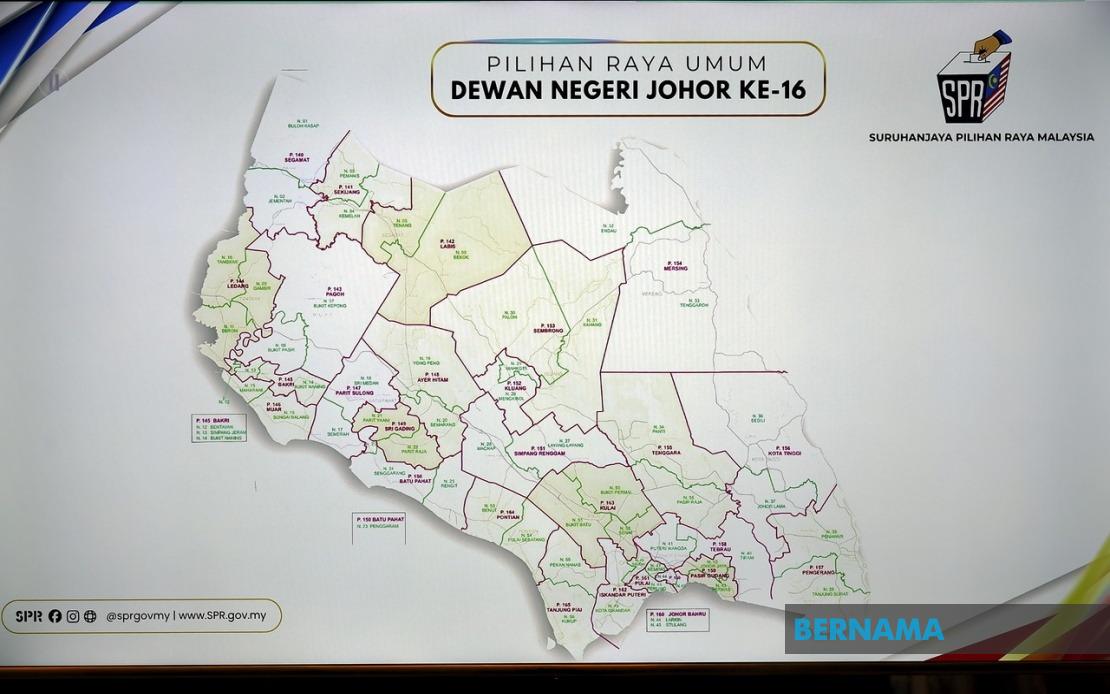
Johor's 16th state election moves into decisive territory tomorrow when nomination day opens the floodgates for what promises to be a fiercely competitive electoral contest. Across all 56 state assembly constituencies, candidates from multiple political parties will formally register their candidacies, transforming weeks of backroom manoeuvring and grassroots campaigning into an officially sanctioned battle for legislative seats. The Election Commission has established a tight procedural window, with registration occurring between 9 am and 10 am at designated nomination centres statewide, followed by a screening process before the complete roster of contenders is publicly released.
The sheer scale of participation underscores the intensity with which Malaysian political forces view this contest. Nearly 2.73 million registered voters—comprising over 2.7 million ordinary electors plus military personnel, their spouses, and police officers—will determine the composition of the state assembly when polling day arrives on July 11. Early voting has been scheduled for July 7, providing convenience for eligible military and law enforcement voters. This massive electorate reflects Johor's status as the nation's second-most populous state, making outcomes here inherently consequential for broader regional political dynamics and potentially influential on federal-level calculations.
Pakatan Harapan arrives at the nomination deadline with a comprehensive strategy, fielding candidates across all 56 seats through an inter-coalition arrangement. Parti Keadilan Rakyat brings 20 contenders to the table, with Amanah contributing 19 and DAP deploying 17. This full deployment signals confidence in the coalition's organisational capacity and reflects a determination to contest every possible constituency rather than concede ground through strategic non-participation. The composition mirrors negotiated seat-sharing agreements that have defined PH's internal workings since its 2018 electoral breakthrough, though recent tensions within the coalition have generated speculation about whether such unity will hold through the campaign.
Barisan Nasional responds with its own comprehensive slate, featuring 36 UMNO candidates as the dominant partner, supplemented by 16 from the Malaysian Chinese Association and four from the Malaysian Indian Congress. This full-seat strategy mirrors BN's traditional approach of establishing presence in every constituency, leveraging the coalition's historical organisational infrastructure and entrenched ground networks. The configuration reflects UMNO's overwhelming numerical dominance within BN, particularly in Johor where the party maintains its deepest roots and most established political machinery.
Perikatan Nasional, the third major coalition structure competing in the contest, has calibrated its approach differently. PAS will contest 11 seats, Bersatu 16, and the Malaysian Indian People's Party five, totalling 32 candidates across the state. This partial deployment suggests either resource constraints or a strategic decision to concentrate efforts in constituencies deemed particularly winnable for the coalition's component parties. The relatively modest numbers compared to the comprehensive deployments of PH and BN reflect PN's weaker organisational base in Johor, where it has struggled to establish deep roots despite capturing several parliamentary seats in 2022.
Three additional parties enter the contest with smaller footprints that nonetheless represent distinct political gambits. The Malaysian United Democratic Alliance contests four seats, positioning itself as a reform-minded centrist option. The Socialist Party of Malaysia fields a single candidate, maintaining its long-standing but marginal electoral presence. Most intriguingly, Parti Bersama Malaysia makes its electoral debut across 15 constituencies, representing a fresh entrant into Johor's political arena. Together, these three parties inject additional choice and fragmentation into what might otherwise be a straightforward three-way contest between the major coalitions.
The Election Commission has emphasised procedural rigour ahead of tomorrow's nomination deadline, urging prospective candidates to verify their documentation with Returning Officers and State Election officials beforehand. Deposit payments, which serve as financial commitments to the electoral process, must be settled expeditiously, with receipts retained as proof during paper submission. This administrative emphasis reflects lessons drawn from previous elections where late-stage documentation issues have occasionally created last-minute complications or candidate disqualifications, potentially altering the competitive landscape in specific constituencies.
Anti-corruption enforcement looms large over the campaign period. The Malaysian Anti-Corruption Commission has issued formal directives to all candidates and political parties, reminding them of obligations under the MACC Act 2009 and the Election Offences Act 1954 (Amendment 2012). To operationalise this oversight, the commission has established five dedicated 24-hour operations rooms positioned across Tampoi, Batu Pahat, Kluang, Segamat and Mersing. These facilities create accessible reporting channels for members of the public to lodge complaints regarding suspected corruption, electoral misconduct, or abuse of power. The spatial distribution across diverse regions of Johor ensures reasonable geographic accessibility for potential informants and signals the MACC's commitment to maintaining electoral integrity throughout the campaign.
The political context shaping this election traces directly to the Johor State Legislative Assembly dissolution announced on June 1. That administrative action set the constitutional clock running toward the mandatory election, following the assembly's dissolution rather than occurring at the natural completion of a full electoral term. The timing and circumstances surrounding the dissolution reflect broader factional movements within Johor's political ecosystem, though official statements have maintained procedural regularity.
The previous state election in 2022 established the baseline against which current prospects must be measured. Barisan Nasional secured a commanding 40 seats, substantially outpacing Pakatan Harapan's 12 seats, Perikatan Nasional's three seats, and MUDA's single seat. These results delivered overwhelming legislative dominance and enabled BN to construct a government with a supermajority. Whether those patterns hold or shift in this election remains the central question animating all current political calculations. The two-year interval since 2022 has witnessed evolving political circumstances at both state and federal levels, including shifts in coalition configurations and factional alignments that might alter voter preferences from their 2022 baseline.
For Malaysian observers and regional watchers, the Johor contest carries significance extending beyond the state's borders. Johor's size, economic importance, and position as UMNO's traditional stronghold make its electoral verdict consequential for understanding broader patterns in Malaysian electoral behaviour. Results here will inform assessments of whether the federal coalition dynamics established following the 2022 federal election remain stable or face erosion. The extent to which voters in this prosperous, ethnically mixed state embrace or reject the incumbent BN-led state government will send signals about satisfaction levels with current governance arrangements and the relative appeal of opposition alternatives.

