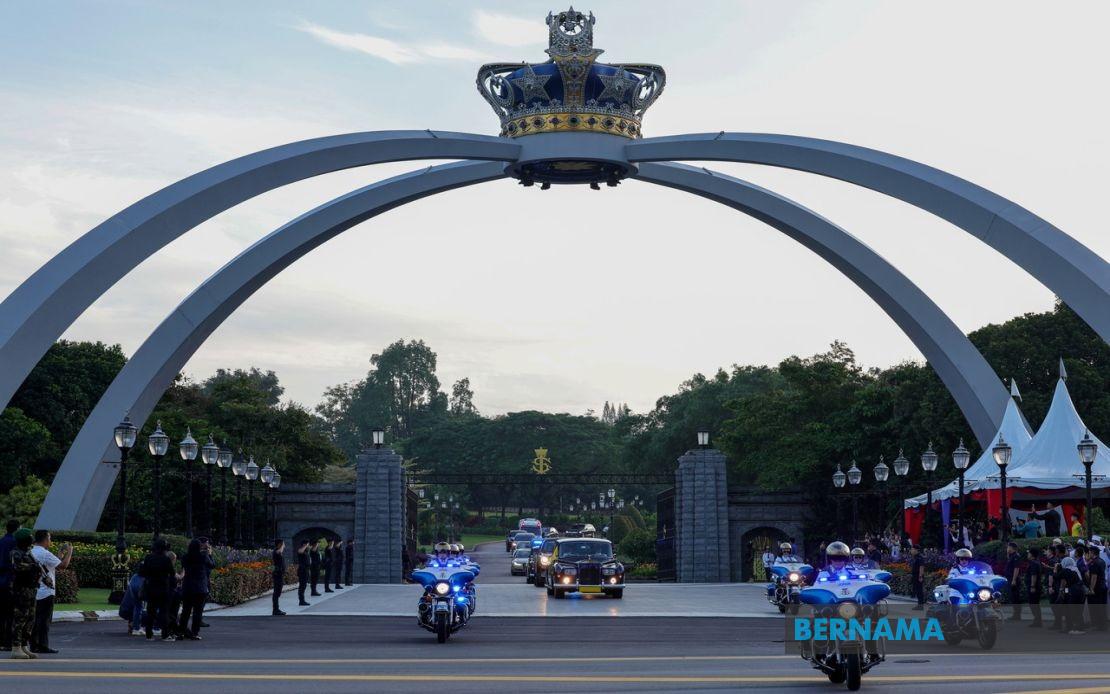
The ceremonial swearing-in of Johor's incoming Menteri Besar will proceed this afternoon at the state palace, marking the formal transition of leadership following the Barisan Nasional coalition's commanding performance at yesterday's polls. The royal event at Istana Bukit Serene is scheduled to commence at 3 pm, with media representatives invited to observe proceedings from the Crown Arch entrance to capture the historic occasion.
The identity of the designated Menteri Besar remained undisclosed at the time the official palace invitation circulated through WhatsApp channels to media outlets. This measured approach reflects customary practice in Malaysian constitutional monarchy, where the Sultan's formal appointment precedes public announcement of the officeholder's name. The ceremonial formality underscores the constitutional significance of the post as head of state executive authority, accountable to both the Sultan and the state legislative assembly.
Activity intensified throughout the morning at Saujana, the official residence of the Menteri Besar, where media contingents had assembled since noon to track unfolding developments. Similar vigilance was evident outside the palace gates themselves, with journalists positioning themselves to capture the moment when the incoming chief minister arrives for the swearing ceremony. This concentrated media presence reflects the high-stakes political significance of Johor's leadership transition and the broader implications for Malaysia's federal political landscape.
Earlier today, Sultan Ibrahim Iskandar received Barisan Nasional chairman Datuk Seri Ahmad Zahid Hamidi at Istana Pasir Pelangi for an extended audience lasting approximately one hour. The presence of Johor BN chairman Datuk Onn Hafiz Ghazi at this palace meeting suggested preparation for the leadership transition and coordination between federal coalition leadership and the state administration. These pre-ceremony consultations represent standard constitutional protocol whereby the Sultan deliberates with political stakeholders before formalising appointments.
The backdrop to today's swearing-in involves the decisive electoral mandate Barisan Nasional secured on July 11, when voters delivered the coalition a substantial parliamentary supermajority in Johor's state assembly. The coalition captured 48 of the 56 contested state seats, a performance reflecting consolidation of BN's dominance in the southern state and potentially signalling voter confidence in the coalition's governance record. This outcome assumes particular significance given Johor's status as Malaysia's second-largest state by population and its economic importance as a major manufacturing and logistics hub for Southeast Asia.
The incoming Menteri Besar will assume office during a period when Johor continues navigating post-pandemic economic recovery and managing development pressures in its rapidly urbanising zones. The new leadership will inherit ongoing policy challenges including infrastructure expansion in the Iskandar Malaysia investment zone, management of the state's tourism sector, and coordination with federal authorities on cross-border economic initiatives with Singapore. The Menteri Besar position carries substantial responsibility for translating the coalition's electoral mandate into concrete administrative performance.
Johor's political trajectory has undergone considerable shifts in recent years, with power alternating between coalitions and different political configurations. The present BN victory represents restoration of the coalition's dominant position in the state following previous periods of contested governance. The resounding nature of the electoral outcome provides the incoming administration with a clear mandate to pursue policy initiatives and suggests voter acceptance of the coalition's development approach.
Today's ceremonial proceedings will formalise the constitutional apparatus for translating electoral victory into governmental authority. The swearing-in ceremony represents more than symbolic pageantry; it establishes the formal legitimacy and accountability frameworks through which the Menteri Besar will exercise executive powers. The oath administered before the Sultan reinforces the constitutional subordination of elected leadership to constitutional monarchy and the Rule of Law.
The incoming administration will operate within Malaysia's federal system, requiring coordination with the federal government on matters spanning development financing, infrastructure funding, and alignment of state policies with national priorities. The Menteri Besar's relationship with federal authorities becomes crucial for accessing development resources and implementing economic strategies that depend on national-level support. This intergovernmental dimension shapes the practical effectiveness of state-level governance regardless of electoral mandates.

