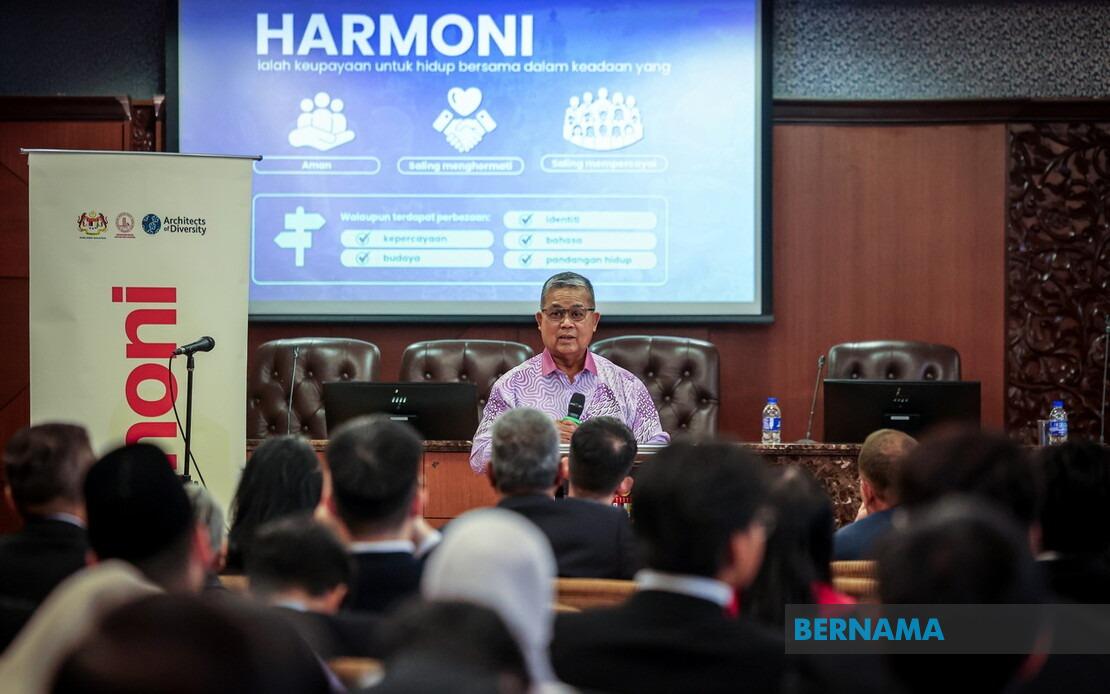
The Department of National Unity and National Integration (JPNIN) is developing a Community Tension Index designed to quantify the state of social cohesion across Malaysia and identify emerging threats to communal harmony. Minister of National Unity Datuk Aaron Ago Dagang unveiled the initiative during remarks at the 2026 Harmony Symposium, organised by the Secretariat of the Malaysian Parliamentary Cross-Party Group on Racial and Religious Harmony at Parliament Building in Kuala Lumpur on June 26. The index represents a systematic attempt to move beyond anecdotal assessments of national unity, providing government policymakers with empirical data to guide preventive measures and strategic interventions before tensions escalate into widespread conflict.
The timing of this initiative reflects a fundamental shift in how Malaysia's authorities perceive threats to social stability. Rather than viewing divisive content as primarily confined to physical spaces, the government now recognises that digital platforms have become the primary battleground for competing narratives around race, religion and royalty—the so-called 3R issues that remain particularly sensitive in Malaysia's multicultural context. Between January 1, 2025 and January 31, 2026, the Malaysian Communications and Multimedia Commission (MCMC) removed 1,493 pieces of online content related to these three categories through enforcement actions. This volume suggests a systemic problem that conventional monitoring mechanisms struggle to address comprehensively.
The proliferation of divisive content online stems partly from structural features inherent to social media platforms themselves. Aaron highlighted how recommendation algorithms create what he termed "filter bubbles" and "echo chambers"—self-reinforcing information environments where users predominantly encounter content confirming their existing worldviews. These mechanisms inadvertently amplify polarising messages while suppressing moderate or bridge-building perspectives. For Malaysian society, where constructive interfaith and interracial dialogue remains essential to maintaining harmony, the algorithmic narrowing of discourse poses a genuine threat to the shared understanding necessary for coexistence. Users increasingly inhabit separate informational universes, making genuine dialogue across community lines progressively more difficult.
The Community Tension Index itself will measure various dimensions of social cohesion by collecting data from multiple sources and stakeholder groups. While specific methodologies were not detailed in Aaron's remarks, such indices typically incorporate measures of trust between communities, frequency and severity of reported tensions, media sentiment analysis, and perceptions of safety and inclusion among different demographic groups. For Malaysia, the index would need to account for the particular sensitivities around religion, monarchy and ethnicity while remaining sensitive to regional variations—tensions that manifest in urban centres like Kuala Lumpur may differ significantly from those in smaller towns or rural areas where community structures and information sources vary considerably.
Beyond measurement and monitoring, JPNIN has initiated broader consultations regarding the establishment of a National Harmony Commission (SKN), a proposed institutional body designed to institutionalise the government's approach to preventing and resolving communal tensions. According to Aaron, the commission would function as a dedicated mechanism for early prevention, mediation and conflict resolution, operating on principles that remain both harmonious and constructive in approach. The institution would also possess investigative powers to examine issues that might threaten national harmony, potentially giving it considerable reach into disputes that might otherwise remain localised. This represents a significant institutional innovation in Malaysia's governance architecture, creating a dedicated entity focused exclusively on social cohesion rather than distributing these responsibilities across multiple agencies.
The proposed commission's role in early prevention carries particular significance in a digital context. Traditional conflict resolution mechanisms typically engage after tensions have already surfaced and hardened into opposing positions. An early warning system based on the Community Tension Index could theoretically identify emerging flashpoints—trending hashtags promoting divisive narratives, coordinated campaigns targeting specific communities, or sudden spikes in complaints about particular issues—before they metastasise into real-world confrontations. For a diverse society like Malaysia, where historical communal incidents remain within living memory and continue to influence interethnic relations, preventive approaches offer potentially more effective paths to stability than reactive interventions.
The initiative also reflects international best practices in social cohesion management. Several countries have developed similar indices or established national commissions focused on interfaith and interethnic relations. New Zealand's approach following the Christchurch attacks, Canada's multiculturalism policies, and Singapore's emphasis on racial harmony all involve both systematic measurement and institutional coordination. Malaysia's adaptation of these approaches acknowledges that maintaining harmony in diverse societies requires intentional, well-resourced effort rather than reliance on goodwill alone. The explicit focus on 3R issues recognises Malaysia's particular vulnerabilities while attempting to create mechanisms robust enough to address evolving threats in digital environments.
Implementation of the Community Tension Index will require coordination across government agencies, tech platforms, civil society organisations and academic institutions. JPNIN's engagement sessions with various stakeholders represent an initial step in building this ecosystem of cooperation. Universities could contribute research expertise in designing robust methodologies and interpreting data. Civil society organisations bring credibility with community groups and deep contextual knowledge of local dynamics. Tech platforms possess data on harmful content circulation, though balancing surveillance with privacy rights will require careful negotiation. This multiagency approach reflects recognition that no single institution possesses sufficient information or legitimacy to meaningfully assess social cohesion in Malaysia's complex landscape.
For Malaysian readers and policymakers, the most immediate practical implication concerns how government resources will be allocated based on index findings. Will areas with high tension scores receive targeted interventions—additional community policing, school-based dialogue programmes, or enhanced fact-checking resources? How will the government balance transparency about findings with sensitivity to communities that might be identified as tension flashpoints? The answers to these questions will substantially determine whether the index becomes a genuine tool for proactive peacebuilding or merely another bureaucratic monitoring mechanism generating data without driving meaningful change. Successful implementation requires political will to follow through on early warning signals, even when addressing them might prove controversial or resource-intensive.
The shift toward systematic measurement and institutional coordination around national harmony reflects broader recognition that Malaysia's stability cannot be taken for granted. While the country has navigated numerous potential flashpoints over its history, the velocity and reach of digital communication means tensions can escalate with unprecedented speed. An online misrepresentation of a religious figure, a doctored image suggesting governmental overreach, or a coordinated disinformation campaign can rapidly activate historical grievances and mobilise large populations before traditional fact-checking mechanisms can respond. By establishing frameworks to detect, monitor and address these emerging threats, the government signals its commitment to protecting the social cohesion that underpins Malaysia's prosperity and relative stability compared to some neighbouring countries experiencing greater communal instability.

