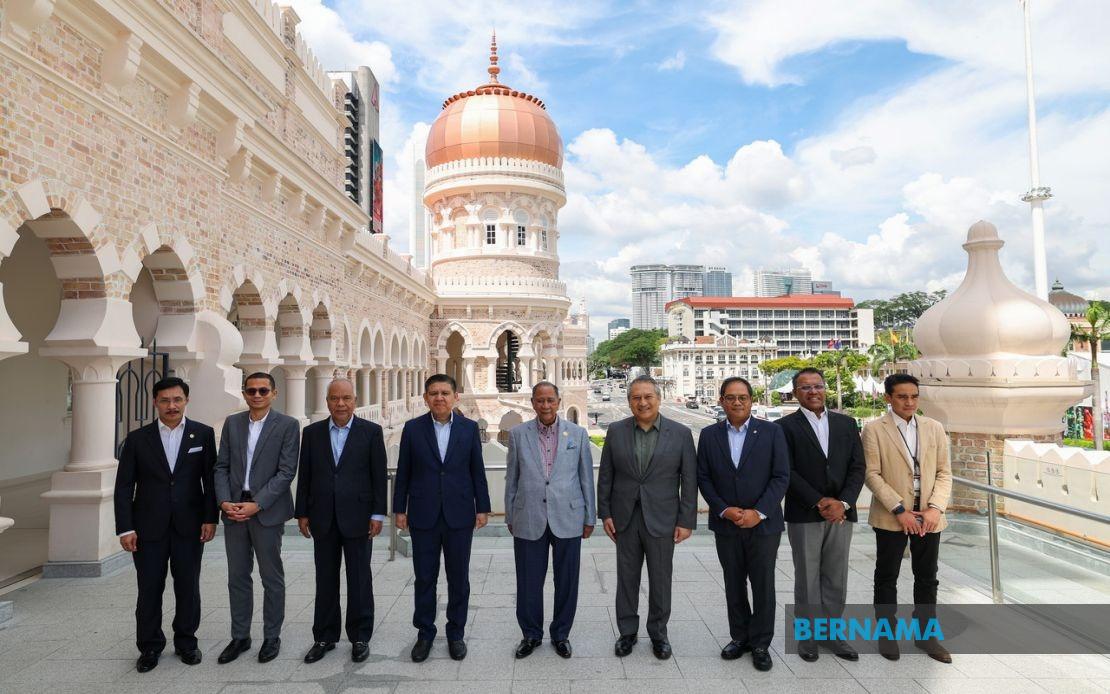
The Sultan of Kedah, Al Aminul Karim Sultan Sallehuddin Sultan Badlishah, paid a formal visit to the Sultan Abdul Samad Building in Kuala Lumpur on June 24, touring the recently restored heritage landmark that stands as a tangible symbol of Malaysia's independence journey. The royal visit underscores the continuing commitment of the nation's institution to preserving sites of historical importance, particularly those connected to the country's transition from colonial rule to nationhood.
Received by Khazanah Nasional managing director Datuk Amirul Feisal Wan Zahir upon his arrival at approximately 10.30 am, the Sultan engaged with several senior officials including chief corporate officer and general legal adviser Datuk Mohamed Nasri Sallehuddin and head of real assets Selvendran Katheerayson. The structured itinerary reflected the significance attached to the occasion, with each gallery and exhibition space carefully incorporated into the schedule to showcase the restoration's scope and quality.
The morning agenda centred on the Confluence Hall, where the Sultan examined displays documenting Kuala Lumpur's origins and urban development trajectory. Mariana Isa, a senior manager at Think City, provided detailed briefings on the exhibition's curatorial approach and the historical narratives embedded within each section. This gallery serves as the building's primary educational offering, translating centuries of Kuala Lumpur's transformation into an accessible visual and contextual experience for diverse audiences.
Progressing through the facility, His Royal Highness also inspected the Visionary Hall, which employs three-dimensional models and interactive multimedia presentations to illustrate how the capital has evolved and the strategic planning decisions that shaped its contemporary form. The inclusion of this exhibition space reflects a broader institutional recognition that heritage preservation extends beyond mere structural conservation—it encompasses the active interpretation and communication of historical meaning to present-day visitors and future generations.
A visit to the building's Porte Cochere balcony provided the Sultan with a vantage point to observe the architectural prominence of this colonial-era structure within Kuala Lumpur's contemporary urban landscape. The positioning allowed reflection on how the building's nineteenth-century design principles have withstood modernization pressures and remain functionally integrated into the city's civic identity.
The itinerary concluded with an inspection of the School of Hard Knocks, an enterprise operated by Royal Selangor that functions as both a social initiative and cultural venue within the restored complex. Following this segment, the Sultan participated in a light luncheon before departing the building at approximately 1.15 pm, bringing the three-hour engagement to a close.
Datuk Amirul Feisal publicly acknowledged the royal visit as a significant endorsement of Khazanah Nasional's broader mission concerning heritage stewardship. His remarks positioned the Sultan's attendance within a larger framework extending beyond the physical restoration of the building itself, emphasizing how conservation efforts serve the dual purpose of safeguarding material heritage while simultaneously strengthening national historical consciousness. He articulated that such institutional support validates the investment required for ambitious heritage projects.
Since its public opening on February 2, the Sultan Abdul Samad Building has attracted approximately 200,000 visitors, suggesting robust community interest in the revitalized facility and its educational offerings. This visitor volume indicates that the restoration has succeeded in transforming the structure from a largely symbolic landmark into an actively engaged cultural destination capable of absorbing significant foot traffic.
The restoration initiative itself represents a substantial undertaking, with Phase One completion officially marked on January 31 when His Majesty Sultan Ibrahim, King of Malaysia, presided over ceremonies acknowledging the achievement. The conservation work spanned eleven months under the Khazanah Heritage Fund programme, employing specialized methodologies to address deterioration while maintaining architectural authenticity. This phased approach acknowledges that comprehensive heritage restoration typically requires sustained effort and resource allocation.
Historically, the structure originally functioned as the Secretariat Building during the colonial administration, positioning it at the administrative heart of British Malaya. Its most iconic moment arrived in 1957 when the building witnessed the symbolic lowering of the Union Jack and the simultaneous raising of the Federation of Malaya flag—a ceremonial transition crystallizing the nation's independence achievement. This historical resonance explains the building's elevated status within Malaysian collective memory and its designation as worthy of major restoration investment.
For Malaysian observers and regional stakeholders, the royal visit carries implications extending beyond ceremonial protocol. It signals ongoing dynastic and institutional commitment to historical preservation at a moment when rapid urbanization pressures heritage sites across Southeast Asia. The Sultan of Kedah's engagement provides a template for how royalty can actively participate in cultural stewardship beyond ceremonial functions, modeling the integration of heritage consciousness into governance structures.
The Khazanah Nasional initiative demonstrates that significant heritage buildings can achieve contemporary relevance through thoughtful curation and adaptive reuse. Rather than functioning as static museums, the Sultan Abdul Samad Building now serves educational, commercial, and cultural purposes simultaneously, suggesting a sustainable model for heritage preservation that generates visitor interest and institutional revenue while honoring historical significance.
Looking forward, the successful completion of Phase One restoration creates foundation for potential subsequent phases, possibly expanding public access or deepening interpretive offerings. The royal endorsement visible through the Sultan of Kedah's visit provides political and cultural momentum for sustaining this conservation momentum, reinforcing to government and private stakeholders that heritage preservation commands respect at the highest institutional levels across Malaysia's federal structure.

