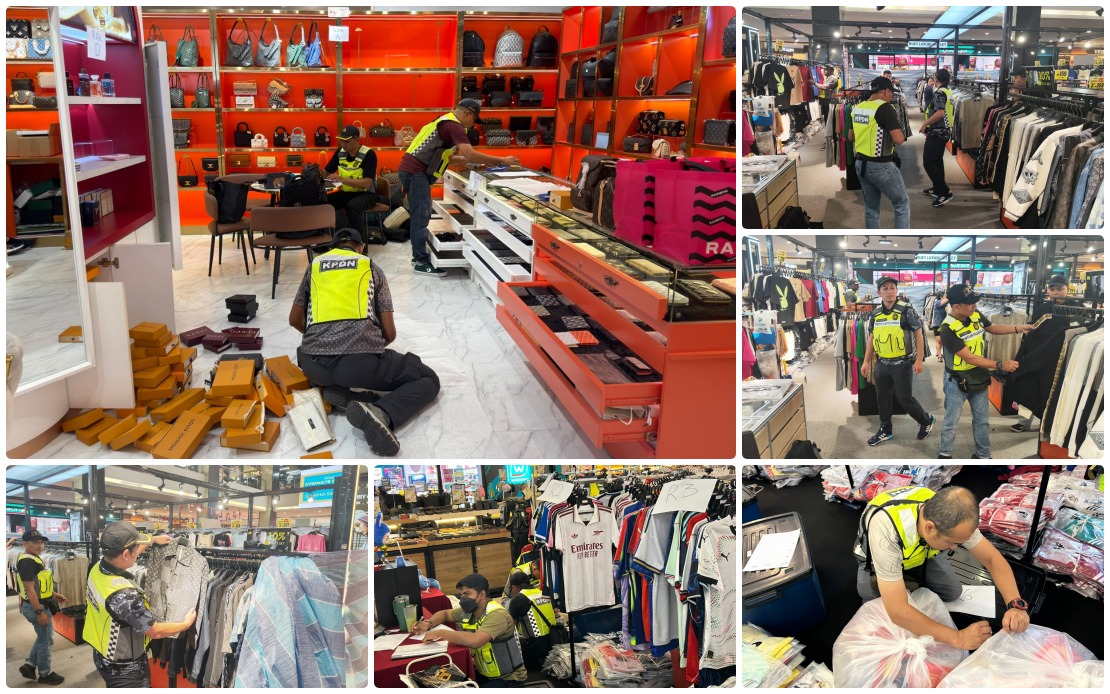
The Ministry of Domestic Trade and Cost of Living (KPDN) has completed a significant enforcement operation against the sale of counterfeit branded goods in Johor Bahru, resulting in the seizure of merchandise estimated at RM600,000 across three retail locations. The raids, conducted on June 15 by the Putrajaya Enforcement Division, represent an intensified effort to combat intellectual property violations that have become increasingly sophisticated in the region. Datuk Azman Adam, the ministry's enforcement director-general, disclosed the operation in a statement issued on June 19, underscoring the government's commitment to protecting legitimate brand owners and consumers from deceptive trading practices.
The operation culminated from a sustained month-long intelligence-gathering effort targeting traders who had established distribution networks through major supermarket chains in the state. KPDN investigators identified the suspects as potentially supplying counterfeit merchandise to other retailers, indicating an organised supply chain rather than isolated street vendors. This sophisticated distribution model suggests that counterfeit goods were reaching consumers through seemingly legitimate retail channels, a troubling development that undermines consumer trust in established shopping venues. The breadth of the operation across multiple premises points to a coordinated network designed to maximise market penetration and profits through volume sales.
The seized merchandise encompassed a diverse range of luxury and fashion items bearing forged trademarks, including clothing, handbags, wallets, belts, and perfumes purportedly belonging to internationally recognised brands. Such products typically command premium prices due to brand reputation and perceived quality, making them attractive targets for counterfeiters seeking to exploit consumer aspirations for luxury goods at fraction costs. The inclusion of perfumes in the seizure reveals that counterfeiters have expanded beyond traditional fashion items to higher-value personal care products, where authenticity verification proves more challenging for ordinary consumers. Associated business documentation discovered during the raids has provided investigators with crucial evidence of the operation's scale and sophistication.
Four individuals—comprising the premises owner, caretaker, and two others involved in business management—were detained to assist ongoing investigations. Their cooperation is deemed essential for understanding the supply chain origins, distributor networks, and customer bases that sustained this operation. The involvement of multiple individuals in different operational roles suggests a formalised business structure rather than casual entrepreneurship, reinforcing authorities' assessment that this represented an organised commercial enterprise. Each suspect's specific role within the organisation will likely determine the severity of charges and potential penalties.
Initial verification by representatives of the trademark owners confirmed sufficient grounds to pursue charges under Section 102(1)(c) of the Trademark Act 2019 [Act 815], which specifically addresses possession, custody, or control of goods bearing illegally applied trademarks with trading intent. This legislative framework provides KPDN with robust prosecutorial tools designed specifically for modern counterfeit operations. The act distinguishes between individual offenders and corporate entities, imposing graduated penalties that escalate substantially for repeat violations, reflecting parliament's intent to deter organised counterfeiting networks.
For individual offenders, first-time conviction carries penalties of up to RM10,000 per counterfeit item or three years imprisonment, or both, creating meaningful financial and custodial consequences. Repeat offences attract significantly harsher penalties, with fines reaching RM20,000 per item and imprisonment extending to five years. These escalating penalties acknowledge that organised counterfeiters often recidivate despite initial prosecution. For corporate entities and companies involved in manufacturing or distribution, penalties commence at RM15,000 per item for first offences and climb to RM30,000 per item for subsequent violations, ensuring that institutional actors face proportionally severe consequences.
The legislative framework reflects growing regional and international concern about counterfeit goods' broader economic impacts. Beyond direct revenue loss for legitimate brand owners, counterfeiting corrupts market competition, damages consumer confidence in retail channels, and can pose genuine health and safety risks when applied to pharmaceuticals, personal care items, or food products. ASEAN nations including Malaysia have progressively strengthened intellectual property protections, recognising that sophisticated counterfeiting networks operate across borders and require coordinated enforcement responses. This Johor operation demonstrates KPDN's capacity to execute complex investigations and coordinate multi-location raids effectively.
Datak Azman's public statement regarding KPDN's commitment to intensified future operations carries significance for both consumers and legitimate businesses operating in Malaysia. The ministry's declaration that it will not compromise with counterfeit operations signals strengthened enforcement resolve, potentially encouraging brand owners to report suspected violations and consumers to report suspicious retailers. This visibility also serves deterrent functions, alerting potential counterfeiters that supply chain vulnerabilities are increasingly monitored and prosecuted. The emphasised focus on intellectual property rights protection aligns Malaysia with international trade agreements and international brand owner expectations.
For Malaysian consumers, this operation underscores the risks inherent in purchasing heavily discounted branded goods from unverified sources or informal retail channels. Counterfeit products frequently exhibit inferior craftsmanship, use substandard materials, and lack quality assurance testing, despite commanding near-authentic price points. The psychological satisfaction consumers derive from brand consumption becomes illusory when products are fake, representing pure economic waste. Legitimate retailers, particularly supermarket chains identified as unwitting distribution points, face reputational consequences when their shelves inadvertently stock counterfeit merchandise, creating incentives for rigorous supplier verification.
The broader implications extend to Southeast Asia's economic development trajectory. The region's growing middle class represents an attractive market for both legitimate luxury brands and counterfeiters seeking to capture aspiring consumers. Malaysia's decisive action against this operation contributes to a regional enforcement environment that gradually increases operational risks and costs for counterfeit networks. When neighbouring countries demonstrate similar commitment to intellectual property protection, counterfeiters must continuously relocate operations, disrupting their networks and limiting their market reach. This cumulative effect across multiple jurisdictions represents the most effective long-term strategy for combating organised counterfeiting.
Looking forward, the success of this particular operation depends substantially on prosecution outcomes and the willingness of courts to impose penalties reaching statutory maximums. Conviction rates for intellectual property violations have historically varied across Malaysian jurisdictions, with some courts imposing relatively lenient sentences that fail to deter recidivism. The RM600,000 seizure value in this case provides prosecutors with concrete evidence of significant criminal enterprise, potentially influencing judicial sentencing decisions. KPDN's willingness to publicise enforcement actions also creates accountability mechanisms, enabling civil society and international brand representatives to monitor prosecution progress and sentencing outcomes.
Meanwhile, the intelligence-driven methodology employed in this operation—involving month-long surveillance prior to execution—suggests KPDN is adopting sophisticated investigative approaches rather than reactive enforcement. This forward-looking posture, combining proactive intelligence gathering with surprise raids at critical moments, provides superior disruption potential compared to routine compliance inspections. The approach mirrors enforcement strategies employed by customs authorities targeting smuggled goods, demonstrating institutional learning within Malaysia's regulatory apparatus. Sustained commitment to intelligence-led enforcement operations will likely yield diminishing returns for counterfeit networks operating throughout the Klang Valley and other major metropolitan areas.

