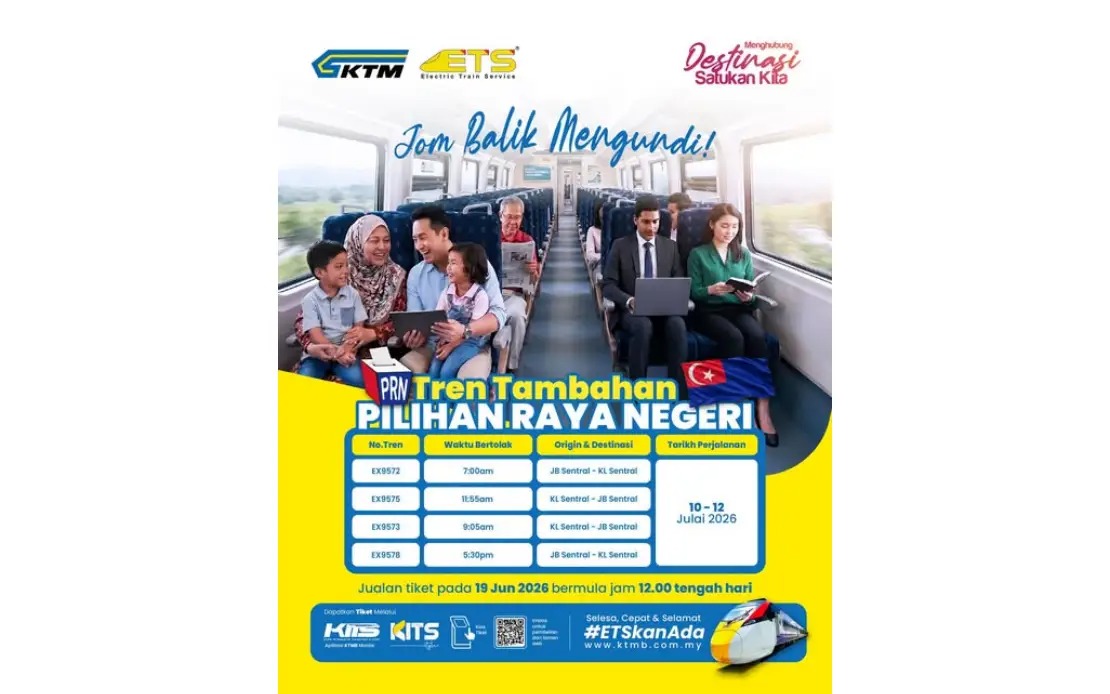
Malaysia's national railway operator Keretapi Tanah Melayu Berhad (KTMB) has moved to expand passenger capacity on its southern-bound Express Rail Link (ETS) services, responding to anticipated demand from voters travelling home for the Johor state election. The operator announced the additional train slots through its official social media channels, signalling preparations for what transport authorities expect to be a significant surge in rail traffic during the polling period.
Ticket bookings commenced at noon on June 19, with KTMB offering multiple avenues for purchase to maximise accessibility for travellers. Prospective passengers can secure reservations via the KTMB Mobile application, the KITS Style platform, the company's official website at online.ktmb.com.my, or through in-person visits to KTMB ticket kiosks located across the country. This multi-channel approach reflects the operator's recognition that voters—many of whom may be working or studying outside their home state—require convenient booking options during what is typically a busy period.
The timing of the service expansion aligns with the Election Commission's designation of July 11 as polling day for the Johor state election. This date follows the dissolution of the State Legislative Assembly on June 1, which triggered the electoral process. By opening the three-day travel window from July 10 to 12, KTMB has effectively bracketed the voting day to accommodate both early arrivals and post-polling day returns, a standard approach that acknowledges voters may need flexibility in their travel schedules.
The decision to augment ETS capacity reflects a broader pattern of transport coordination during Malaysian electoral events. Major elections consistently generate predictable spikes in intercity rail and road traffic as citizens return to their constituencies to vote. KTMB's proactive approach—announced well in advance of the travel window—suggests the railway has analysed expected passenger volumes and determined that regular scheduled services would be insufficient. This forward planning helps prevent congestion at stations and overcrowding on trains, maintaining service standards during peak periods.
For voters in Johor and surrounding regions, the expanded rail option offers a compelling alternative to driving, particularly for those commuting from Kuala Lumpur and the Klang Valley. The ETS network's southern corridor connects major urban centres, making it feasible for working professionals and students to return home efficiently. Rail travel also reduces road congestion during what becomes a critical transport period, benefiting the broader travelling public and reducing strain on highway infrastructure.
The announcement carries implications beyond immediate voter convenience. It demonstrates KTMB's operational responsiveness to national events and its capacity to mobilise additional resources within compressed timeframes. Such flexibility is essential for a transport operator serving a country where electoral cycles—both federal and state—create recurring demand surges that demand sophisticated planning and execution.
From a democratic participation perspective, removing transport barriers encourages voter turnout, particularly among those who have relocated for economic opportunities but retain voting rights in their constituencies. High-capacity, affordable rail services lower the practical cost of voting, which can be significant for lower-income voters for whom travel expenses might otherwise be prohibitive. KTMB's expansion thus functions as a small but meaningful enabler of electoral participation.
The southern corridor's importance for Johor voters cannot be overstated, as a substantial portion of the state's electorate works or studies in other regions. Whether employed in Selangor's manufacturing sectors, attending universities in the Klang Valley, or working in Kuala Lumpur's financial district, many Johor residents rely on efficient return routes to exercise their constitutional right to vote. Rail services provide speed and comfort advantages over road travel for long-distance commuting, particularly on congested routes where highway delays would compress the available voting window.
Operationally, adding services requires coordination across multiple departments—train crew scheduling, maintenance oversight, passenger services, and ticketing systems. KTMB's ability to execute this expansion demonstrates organisational preparedness and resource availability. The multi-platform ticketing approach also indicates technology infrastructure capable of handling increased transaction volumes without system failures, a consideration often overlooked but essential for customer satisfaction.
Looking ahead, this model of election-related service augmentation may inform how KTMB approaches future national and state polls. Should the Johor expansion succeed in meeting demand and receive positive feedback from passengers, the operator may refine its scaling procedures for subsequent elections. Similarly, other transport providers—bus operators and budget airlines—often implement comparable capacity increases during electoral periods, creating a coordinated transport ecosystem that supports civic participation.
The broader Southeast Asian context also merits consideration. Regional transport networks generally expand service during high-demand periods, but few operators publicise such efforts as explicitly as KTMB has done. This transparency helps voters plan with confidence and suggests growing recognition that seamless transport access is integral to functional democracy. As Malaysia continues to hold regular electoral exercises at federal and state levels, the mechanisms that facilitate voter mobility—including railway capacity planning—become increasingly central to electoral administration.

