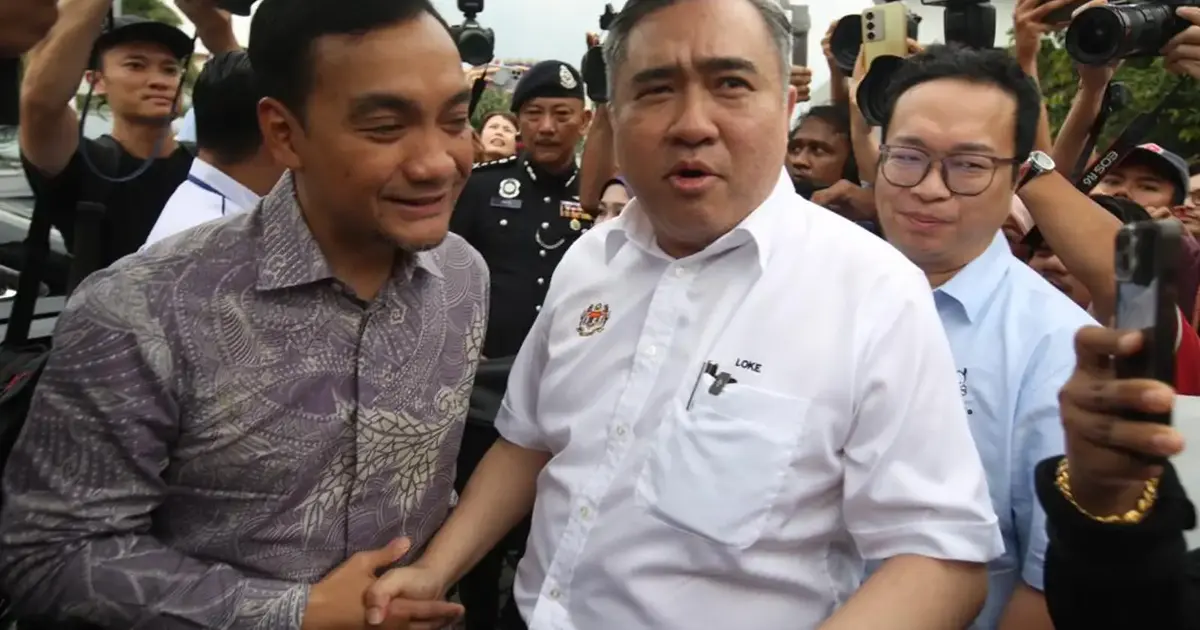
Transport Minister Anthony Loke and Johor Menteri Besar Onn Hafiz Salleh came face-to-face for the first time since their recent public spat, demonstrating the delicate balancing act required in Malaysian politics when coalition partners find themselves at odds. The meeting, centred around a transport ministry event, proceeded without visible acrimony, though the carefully choreographed proceedings revealed the work required to paper over cracks in their working relationship.
The encounter provided a test of political maturity for both figures, each representing significant constituencies within Malaysia's complex federal-state governance framework. Loke's position as Transport Minister places him at the apex of national infrastructure planning, while Onn Hafiz's role steering Johor—the nation's economic engine and most populous peninsula state—commands considerable regional influence. Their previous disagreement, conducted through social media channels, had raised questions about the stability of their professional relationship and the broader health of the Pakatan Harapan coalition.
During his remarks at the ministry event, Onn Hafiz took a measured but pointed approach, indirectly criticizing the DAP leader through reference to the logistical inconvenience caused by the gathering. By emphasising that he had been obliged to alter his schedule following a last-minute invitation to attend the function, the Johor leader managed to lodge a subtle complaint while maintaining the technical protocols of public diplomatic engagement. This rhetorical manoeuvre allows both politicians to claim they addressed their differences whilst avoiding explicit confrontation.
The nature of their previous disagreement reflects broader ideological and strategic divisions within the ruling coalition. The DAP, as a predominantly Chinese-supported party advocating secular governance and progressive policies, occasionally clashes with the more ethnically-focused and Islamically-inclined approach championed by Onn Hafiz's UMNO-aligned faction. These tensions, while manageable at the national level through careful coalition management, tend to surface more visibly in states like Johor where demographic and political considerations carry heightened significance.
Such public-yet-restrained interactions have become the vernacular of Malaysian coalition politics, where elected officials must simultaneously represent their constituent communities while maintaining the broader alliance necessary for governance. The meeting's cordial atmosphere, despite the underlying friction, demonstrates leaders' understanding that public displays of disunity invite opportunistic challenges from opposition quarters. Both Loke and Onn Hafiz recognised that allowing tensions to boil over would hand strategic advantages to rival political forces.
The incident underscores how technology and social media have transformed political disagreements in Malaysia. Unlike previous eras when such disputes might remain confined to closed-door discussions or party structures, contemporary conflicts play out across digital platforms where constituents observe and interpret every exchange. This shift has created pressure for leaders to resolve differences swiftly, as prolonged online disputes damage credibility and invite public criticism from multiple directions.
For Malaysian readers navigating the current political landscape, these encounters between coalition partners reveal important truths about how government actually functions. The national administration depends not on unanimous agreement across all parties, but on the willingness of diverse political actors to compromise and collaborate despite significant differences. Moments of friction, properly managed, need not destabilise governing coalitions—provided leadership remains committed to the broader project of administering the country effectively.
The transport ministry's event that prompted this reunion likely centred on infrastructure initiatives requiring coordination between federal and state authorities. Johor's rapid urbanization and growing transportation demands make close federal-state cooperation essential for projects ranging from public transit expansion to road network improvements. Both Loke and Onn Hafiz, regardless of their personal tensions, share institutional incentives to ensure that transport policy succeeds at ground level, where constituents experience the real-world consequences of political decisions.
The meeting's significance extends beyond the immediate personalities involved, offering a microcosm of how Malaysia's coalition government navigates the complexity of multi-party, multi-ethnic governance. The country's political system requires constant negotiation between parties representing different communities, ideologies, and regional interests. When such negotiations involve transparent communication and mutual respect for institutional roles, the system functions relatively smoothly. When they break down into persistent hostility, governance suffers and opportunities for opposition parties to exploit divisions multiply.
Looking forward, observers of Malaysian politics should monitor whether this cordial-yet-tense encounter leads to genuine reconciliation between the two leaders or merely represents a temporary ceasefire. The quality of their working relationship carries implications not just for Johor's development trajectory but for the broader stability of the federal coalition government. Transport policy, covering areas from urban rail networks to highway tolling, touches millions of Malaysians daily, making departmental effectiveness dependent on smooth federal-state coordination. Loke and Onn Hafiz's ability to move past their disagreement will therefore have tangible effects on the experience of ordinary commuters and businesses relying on Malaysia's transport infrastructure.