The anniversary of Prophet Muhammad's migration to Medina served as a catalyst for nationwide reflection on personal transformation and collective progress, with celebrations held across Malaysia on June 17 emphasising how the concept of hijrah extends beyond historical significance to inspire contemporary renewal and societal advancement. Woven throughout the day's events was a broader message that meaningful change requires not only individual commitment but also visionary leadership capable of channelling that energy toward the welfare of all citizens and the strengthening of Islamic civilisation.
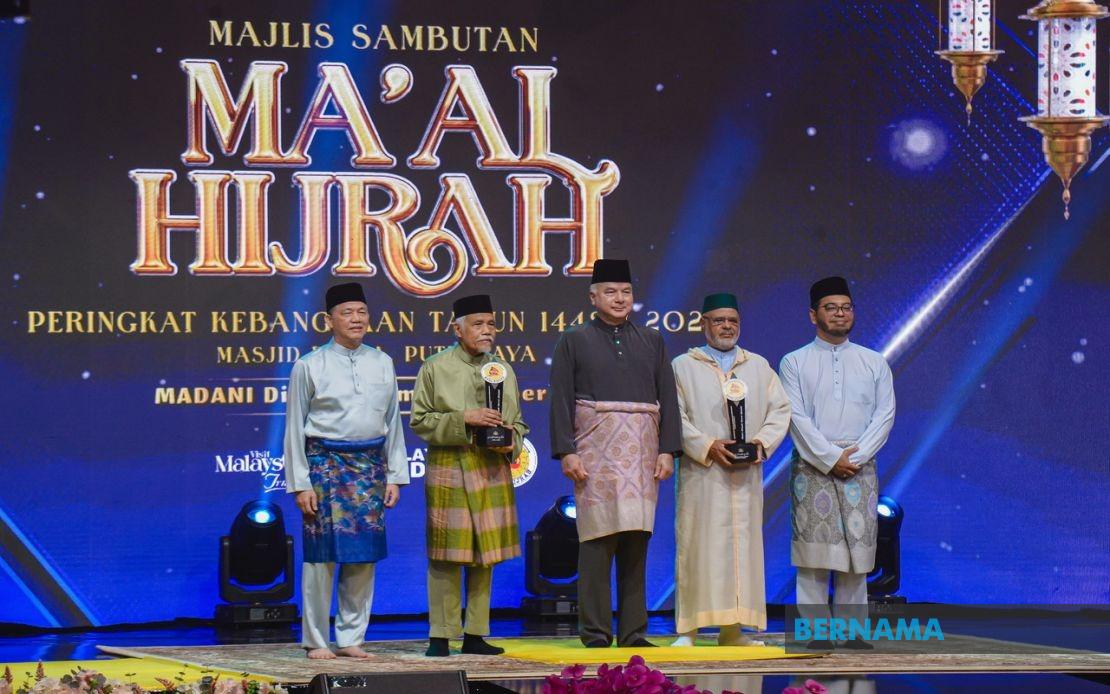
The centrepiece gathering, held in Kuala Lumpur under the theme "MADANI Dihayati, Ummah Diberkati" (MADANI Lived, Ummah Blessed), drew approximately 5,000 attendees and attracted prominent national figures including Deputy Prime Minister Datuk Seri Fadillah Yusof and Minister in the Prime Minister's Department (Religious Affairs) Dr Zulkifli Hasan. Their participation underscored government commitment to leveraging religious occasions as platforms for reinforcing principles of good governance and ethical leadership. The gathering combined traditional spiritual elements—Quran recitations and religious discourse—with formal recognition of individuals deemed exemplars of Islamic values, creating a programme that balanced devotional practice with institutional acknowledgement of community contributions.
Sultan Nazrin, in his capacity as Sultan of Perak, presented the prestigious National Tokoh Maal Hijrah Award to International Islamic University Malaysia rector Prof Emeritus Datuk Dr Osman Bakar, recognising the institution's role in advancing Islamic higher education and scholarship within Malaysia's academic landscape. Simultaneously, the International Tokoh Maal Hijrah Award was conferred upon Moroccan Islamic jurisprudence scholar Dr Ahmad Al-Raysuni, reflecting Malaysia's engagement with contemporary Islamic thought across the Muslim world and signalling openness to intellectual exchange beyond national borders.
The award categories recognised diverse expressions of Islamic commitment and community service across different demographics and professional spheres. Community activist Datuk Ag Sharin Alimin, whose career in religious affairs administration positioned him at the intersection of government and community engagement, received the male category Tokoh Maal Hijrah Award, while former Sabah deputy state secretary Datuk Masnah Matsalleh was honoured in the female category, acknowledging women's contributions to public service and social welfare within the Malaysian administrative framework.
Parallel celebrations extending to Sabah illustrated how the Maal Hijrah observance resonates across Malaysia's diverse regions and ethnic landscapes. A separate ceremony, attended by approximately 1,000 participants, featured Ahmad Samsuri presenting the Tokoh Maal Hijrah Award to 95-year-old Quran teacher Jusoh @ Muda Ismail. The selection of a nonagenarian educator who had studied under the legendary Quranic scholar Tuan Guru Haji Mat Lintar carried symbolic weight, linking contemporary Islamic practice to established traditions of Quranic learning and suggesting continuity across generations despite Malaysia's rapid modernisation. The presence of Chief Minister Datuk Seri Hajiji Noor and organising committee chairman Datuk Dr Mohd Arifin Mohd Arif, also Sabah's Local Government and Housing Minister, demonstrated coordination between ceremonial recognition and administrative structures responsible for communal welfare.
The recurring emphasis on leadership quality throughout the celebrations reflected broader concerns within Malaysian society regarding governance standards and institutional integrity. By framing Maal Hijrah as an occasion to contemplate not merely personal spiritual renewal but also the character of those entrusted with public responsibility, organisers positioned religious commemoration as an opportunity for societal recalibration. This approach acknowledges that transformative change at the individual level must be accompanied by institutional frameworks capable of supporting and sustaining such evolution.
The concept of hijrah itself carries profound resonance for Malaysian Muslims navigating questions of identity, progress, and values in a pluralistic, rapidly evolving society. Rather than treating the historical migration as a static historical event, the celebrations reinterpreted hijrah as an ongoing process of meaningful transition toward greater alignment with Islamic principles while simultaneously advancing collective well-being. This contemporary application proves particularly relevant as Malaysia seeks to reconcile rapid economic development with preservation of cultural and religious values.
Recognition awarded to individuals spanning different professional backgrounds—from academic administration to religious education to civil service—illustrated how Islamic values manifest across Malaysia's institutional landscape. The deliberate inclusion of women in recognition categories alongside men signalled evolving understandings of gender participation within religious and community contexts, reflecting demographic and social changes within Malaysian society over recent decades.
The participation of national and regional political figures transformed these celebrations beyond purely religious gatherings into occasions where government endorses and amplifies particular narratives about national identity and values. By attending and conferring awards, officials signal that Islamic principles, interpreted through contemporary frameworks, remain central to Malaysia's self-conception and future trajectory. The MADANI framework explicitly referenced in the celebration theme connects religious observance to the government's broader development vision, suggesting integration between spiritual renewal and policy objectives.
For Malaysian Muslims and the broader society, such nationwide celebrations serve multiple functions simultaneously: they provide occasions for spiritual reflection rooted in Islamic tradition, platforms for acknowledging contributions of exemplary individuals, and opportunities for political leaders to articulate visions of national progress grounded in religious values. The emphasis on quality leadership and unified ummah across the day's events indicated that institutional and collective dimensions of Islamic practice receive equal weight with individual spiritual development, a balance reflecting contemporary Malaysian concerns about governance, social cohesion, and sustainable advancement in an increasingly complex regional environment.