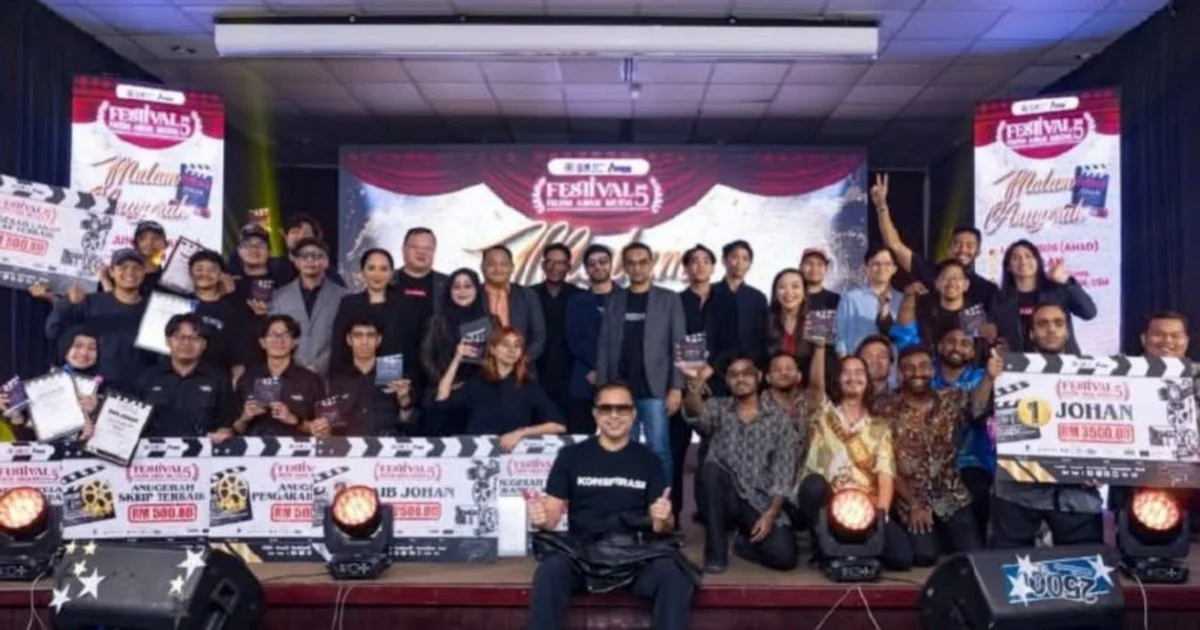
Recognising that traditional enforcement mechanisms alone cannot sustain a culture of integrity across society, the Malaysian Anti-Corruption Commission (MACC) has embarked on a decidedly unconventional approach: channelling its anti-corruption messaging through the lens of youth cinema. The agency's involvement with the 5th Youth Film Festival (FFAM), held at Universiti Sains Malaysia (USM) in Penang, represents a calculated pivot towards cultural and creative means of fostering ethical awareness among Malaysia's younger demographic—a generation increasingly shaped by visual storytelling rather than formal institutional rhetoric.
This collaboration reflects a broader recognition within Malaysia's anti-corruption establishment that the fight against graft cannot be waged solely through investigation, prosecution, and legislative frameworks. The festival provides a platform where young filmmakers and audiences can engage with integrity as a lived value rather than an abstract principle. By tapping into the emotional resonance and narrative power of cinema, MACC is attempting to embed anti-corruption thinking into the cultural consciousness of students and emerging professionals who will shape Malaysia's institutions over the coming decades.
The strategic positioning of this partnership at a university setting amplifies its significance. Universiti Sains Malaysia, one of the nation's leading research institutions, attracts intellectually engaged students from across the country. These young people represent not only future civil servants, business leaders, and policymakers, but also influencers within their own peer networks and communities. Engaging them through a medium they inherently understand—film—creates the potential for organic, grassroots dissemination of anti-corruption values far beyond what conventional lectures or compliance training could achieve.
The choice of film as the vehicle for this message carries particular weight in the Malaysian context. Cinema occupies a unique cultural space in Malaysian society, serving as both entertainment and social commentary. By integrating anti-corruption themes into the festival framework, MACC is essentially converting a celebrated cultural event into an educational tool that doesn't feel didactic or patronising. Young filmmakers participating in FFAM are encouraged to explore corruption in all its dimensions—not merely the sensational cases that dominate news headlines, but the everyday compromises and systemic failures that erode institutional trust.
This approach also acknowledges a critical generational divide in how anti-corruption messages are received and internalised. Younger Malaysians have grown up with greater transparency regarding corruption scandals and institutional failures. They are less likely to accept paternalistic messaging or to compartmentalise ethics as someone else's responsibility. By inviting them to become creators and interpreters of anti-corruption narratives, rather than passive recipients of agency-led campaigns, MACC is working with rather than against the values and preferences of this demographic.
The festival structure itself offers multiple engagement pathways. Student filmmakers must grapple with the thematic substance of corruption—its causes, consequences, and contexts—in order to craft compelling narratives. This creative process forces a deeper interrogation of the issue than passive consumption of anti-corruption posters or awareness videos. Audiences attending FFAM meanwhile encounter these diverse, youth-generated perspectives on integrity, potentially sparking conversations and critical reflection among peers that carry far more influence than top-down institutional campaigns.
From an institutional perspective, MACC's involvement in FFAM also serves a reputational and engagement function. The agency repositions itself not as a purely punitive body wielding investigative power, but as a guardian of systemic integrity invested in long-term cultural change. This matters considerably in a landscape where public trust in institutions remains variable and where perceived heavy-handedness in investigations can itself become fodder for suspicion. By appearing as a convener and enabler of youth-led dialogue on ethics, MACC subtly reframes its mandate and role.
The implications for Malaysia's broader anti-corruption ecosystem are noteworthy. If this festival initiative proves effective in raising awareness and embedding integrity values among young professionals entering the workforce, it could influence institutional culture across government, civil service, and the private sector over the medium to long term. Graduates who have engaged with anti-corruption themes through creative media may prove more resistant to corrupt practices and more inclined to report or resist such behaviour when encountered in their workplaces.
However, the effectiveness of such cultural initiatives ultimately depends on their authenticity and consistency. A one-off festival collaboration, however well-intentioned, cannot single-handedly counter systemic incentives that reward corrupt behaviour or hierarchical cultures that discourage whistle-blowing. For MACC's investment in creative arts and youth engagement to bear meaningful fruit, it must be embedded within a broader ecosystem of institutional reform, transparent governance, and genuine accountability mechanisms.
The placement of FFAM in Penang also carries regional significance. As one of Malaysia's economically dynamic states with a strong civil society presence and relatively robust media landscape, Penang serves as a natural laboratory for piloting innovative approaches to anti-corruption engagement. Success in Penang could provide a template for scaling such initiatives across other universities and states, gradually building a cohort of young Malaysians who view integrity not as compliance but as a core personal and professional value.